Thursday, 1 August 2019

Roma: a hit movie and life in 1970s Mexico City


Roma was perhaps the most surprising international hit film of 2018. The dialogue is all in Spanish or in Mixtec, an indigenous language of the southern state of Oaxaca. Its star is Yalitza Aparicio, a young woman from Oaxaca who had not acted in a film before, and who learned Mixtec for her role. Roma is Alfonso Cuarón’s loving portrait of the Mexico City neighbourhood in which he grew up. As it happens, I was living in the neighbouring district of Condesa, so the sights and sounds of the film were familiar to me.
 
Mopping the driveway: Roma
I first arrived in Mexico in 1972 as part of an exchange programme between the Mexican and British governments, with two other young students: Alan Knight, now professor emeritus of Latin American History at Oxford, and Guy Thompson, emeritus of the University of Warwick. Two employees of CONACYT, the government agency that funds academic activities in Mexico, collected us at the airport to drive us to our lodgings. I decided to get out at the second stop and was greeted by my landlady, the recent widow of a businessman. When I returned to Mexico to research my PhD, she had remarried and moved to the USA, so I lodged with her daughter’s family in the same home.

Mexico City is divided into colonias, each with its own history and character. The original core of the city includes the vast main square or zócalo, the cathedral and the Palacio Nacional, the president’s official office. Many colonial buildings that have withstood Mexico’s violent past and numerous earthquakes give the centre recall the three centuries of Spanish rule. As the city grew, it colonized (hence colonias) pieces of land. For example, the victorian district where the British embassy now stands is Colonia Cuauhtémoc, known for its spacious homes of government ministers of the late 19th and early 20th-centuries.
Hotel La Casona, a former Roma mansion
On the other side of the east-west Avenida de la Reforma, and either side of the north-south Avenida de los Insurgentes, is Colonia Roma. One of the glories of Roma is its domestic architecture, notably Art Deco but also a variety of European-influenced styles popular in the late 19th and early 20th-centuries.
 
Colonia Roma domestic architecture
Colonias have their own distinctive street naming system. The streets of Roma are named after Mexican cities and states, as are the streets of Colonia Condesa, my colonia, so named because it was built on land owned by a countess. I lived on Mexicali street. This was a modern concrete and glass building, with a small indoor garden, a large sitting room/dining room, a perpetually busy  kitchen, and three large bedrooms. At the back was a concrete yard and another very plain concrete building which housed the laundry and the maids’ apartment, reached by an external stair.
 
Calle Mexicali: number 14 is centre left behind the small tree
Condesa was a solidly middle class neighbourhood, occupied by families for whom the post-revolutionary regime that dominated Mexico from 1930-2000 had been a source of good incomes. Mexicali had a mix of modern houses, small apartment blocks and some European-style and Art Deco homes that dated to the 1920s or 1930s. At either end of the street were wide avenues whose lanes of traffic were divided by trees. Avenida Insurgentes is a short walk east. There I would catch my bus to the archives and libraries where I researched. On my way home, I could stop at Sanborn’s café for a cool drink, and, if I felt extravagant, a bowl of strawberries.

My landlady was fairly typical of Condesa’s population. Her deceased husband was a prosperous businessman. She was an emotional, adorable lady of fiery temperament. She made a mean margarita, a mixture of only tequila and Cointreau, omitting the non-intoxicating lime juice. She had a collection of saints in her wardrobe, although as I recall she did not attend church. Every afternoon, a group of local ladies came to the house for the afternoon tertulia (social gathering) of coffee, chat and good manners. It was these ladies who persuaded me to abandon the Castilian I had learned for eight years, in favour of wonderfully expressive Mexican Spanish. I learned my earthier vocabulary over Friday night poker sessions with younger friends. My landlady’s daughter had worked as a flight attendant and spoke good English. She married an economist who graduated from the national university. He was active in the student protests of 1968 and, after the Tlatelolco massacre and government repression, had gone into hiding for a time. When I met him and lodged with his family, he was working for the Ministry of Public Works.

A Mixtec quinceañera and her "chamberlains"
Just as in Roma, the family had two maids. Silvia, a Mixtec speaker with an accent when speaking Spanish, and dark skin. Both marked her out as an Indian. She reached her 15th birthday during my stay. In Mexico the celebration of a girl’s 15th birthday is an important occasion for a mass and a party. I doubt that Silvia’s family could afford a very grand party, but her employers bought her an elegant white dress and sent her to her home village for the celebrations. And, just as in Roma, another of the maids became pregnant out of wedlock. The maids worked six days per week, did the laundry, swept and mopped floors indoors and out, cooked and served breakfast, lunch and dinner daily, and breakfast on Sunday, but not after 10am when their day off started.
Serving breakfast in Roma

A Condesa nevería
Condesa was a calm and agreeable place to live. Its iced cream shops were legendary and there was a good selection of taquerías for an excellent snack, or small restaurants serving a hearty comida corrida (fixed price lunch) for 12 pesos (the equivalent of a US dollar). There were street sellers also. I recall vividly the sound that announced the arrival of the itinerant seller of baked sweet potatoes, a low, throaty steam whistle.

Life for the residents of Condesa was immeasurably more comfortable and cossetted than for residents of Mexico City’s poorer neighbourhoods, such as Tepito, a central district notorious  as a den of criminals. The home on Mexicali was spacious, well-lit and comfortably furnished. The Ministry of Public Works ran a subsidized store where employees could buy food and clothing. The butcher was a cross-eyed gentleman. It was terrifying to see him wield a sharp cleaver with abandon. Items not available there could be bought at the Puerto de Liverpool or Palacio de Hierro department stores.
 
El Palacio de Hierro department store
Those who had achieved a still more prosperous lifestyle than the residents of Condesa, might live in the swish modern neighbourhood of Polanco. Polanco housed the best hotel in the city, the Camino
Deportivo Chapultepec
Real (the Queen stayed there while I was in Mexico City). Across the road from the Camino Real was the Deportivo Chapultepec, a combination sports and social club with the best facilities in the city. I was often invited there by a group of young men, which included one of Mexico’s best tennis players and two brothers who played for the national badminton team. The gentleman members who were a little too old for strenuous sports might gamble away a sociable afternoon playing chuti mul, a form of dominos, in a room in which the continuous clack of dominos slapped on to the table drowned out most conversation.

A home in Lomas de Chapultepec
More prosperous still were the neighbourhoods where the truly rich had their homes. One such was Lomas de Chapultepec, close to Chapultepec park at the far end of Avenida de la Reforma. A friend who lives there once introduced me to a neighbour who was chief of staff to president Carlos Salinas de Gortari. To the south of the city, San Ángel was a wealthy district of cobbled streets with homes and gardens concealed behind high walls covered in gloriously colourful but very thorny bougainvillea.
 
Homes in San Ángel
Certain things were beyond the reach of any but the very rich. For example, when Mexicans referred to vino (wine) they invariably meant not wine but rum, tequila or some other nationally produced spirit. Wine came from Europe, and European goods were prohibitively expensive. On a road trip with my Deportivo friends I visited the federal territory of Quintana Roo. This area, now an international tourist destination, was then so remote from central Mexico, and transport of goods so prohibitive, that it was a tax free zone. Goods from overseas were imported by. I bought a small supply of Cadbury’s chocolate and English tea (unaffordable in the capital) and smuggled them past the customs officers on the territory’s border as a treat for my host family.

I recall only one alarming event. I was sitting at home one Sunday reading calmly when I heard six gunshots. I did not go out that day, but learned later that in the apartment building across the street, the doorman had been pestering a pretty young girl. Her brother borrowed a gun from a friend to persuade the doorman to leave his sister alone. The doorman argued the point and received six bullets for his trouble.

A sweet potato seller
I can testify that Cuarón’s film captures beautifully the lifestyle, the sights and smells of 1970s Colonia Roma. During one scene, I heard in the background the whistle of the sweet potato seller and was transported to Colonia Condesa for a moment. If you are tempted to visit Condesa, my old neighbourhood has become one of the chic colonias, full of expensive restaurants, late night clubs and lively gay bars (Mexico City is a remarkably tolerant place for gay men and women). Except for those brought down by 2017’s earthquake, the buildings are mostly the same, but the ladies of the Condesa tertulia where I learned to speak like a Mexican have long gone.

Monday, 8 July 2019

Mexican cuisine and meeting a dinosaur


I recently spent part of a week cooking Mexican takeaway dinners for some of our neighbours to raise funds for the charity where our eldest son Chris works in Mexico. One of the glories of Mexico is its cuisine, which varies considerably by region. Cooking for my neighbours made me think about the ingredients I was using and the origins of the dishes I served. I recall a friend who is an historian of Indian art remarking that Indian food originally relied on spices for its flavours. The chiles that make some Indian dishes so hot cannot have been used in India until after the contact between Spain and Mexico in 1519, since only ancient Mexicans had the pleasure of eating chiles until that date. In fact, the relevant date was probably 1565 when a friar by the name of Andrés de Urdaneta succeeded in finding a route from Acapulco in Mexico to Manila in the Philippines and back. Andrés’ feat of navigation launched the annual Manila Galleon, through which Mexico traded with all of Asia for 250 years. Foods travelled from Mexico to Asia and from Asia to Mexico and shaped the cuisines of both continents.
Acapulco Bay in 1852
When I was a graduate student in Mexico I spent a few weeks in Chilpancingo, independent Mexico’s first capital, but by the 1970s an unprepossessing provincial town (it had two cinemas, one “with rats”, the other “without rats”) and seat of the government of the state of Guerrero. I was researching the career of a family of revolutionaries from Guerrero by the name of Figueroa. One of their descendants was the state governor and I had been trying to track him down. I followed him to Acapulco, from where the galleons used to leave for Manila, but he was fishing with the Shah of Iran and seemed not to have time to see me. So, I left the luxurious resort city for Chilpancingo to consult the state archives and try again to meet governor Rubén Figueroa Figueroa.

Acapulco bay. In the foreground is the Fort of San Diego, built to deter pirates
My first move was to visit the rector of the Autonomous University of Guerrero (UAG), who kindly allowed me to use the student canteen and assigned a senior member of staff to make sure I was looked after. This gentleman invited me to the dining event of the week in Chilpancingo. This was a restaurant that opened only for Thursday lunch and served only one dish, pozole verde. Pozole is a stew of pork and hominy seasoned with various ingredients according to its colour (white, red, green), and served with accompaniments such as oregano, onion and radishes. I could get the white version any day at a pozolería (pozole restaurant) near my hotel, but the green pozole was special and anybody who was anybody in Chilpancingo set aside Thursday lunch for it. As we got started with a few glasses of mezcal (a spirit made from agave cactus) we noticed the general in charge of the military district, Enrique Cervantes Aguirre, at the next table. His troops had been busy lately, rescuing governor Figueroa from the guerrilla band led by a local schoolteacher, Lucio Cabañas. They had also, recent scholarship has discovered, murdered and tortured their way through the mountains in the search for the governor. Let’s return to that black page of Guerrero’s history later.

Pozole verde
The ingredient that makes pozole green is what Mexicans call tomates and Americans tomatillos. In fact, these are not tomatoes at all, but they are delicious and one of many foods that have come to us from ancient Mexico and its cuisine. The tomato proper also comes from Mexico, where in the Náhuatl tongue it was called a xitomatl, which the Spanish could not pronounce, so they called it a jitomate in Mexico and a tomate in Spain. Another all-Mexican food whose name in English comes from the Náhuatl is chocolate (xocolatl). Before 1519, cacao beans had two functions. One variety was used as coinage (there was no metal or paper currency), but above all cacao was used to make a luxury drink that could be afforded only by the aristocracy, who drank it out of colourfully painted gourd cups. The āhuacatl (Spanish aguacate, our avocado) also originated in Mexico. The staples of the diet of ancient Mexicans were maize, first cultivated by a lake in the northern part of the state of Guerrero around 7,000 B.C., and beans.
A modern painted gourd cup similar to those used by ancient Mexican lords
Other ingredients arrived in Mexico with the Spanish. The Mexicans had no large domesticated animals (the turkey was the largest) but the Spanish introduced cows, sheep, pigs and goats. A decade or two after the defeat of the Aztecs in 1521 great herds of these animals wandered over Mexico’s plains and valleys, no doubt to the initial amazement of the locals. So, beef and pork arrived, and chickens (for a time an expensive luxury). Sugar cane was introduced very quickly (before 1521 honey was the main sweetener). The Spaniards also imported wheat, orange and lemon trees, and brought wine and vinegar from Europe in barrels. The wine came in handy if water supplies ran out during the sea voyage.

Foodstuffs also arrived from Asia by a long and dangerous sea voyage of several months. Rice was soon growing on the Pacific coast, along with coconut palms. The mango, found in profusion in Mexican markets, came from the Philippines as did cinnamon and other spices. And in return Mexico sent to Manila tropical fruits and vegetables that are now favourites in the Philippines.

As in Spain, lunch is the big meal of the day. It usually starts with two “soups”: a sopa aguada, literally “watery soup”, and a sopa seca, or “dry soup”. Last year the daughter of my former landlady in Mexico City made us a splendid tortilla soup, made with stale maize tortillas, tomato, chile, chicken stock and epazote, a native Mexican herb also known as Jesuit’s tea. A dry soup might be a small plate of tomato-flavoured rice or pasta. Next might be a quickly fried or grilled steak with a sauce of tomato, onion and chile, turkey in a sauce of mole poblano (featuring sesame, chile and chocolate) or a green pepper stuffed with cheese. Lunch will finish with some fruit or a small sweet dish. Our favourite last year in Michoacán was jericalla, an egg custard flavoured with cinnamon.

A short time after my lunch of pozole verde I succeeded in meeting governor Figueroa. His cousin Arturo introduced me to him at a meet-the-public session. I was taken to the front of the queue, where I found the governor flanked by two elderly men, all three wearing guayaberas, an elegant loose-fitting shirt that originated in the Philippines. Governor Figueroa introduced his two companions as Guerrero’s greatest living poets. Given the governor’s reputation as a gun-toting politician, it struck me as curious that he felt the need to be accompanied by literary men. We discussed his rescue from the band of Lucio Cabañas and he invited me to attend a seminar of the treasurers of the state’s largest municipalities the next day. I recall the governor saying that some municipalities were so poor that they could barely afford pencils and paper for the mayor’s office. The truth of this statement was vividly illustrated when I visited the mayor (presidente municipal) of Buenavista de Cuéllar. I found the presidente sitting alone in the modest town hall in an office with a desk, two chairs and a filing cabinet. His desk was bare. He seemed to have nothing to do except wait for an occasional visitor. The fact that his (only?) visitor that day was a young student from Cambridge did not seem to surprise him.
 
Governor Figueroa with two of his captors
I was reminded recently of my lunch of pozole verde, and of governor Figueroa when reading a PhD thesis about Lucio Cabañas’ group. Figueroa had tried to persuade the guerrillas to abandon their struggle in return for cash and a guarantee of political office. Instead, the band held him for ransom. Figueroa escaped twice only to be recaptured. Eventually the army tracked down the fighters who were guarding him and in the ensuing gun battle Figueroa walked to the army’s side unharmed. He demanded that the soldiers give him a gun so that he could shoot at his captors. Mexicans came to refer to their traditional politicians who tried to block democratic reforms as dinosaurs. Governor Figueroa was, without doubt, one of the fiercest of the Mexican dinosaurs – perhaps a tyrannosaurus.
Lucio Cabañas during his guerrilla campaign and (right) soldiers posing with his body

Thursday, 13 June 2019

Aldeburgh Festival and a Mexican General with Four Left Legs


Jan and I have just paid a brief visit to Aldeburgh during the annual festival. We were there to see a choral group, the East Suffolk Skylarks, of which my sister Tricia is a member, give their first public performance. The notable thing about this group is that all the members are people with Parkinson’s or their friends and family members. I had associated Parkinson’s only with trembling limbs, but I discovered that we should understand that it affects muscle control in many ways, including the voice and breathing control. Parkinson’s does not make singing easy.

We watched the group warm up and rehearse at one of the studios at Snape Maltings, a few miles inland from Alderbugh, where the high-profile concerts featuring world-class musicians take place. After a session of warm-up exercises, the Skylarks ran through their programme of sea shanties. Their enthusiasm, commitment to one another, and joyous sound was truly inspiring. There is a family connection with Snape. The maltings were a regular destination for our maternal grandfather, Harry Lucas, captain of a saling barge. Harry must have experienced many a North Sea day of strong wind and rain like the day of the performance. Since some of the Skylarks are quite frail, the organizers were concerned about the weather, and proposed the possibility of performing in the warmth of the maltings instead. But the Skylarks had come to perform in public for the first time and were determined that weather would not stop them.

To reach the bandstand, the performers had to negotiate the steps over the concrete sea wall, walk along a plastic ‘red carpet’ to the stand, and then up more steps. Some of the 23 performers were able to stand to perform, others remained seated. The keyboard player held her sheet music down with the aid of plentiful clothes pegs and a festival volunteer’s hands to prevent the music blowing along the beach. Then an audience of some hundred people heard the glorious sound of jolly sea shanties over the raging wind. The performance was a triumph and the Skylarks’ smiles showed that they knew it.

 The bandstand on the beach at Aldeburgh

Those of you who know my enthusiasm for Mexican history, will doubt that one can link sea shanties performed on a North Sea beach to Mexico. However, one of the songs performed was a shanty variously known as Santianna, Santy Anna, Santayana and so on. The rather improbable subject of this song is General Antonio de Padua María Severino López de Santa Anna y Pérez de Lebrón, known as Santa Anna for brevity. Santa Anna was the prototypical 19th-century Mexican caudillo (military leader), who led several pronunciamientos (coups d’état). He was president of Mexico several times. Americans know him best as the Mexican general who in 1838 besieged Anglo-secessionists in the Alamo in San Antonio, Texas, where Davy Crockett died. Shortly afterwards Santa Anna was defeated by Sam Houston at the battle of San Jacinto, and Texas became an independent republic, before joining the USA in 1845.

Santa Anna was rather good at losing Mexican territory. He was president at the time of the campaign that Americans know as the Mexican-American War, and Mexicans as the Unjust North American Invasion (1846-1848). Mexican defeat resulted in the Treaty of Guadalupe Hidalgo (1848), which ceded to the USA present-day California, Arizona and New Mexico. Santa Anna’s career was definitively ended by the Revolution of Ayutla of 1854-1855.

Curiously enough, Santa Anna, had about as many left legs as he had presidential terms. He first lost his left leg to French cannon fire in the Pastry War of 1838, prompted by a complaint from a French Pastry chef who claimed compensation for damage to his shop in Mexico City. Santa Anna had his leg buried with full military honours in a tomb in Mexico City. His next leg was made of cork, was captured by American troops during the Unjust North American Invasion, and is now on display in the Illinois State Military Museum. His next leg is now in the home of former Illinois governor Richard J Oglesby. It was captured in the same war. Thus, Santa Anna required a fourth leg. His original leg had already come to a tumultuous end when he was deposed from the presidency in 1844. Rebellious Mexicans raided the leg’s tomb and dragged it through the streets.

The original author of the sea shanty knew enough about Mexico to glorify Santa Anna’s military exploits, but, unfortunately, the song is dramatically a-historical. The lyrics inform us that:

He gain’d the day at Molly-del-Rey
Away Santianna
An’ General Taylor ran away
All across the plains of Mexico

Alas for Mexico, far from winning the day Mexican forces were soundly defeated at Molino del Rey, to the south of Mexico City, and Santa Anna never had the pleasure of chasing General Zachary Taylor across any plains. Rather, Taylor led the invasion and defeated the Mexican army repeatedly. Still, it is a very jolly song. And, when performed with gusto by the Skylarks, one quite forgot the North Sea wind.


Sunday, 9 June 2019

Trump and Mexico


At the moment I am reading Yannis Varoufakis’ book Adults in the Room, his account of his negotiations with the EU concerning Greek debt. Varoufakis is a self-promoter, but a moment in the book when he tells the EU negotiators that he was elected by the Greek people to do what they want, not to be subservient to the EU’s troika, came to my mind when I read about Mr Trump’s latest threat directed at Mexico.

By way of background Mexicans (documented and undocumented) and Americans (ditto) have been crossing the border daily ever since the USA seized the Mexican territory that is now Texas, New Mexico, Arizona and California at the barrel of a gun a century and a half ago. In 1942, Mexico solved a critical labour shortage in the USA by signing the Mexican Farm Labor agreement which provided workers for jobs that Americans were not available to do or did not want to do, until the US abolished it in 1964. This did not stop the flow of Mexican across the border. The numbers entering the USA increase when the Mexican economy is not strong or when the US economy is booming, and decrease when times are good in Mexico or bad in the USA.

Some years ago, a university friend was the Mexican consul in San Francisco. He told me that he had two essential duties. One was to visit Mexican citizens who had been arrested to ensure that their rights were not violated. The other was to run a mobile service that toured the fields issuing a credential that certified that undocumented workers were Mexican citizens, which enabled them to open bank accounts and apply for a driver’s licence. My friend told me that the US authorities liked the credential because it reassured them that the Mexican workers were not Muslims (and thus not a terrorist threat). In other words, both governments benefited. The Mexican government credential enabled their citizens to live relatively normal lives, and the US was reassured to some degree that undocumented workers were not a risk to public safety.

You will recall that the latest threat is not the first that Mr Trump has issued against his southern neighbour. During his election campaign he promised to build a big, beautiful wall on the southern border and that “the Mexicans will pay for it”. Why the Mexicans should agree to pay was never clear, and, of course, they politely declined to do so. Once in office, he threatened both the Mexican and Canadian governments with tariffs, which violated his government’s treaty with both nations, known in the USA as NAFTA ,and in Mexico as TLCAN. The treaty was renegotiated on the Mexican side by President Peña Nieto, the predecessor of the present incumbent, Andrés Manuel López Obrador (AMLO). AMLO honoured his predecessor’s agreement and submitted it to the Mexican legislature for approval. On the very day that AMLO submitted the agreement, Mr Trump threatened tariffs, starting at 5% and rising to 25%, on all Mexican imports to the USA unless the Mexican government took unspecified steps to reduce undocumented immigration into the USA. This was a direct violation of the agreement that the Mexicans were in the process of ratifying. As you may have read, the Mexicans reacted calmly, sent their foreign minister to Washington and reached an agreement with the US administration. Some press reports suggest that, in the main, the Mexicans simply agreed to things they were about to negotiate with the US in any case. I do not know if this is true.

This incident raises a few questions. First, the increase in the numbers of people reaching and crossing the southern US border does not consist solely of Mexicans, but principally of citizens of Guatemala, El Salvador, Honduras, Nicaragua – in short countries to the south of Mexico. These countries have a long history of US interference to support particularly vicious and generally military or quasi-military regimes. Google Roberto D’Aubuisson in El Salvador or Oliver North and the Contras in Nicaragua and you will see what I mean. These also happen to be countries whose development aid from the USA has been severely reduced by Mr Trump. The current immigrants do not want to stay in Mexico but to enter the USA and, in many cases, to claim asylum. This raises two questions. Why is it the Mexican government’s sole responsibility to prevent people travelling to the USA? If the USA cannot stop these people crossing the border, how does it think the Mexicans, with far fewer resources, can do so? Much of the southern border of Mexico is remote and barely under government control. And if the US government finds it difficult to provide adequate shelter for those who cross the border, how can Mexico pay for even larger numbers stuck on the border because the US refuses to admit them? Should Mexico now threaten its southern neighbours in similar fashion and what would this achieve?

It is true that much of the vile people trafficking that transports across the US border is carried out by Mexican drug cartels, which have expanded into other illegal businesses, and into legal activities funded by drug profits. It is also true that corruption, from local police officer to senior military men and politicians, in Mexico protects the drug cartels, and therefore the people traffickers. However, it is equally true that demand for drugs in the USA fuels the drug trade. Moreover, high-powered weapons that are legal in the USA are illegal in Mexico, but nevertheless are sold into Mexico, on one occasion at least with the connivance of the US government.

AMLO was elected on the promise of improving the lot of the poor, ending corruption (a very tall order in six years), and reducing violence (ditto). He has taken steps, some symbolic and some real to deliver on his promises. He has increased pensions for many Mexicans, but has scrapped the pensions received by former Mexican presidents. He has reduced his own salary and that of senior government employees. He sold the recently-purchased presidential plane and flies on low-cost carriers. He refuses to live in the official presidential residence, Los Pinos, which he has turned into a museum and cultural centre. He has also made some dubious decisions and his achievements may not be equal to his profuse rhetoric.  However, Mr Trump’s tariffs (which still threaten if Mexico fails to achieve goals that he refuses to define) would have caused huge damage to the Mexican economy and would have driven Mexicans north with the Guatemalans, El Salvadorans etc. In short, they would have made matters worse.

One must also ask whether Mr Trump’s remedies will have any beneficial effects. A wall or a blockade at the border will probably stop quite a lot of people crossing. Those who do cross will do so at greater peril to their lives. But those whom the US most wants to keep out, drug smugglers, people traffickers and other criminal elements, have the resources and know-how to get themselves or their goods across the border or to circumvent barriers. Those people need to be targeted with intelligence, and preferably with the cooperation and good will of the Mexican government. Mr Trump’s insistence on loudly proclaimed initiatives to keep everybody out will exclude those who could live and work to the benefit of the USA and will stop very few criminals.

But the key point really is why does Mr Trump think the president of Mexico’s top priority should be to do his bidding every time his whim or temper causes him to issue a threat? That was the point Mr Varoufakis made about the Greek government and the EU, and the same is true for Mexico.

One comment I read by a Mexcan writer compared Mr Trump’s threats to the behaviour of  an armed robber holding up a family in a car with a gun pointed at a child’s head. The driver could refuse in a dignified manner to hand over his money, or he could persuade the robber to take what he can offer and leave. AMLO seems to have followed the latter course with modest success for now.


Tuesday, 28 May 2019

Japan: Modernity and Tradition


I mentioned recently that connections between Mexico and Japan go back to the late 16th century. A visitor familiar with Mexico is struck by certain superficial similarities between the two cultures in terms of the formal politeness of daily life and the forms of deference to people of higher social status (which automatically includes foreigners). In Japan the behaviours and forms of address are multiple and difficult for foreigners to understand in full. They clearly reflect ancient traditions and systems of status and power. This set me thinking about the theme of tradition and modernity in Japan.

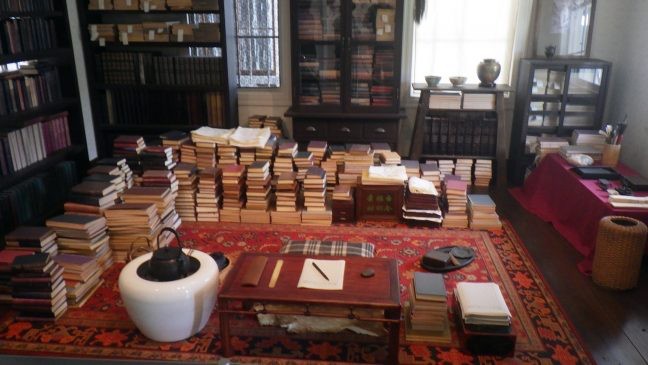
Our plane reading was Ryūnosuke Akutagawa (the master of the short story) and, in Jan’s case, Natsume Sōseki, an early 20th century novelist whose writing career lasted only eleven years, but won him enduring popularity. His first novel, I Am a Cat, was an instant success. We visited the Sōseki museum, built on the site of his home, and only a few yards from our son’s apartment. He published more than 20 novels, a book about the theory of literature and translations of works from English and French. Much of his literary production was for the newspaper Asahi Shimbun. The Japanese government sent Sōseki to London for two years (he recalled them as the two most awful years of his life) to study English literature. His home was of traditional wooden construction and design, with a garden dominated by a Japanese banana tree. His study, recreated in the museum, contained a large library, a low Japanese writing desk and implements. Sōseki’s interest in foreign literature and languages marked him out as modern. Perhaps still more remarkable was his taste for bread and sandwiches. 

Sōseki’s study
Akutagawa was an admirer of Sōseki and attended his weekly salons in his home. Like his mentor, Akutagawa drew on Japanese tradition and western modernity. He re-worked medieval Japanese stories in modern language of great power and concision. Two such stories, Rashōmon and In a Bamboo Grove, deal with good and evil and the slippery nature of truth. Akira Kurosawa combined the two quite different tales into a brilliant film, Rashōmon. On the other hand, Akutagawa was an avid reader of western literature. In Spinning Wheels, he refers to himself as a modern Monsieur Bovary and writes of his admiration for Strindberg and Dostoyevsky. In Death Register he draws on his own experiences, informing us that his mother was a madwoman. Like Sōseki, he wrote to deadlines for a newspaper. And like his master his career was brief: only thirteen years.

Akutagawa
It is hard to escape modernity in contemporary Tokyo’s neon-signed avenues, its skyscrapers, the boutiques of self-consciously fashionable districts such as Daikanyama and Naka-Meguro, or the obsession with gadgetry on show in Akihabara Electric Town. Yet, the drive for modernity is little more than century and a half old. The man credited with dragging Japan into the modern, international, era is emperor Meiji (reigned 1867-1912). The need to modernize Japan had been made clear in 1853 when Commodore Perry’s American naval squadron sailed into Tokyo Bay to give the Japanese a message: they were to open their economy on American terms or else. The humiliated and impotent Japanese had no choice but to agree.

Meiji’s remedy was to import skills of all kinds from overseas. European artists were hired to teach western style oil painting with linear perspective (known as yōga) as opposed to Japanese painting using traditional materials and techniques (nihonga). Graphic designers taught drafting skills, useful for designing postage stamps, but also for blueprints of war ships and armaments. Architects were brought to Japan to design western-style buildings. The success of Meiji’s programme was demonstrated by triumph in the Sino-Japanese war (1894-1895) and the Russo-Japanese war ten years later, in which the Japanese navy destroyed the Russian fleet.

The father of modern Japanese architecture is said to be Josiah Conder, a Briton hired by the government in 1877. Conder designed the Naval Ministry, the Ueno Imperial Museum, churches and university buildings, and villas for wealthy Japanese eager to adopt western tastes. One such was designed for Baron Furukawa Toranosuke, an owner of copper mines. The baron also had a garden designed by a Japanese, Ogawa Jihei. The garden combines a formal rose garden with a Japanese landscape garden. We visited the garden, accompanied by vast crowds of Japanese rose enthusiasts.

Conder’s Furakawa villa, brick clad in stone
Conder also trained a number of eminent Japanese architects. However, the modernization process was not entirely completed, at least in architectural terms, by the time of Meiji’s death in 1912. We joined a tour of the Japanese Diet building, the seat of the House of Representatives (roughly MPs) and the House of Councillors (roughly senators), designed by Japanese architects, after designs by German and American architects had failed to receive approval. The building was constructed in the 1930s using Japanese materials, but exceptions had to be made for technologies that the Japanese had not mastered. These included stained glass (from Britain), mail chutes and a system of door locks with a master key (both American).

The Diet Building
While Baron Furukawa opted for an entirely western-style building, the mansions of other wealthy Japanese combined traditional style with imported modern features. One such was built in 1919 for Kyu-Asakura, Chairman of the Tokyo City Government, who married into an aristocratic family of landowners. The family added to their fortune through rice milling in the 19th century. Asakura adopted his wife’s last name, which no doubt helped his political career. The residential and business areas of the house are of traditional wood construction, with a tiled roof. Screens, some exquisitely painted with motifs of flowers, birds, fans and other designs, divide the rooms. The flooring of the rooms is traditional tatami mats. Rooms are measured in terms of tatami (a small room might be four tatami, a large room twelve or more). In some rooms the cedar wood, obtained at great expense, was cut to display the grain. However, there are innovations. The external screen doors, traditionally of light wood and paper moving on a wooden sill, here are glazed with glass and move on rollers because of the weight. There are western-style toilet fittings. The reception room is wood-panelled, carpeted and has decidedly un-traditional sash windows. In terms of materials the storehouse is a radical departure: it is of concrete construction. The exterior walls have rows of hooks from which mats of wet straw were hung as a measure against fire – fire was a frequent cause of destruction in a city constructed mostly of wood. Asakura also had a garage – and therefore a car at a very early date – constructed, again, of modern materials: concrete blocks and corrugated iron. It would not be out of place in a modest British home, but in 1919 Tokyo signalled wealth.

Asakura house
Asakura house garden
The Kyu-Asakura house is a rare survival (only about three homes of that period survive) on account of the Great Kanto Earthquake, and following fires, of 1923, and the fire-bombing of World War II. This accounts for the architectural modernity of Tokyo, much of it on a scale of ordinary to awful, but a surprising amount truly striking. On a stroll through Harajuku, a district popular with teenagers, some in school uniform, others in outlandish attire, we saw a small spectacular cantilevered office building designed by Klein Dytham. The same partnership designed the Tsutsaya bookshop and other buildings under the train tracks at nearby Naka-Meguro, close to the cafés and boutiques along the Meguro river.

Klein Dytham office building
Tsutsuya bookshop
Despite the neon and the skyscrapers, it is not hard to find ancient temples and shrines in Tokyo – ancient that is in terms of foundation rather than construction, since few survived fire and earthquake. The columns that sustain Senso-Ji temple at Asakusa, for example, are of steel and the roof of titanium. Legend tells us that in 628 two fishermen caught a statue of the bodhisattva Kannon in the Sumida River. They took it to the ruler of their village, who converted his home into a temple to house it. Today, Senso-ji is a vast temple approached along an avenue of shops (religion and trade go well together in Japan). In contrast, we were pleased to find at Shibamata in the eastern suburbs of Tokyo, the Taishakuten Daikyo Buddhist temple, founded in 1629. Unlike Senso-ji, this temple is an entirely wooden structure that has survived earthquakes and wars. It is dedicated to Taishakuten, originally a Hindu god of thunder, adopted by Buddhism as a subduer of evil.
Taishakuten Daikyo Temple
The glory of this temple is the high relief carvings on the exterior, but especially in the interior, of scenes of worship, travelling monks and animals.
Taishakuten Daikyo wood carving
Aspects of the theme of tradition came up in conversations with friends. One told us that when she was young it was usual for girls to be taught ikebana (flower arranging) and tea ceremony as a preparation for marriage, but that few young women now devote much time to them. Over dinner in Kanazawa we commented that we had seen many young women in kimonos in the famous Kenroku-en garden. Our friends disabused us of the impression that tradition was stronger in Kanazawa than in Tokyo: the girls hire the kimonos, and are dressed by shop staff, since many do not know how to put on the kimono. In short, here tradition is a tourist experience.

We had eaten lunch that day opposite a wedding planning business and watched young couples being sold expensive packages. We asked our Kanazawa friends about their wedding forty years ago. They were married in a Shinto shrine, which was conveniently located within a wedding chapel. Their son had been married in a shrine, but his parents explained that the choice between shrine and wedding chapel (these are ubiquitous in Japan) does not usually express any deeply held faith.

When I travelled to Japan for business in the 1990s I met a Buddhist monk, dressed in yellow robes, at a private view in an art gallery in fashionable Omotesandō. He was drinking beer and told me that he was married to the artist. I asked him how he spent his time. He responded that he walked in mountains, bathed in streams and relied on donations for his meals. Drinking beer, wandering in mountains while enjoying beer and art world society in central Tokyo seemed an agreeable lifestyle. The Japanese are generally eclectic and practical. They choose elements of tradition that hold society together and help to make it work, and see no contradiction with simultaneously pursuing modernity in its many guises, superficial or profound.

Tuesday, 30 April 2019

Investigating ancient Mexico: 7000 B.C. to 1600 A.D.


A few of you have asked me to explain the project that brought us to Zamora. At the risk of boring you all I will try to do so in this bulletin.

In 1974, when I was a mere 22 years old, I left for Mexico City (Air India to New York and Greyhound bus to Laredo, Texas) to research a PhD. My topic was the Mexican Revolution of 1910-1920 in the state of Guerrero. The eventual result was a book that was translated into Spanish and, I am encouraged to discover, is still used as a textbook in Mexico.

1970s Guerrero was a lively place. A schoolteacher called Lucio Cabañas led a guerrilla group of the Partido de los Pobres (Party of the Poor). Lucio staged a spectacular coup by holding hostage the governor elect, Rubén Figueroa, a member of a powerful family in Guerrero, and very much a gun-toting, hard-drinking old style Mexican politician. The Mexican army occupied most of the state. I occasionally encountered them checking passengers on buses, but the soldiers were doing much nastier things to poor peasants up in the mountains. Guerrero, alas, was then, and is now, a bye-word for poverty and social deprivation. The difference now is that the drug trade has made the problems much uglier.

Guerrero has not always been the prototypical Mexican basket case. It was here that several of the heroes of Mexican Independence eventually defeated the armies of Spain. In 1813 José María
Aerial view of Chilpancingo
Morelos convened a constitutional congress in Chilpancingo (now the state capital) but was captured and executed before Independence was achieved. Finally, in 1821 Independence leader Vicente Guerrero met a turncoat Royalist general, Agustín de Iturbide in Acatempan to declare the Independence of the United States of Mexico. Their meeting is re-enacted as “the embrace of Acatempan” every year.

My project starts at the very beginning to investigate what Prehispanic Guerrero was like and what the Spaniards changed in the first eight decades of Independence. My question is whether what went wrong started with the arrival of the Spanish.

Laguna de Tuxpan, where maize was first cultivated
The story begins about 7,000BC on a lakeshore in the northern Guerrero Valley of Iguala. Here a group of nomadic hunter-farmers were the first to cultivate the staple grain of every modern Mexcan’s diet – maize. They prepared their dinner by grinding maize on a stone, leaving behind traces of starch which scientists analyzed just a few years ago. Without the agricultural innovations of those ancient guerrerenses (as the people of Guerrero are known) there could have been no Aztecs or Mayas in our children’s school textbooks.
 
Diego Rivera painting of an Indian woman grinding maize, 20th century
A little later, about 2,300BC another group of hunters were living in a bay on the site of the modern tourist resort of Acapulco. These guerrerenses lived off shellfish and fish. Analysis of thousands of fish bones has proved that their favourite was tuna. Now, tuna does not come close to the shore, so these early Mexicans must have had boats and fishing equipment to catch quite large fish. They also made the first known ceramics in Mexico: the not very beautifully named Pox Pottery.

Ancient Guerrero was rich in things which were hugely in demand in other parts of Mexico. Guerrerenses produced cotton in large quantities, and made very fancy clothing for the rich and powerful. They also cultivated cacao (Mexicans were the first people in the world to taste chocolate) and made gorgeously painted gourd cups from which the great and (not so) good drank. And if you wanted prestigious jewelry or sculpture made from precious stones, or shells from the Pacific coast, craftspeople in Guerrero could supply it. Guerrerenses were also skilled metalworkers, making fine objects of bronze and occasionally of gold.
Mezcala style sculptures from Guerrero

Guerrero was such a source of desirable goods that the two great empires of ancient Mexico, the Aztecs and the Tarascans fought frequent wars to control as much of the region as they could (the Aztecs controlled most, but the Tarascans seized territory with copper mines and salt pans).

Things changed radically when the Spaniards arrived. The conquerors were a rough and ready lot who wanted to get rich – and fast. As far as Guerrero was concerned, they were interested in only two things: precious metals and trade with Asia. Guerrero was the key to both.

An aerial view of Taxco with the church of Santa Prisca
In the north, not far from where those early farmers first cultivated maize, the Spaniards found silver in a place called Taxco. The indigenous people of Guerrero had worked metal for centuries, but in only small quantities to make ritual objects or jewelry. The Spaniards were different: they wanted lots of silver and they wanted it fast. For that they needed two things: human labour in large quantities and animals to feed the miners and to transport the metal to Mexico City – oh, and salt to extract the silver from the ore, and wood or charcoal to heat it. They solved the labour challenge by importing slaves from Africa, enslaving some Indians and forcing many more to work in the mines. Taxco was not a nice place to work: the silver ore contained lead. Since the ore had to be heated to extract the silver the miners were exposed to lead fumes, and their families drank lead in contaminated water. The mine owners stripped the hills of their forests to process the ore.

The mine owners made fortunes. The richest of all, was, curiously enough, a Frenchman, José de la Borda, who undertook many good works for the good of his soul. He is now best known as the man who built the exquisite church of Santa Prisca. Santa Prisca is an exception that proves the rule: very little of the silver wealth remained in Mexico. As soon as it was extracted, it was sent to Europe to finance the Spanish king’s wars, or to Asia to buy exotic luxuries. Taxco is now a destination for tourists who stroll its hilly streets lined by colonial buildings, visit Santa Prisca and shop for silver and other crafts.

Acapulco bay, probably 1950s
As some Spaniards rushed to the Taxco mines, others headed for the coast where they hoped to find the fabled western route to Asia. They found it at Acapulco Bay where ancient guerrerenses had once fished for tuna. In 1565 a Spanish friar guided a fleet of ships to Manila and, most importantly, found the return route. For the next 250 years Spanish ships arrived every year at Acapulco.  Merchants descended on the port to trade the silver dug out by Indian and African labour for precious silks, porcelains, works of art and spices from Asia. They loaded their purchases on great trains of mules to transport them on mountain tracks the 700kms or so to Veracruz on the Gulf Coast from where they were despatched to Spain. Imagine the quantity of mule droppings deposited along the route by tens of thousands of mules over 250 years.   Many Spaniards grew rich from the trade or from organizing mule transport.

You should not conclude from this brief and rather simplified account, that prehispanic guerrerenses lived in a democratic paradise: their rulers were autocrats who waged wars, owned slaves and practiced human sacrifice. But the point is that, in that context, Guerrero had quite a lot of things going for it. As if with a flick of a switch the Spaniards changed all that. They reorganized the regional economy on a south-north axis from Acapulco to Taxco and Mexico City. Everything that travelled the Royal Road, as the dung-laden track was grandly called, left for Mexico City, Asia or Europe, leaving little behind for the locals. Everywhere to the right and left of the road was of little interest except for grazing beef cattle, sheep and goats and raising mules. Before the Spaniards arrived in Mexico the largest domesticated animal was the turkey. Within two or three decades, Europeans travelled on horses, mules bore cargo, and herds of tens of thousands of grazing animals were wandering the remoter parts of Guerrero. Imagine animals whose like you had never seen coming over the hill in quantities to eat and trample your carefully planted field of maize.

It is impossible to say whether Guerrero would have been a better place if the Spaniards had never arrived. But while they busied themselves saving indigenous souls, they were responsible for at least some of modern Guerrero’s problems.

Sunday, 8 July 2018

Zamora Epilogue: Elections of 1 July


One May Sunday evening, among the food stalls and children’s amusements in our local plaza, Jan and I met the candidate for the federal congress of the MORENA party, Yolanda Guerrero Barrera. We wished her good luck, but I assumed that in this conservative, deeply Catholic, part of Michoacán she could not win. After all, Zamora had long been a bastion of the conservative PAN (Partido Acción Nacional). I was wrong: Yolanda’s Facebook page now proudly declares her to be the representative of the 5th District of Michoacán. Her rival, Sergio Flores, the PRI candidate, received 12,222 votes. Yolanda’s share of the vote was 49.6%.

Yolanda was not alone in her triumph. MORENA won 15 of the 24 seats of the state congress, including Zamora where the new congresswoman is Teresa Mora. PAN won the other nine seats. The PRI, which had run the state for much of the 20th century could not win a single district. The PRI fared no better in the election of a new federal senator. Toño Ixtlahuac, whose retouched photo smiled at us from numerous billboards, was defeated by Antonio García Conejo, a member of the Partido de la Revolución Democrática (PRD: Revolutionary Democratic Party) allied with the PAN and Movimiento Ciudadano (Citizen’s Movement). García Conejo made his name by stripping off his clothes in the congressional chamber during the debate on energy reform, a policy designed to end the monopoly of the state petroleum company, PEMEX.

In Zamora, the new Presidente Municipal (mayor) is another MORENA candidate Martín Samaguey Cárdenas, who received 35% of the votes. He has promised to reduce municipal salaries, including his own by 50%. The municipal government will be responsive, with staff who are honest and committed to helping the citizens of Zamora. His immediate actions include buying 40 dialysis machines, and establishing a refuge for the homeless and a shelter for street children.

The story was rather different in Zamora’s smaller neighbour, Jacona. There Adriana Campos Huirache of the PRI received 7,512 votes, enough for her to become the first female Presidenta Municipal. Adriana has held several positions in the municipal government and was Jacona’s representative in the state congress.

The elections that gave Yolanda her seat in the legislature in Mexico City, were truly momentous. For a century Mexico was ruled by the PRI (or its predecessors), with a 12-year interlude from 2000-2012 when Mexicans elected two Presidents of the PAN, Vicente Fox and Felipe Calderón. It is quite possible that the outgoing president, Enrique Peña Nieto, may be the last PRI politician to hold the highest office. MORENA, led by Andrés Manuel López Obrador (known as AMLO) crushed the PRI’s candidate, José Antonio Meade Kuribreña, and the PAN’s Ricardo Anaya. Some 47 million Mexicans voted on 1 July and 53% of them (24.9 million) voted for AMLO. His predecessor received the votes of 15.9 million.

Eight of Mexico’s 31 states elected governors on 1 July: four of the states were won by MORENA, 4 by Pan or a party allied with PAN, none by the PRI. In addition, the new MORENA head of government in Mexico City (the most populous place in all of Mexico) is Dr Claudia Sheinbaum, by training a physicist and energy engineer (she received 48% of the votes). And it seems that AMLO’s colleagues will have a majority in both the Federal Congress and Senate. Since the end of the PRI’s one-party rule, no president has held in his hands so many of the levers of power.

All of this is an enormous change in the politics of Mexico. The real question is what it all means. AMLO ran on promises to end corruption and to improve the lot of Mexico’s poor. He promised respect for human rights and to combat violence.  Concerning, public safety, AMLO declared that the armed forces should not be deployed in “civilian functions” nor to suppress popular movements. The programme is expressed in quite general terms. We must wait to see what it actually means and how he intends to implement it. Those of you who can read Spanish will find the MORENA programme at: https://lopezobrador.org.mx/programa-del-movimiento-regenracion-nacional/

The response of the Mexican people is a huge cry of frustration and despair, directed against parties that have not effectively addressed Mexico’s many problems. The desire for change combined with a large majority of the popular vote, should enable AMLO to act decisively. It is inconceivable that the problems can be addressed in one six-year term, but perhaps AMLO can make a positive start on which his successors can build. The danger is that he has raised expectations that he may severely disappoint.

Finally, you may have noticed that several of the elected officials mentioned in this bulletin are women. Mexico has yet to elect its first female president (but then this is also true of its northern neighbour), but women hold political office from humble municipalities like Jacona to ministerial positions in Mexico City.

Lastly, since this is definitely my final Mexican bulletin, I hope I have told you enough of Mexico’s many wonders and its people to entice a few of you to visit the country. If you would like tips about where to go (or, alas, where not to go) feel free to ask me.