Sunday, 10 January 2021

Anatomy of an Instant


As I read emails from friends in the USA in response to the assault on Congress, I recalled reading Javier de Cercas’ Anatomía de un Instante, that Jan had given me as a birthday present, a 437 page analysis of a single moment: when Lieutenant Colonel Antonio Tejero led a group of Civil Guards into the chamber of the Cortes (the Spanish Congress) on 23 February 1981 to stage a coup. His intent was to overturn the new democracy and restore military rule. The book is a close reading of one photo, and of three figures who stand out in it: Adolfo Suárez, the Presidente de Gobierno, General Manuel Gutiérrez Mellado, the Minister of Defense, and Santiago Carrillo, Secretary General of the Communist Party. As gunshots rang out in the chamber, and legislators cowered behind their desks, these three men alone refused to be cowed by Tejero and his men. All three were veterans, either of Franco’s regime, or of the struggle against it. All three had accepted the path to elected democracy and that day proved their determination to uphold it.


Antonio Tejero orders members of the Cortes to lie on the ground

Gutiérrez Mellado, an old-style military man, by then 69 years old, and the insurrectionists’ ultimate superior, stood up, approached the rebellious Civil Guards and reprimanded them. Suárez, fearful for the General’s safety, tried to restrain him, and when this did not succeed attempted to intercede as he was marched out of the chamber under illegal arrest by the rebels.


As General Gutiérrez Mellado reprimands the National Guard officers, Adolfo Suárez tries to intervene

I wonder who in America will be the men or women with the moral and physical courage of General Gutiérrez Mellado, Presidente Suárez, and Secretary General Carrillo, to simply say firmly ‘No’ to tyranny. Few members of the Republican Party currently seem to possess such moral courage and integrity.

Monday, 21 December 2020

An Indian Christmas 1944-Style

 I had not intended to write anything more for the blog before next month, but thanks to the Prime Minister I find I have more time on my hands than I had expected. This Christmas will be like no other. By coincidence, I read recently Jan’s father’s letters to his parents from India and Burma. On 31 December 1944 he described the celebrations of his army unit in Comilla, India (now Bangladesh), in the tropical lowlands, so a white Christmas was impossible. The party was held in the basha (a thatched bamboo hut) which served as the enlisted men’s’ mess. The men had turned this, as far as they could, into a pub called the Bullock Inn to resemble home. Here was a little bit of England in a corner of the Empire. Ron Waddams’ description of a 1944 Christmas describes celebrations which were very different to those he was accustomed to at home in London.


Ron's photos from Comilla and Imphal, modern Bangladesh. The basha is pictured in the two photos top left

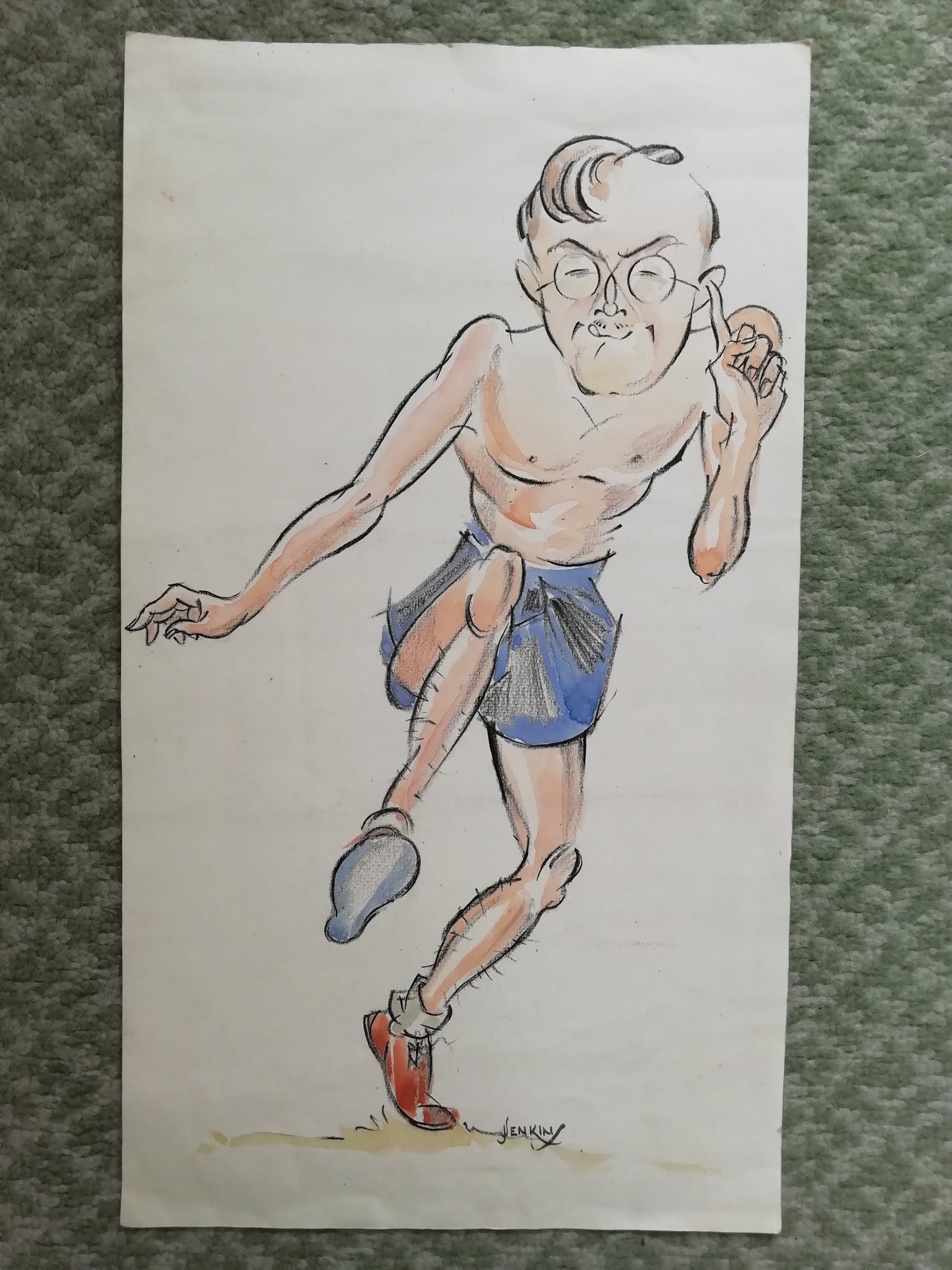
“We started our celebrations last evening [Christmas Eve] with a little drinking party in our new recreation hut. This hut we had previously decorated and it looked most cheery with bunches of leaves to replace holly, a large painted Christmas tree with pin-up girls stuck all over it, around the walls were sketches of more beautiful girls, and some cartoons of the boys, the one of me is very good so I intend to send it to you with the Programme, and in one corner of the hut we have a very interesting bar fixed up. So the stage was well set for the evenings [sic] fun … [W]e started of [sic] with a darts competition. In this I managed to reach the semi finals, but then I was knocked out. Boiled sweets were handed round and we each had a bar of Cadbury’s chocolate, just like being at a kid’s party. The rest of the evening was whiled away with a few rums, and as the drinks flowed among the boys, so did the chattering grow and the jokes became more savoury. Indeed, the atmosphere soon became thick and blue, like that of our worthy hostels in England, and when  bawdy song broke over the gathering the likeness was even more true. The boys made me sing: ‘Popeye the Sailor’.


Cartoon of Ron drawn for Christmas 1944

On Christmas morning in accord with old traditions the sergeants came round to wake us up, and brought us all coffee and rum to help clear the cob webs away. The day was gloriously sunny, and nothing like the cold snowy day you had in London which I have just read about in a newspaper. It was so inviting, that after breakfast I decided to go for an easy stroll, partly to enjoy beautiful natures and partly to clear my head, which wasn’t exactly thick but a trifle muzzy. I went down a footpath all closed in with leafy bushes and overlaying palms. This eventually brought me out onto a river bank, where on a strip of grass I had a rest. Rivers always seem so soothing to me. I remember I used to go down to watch the Thames at lunch time when I was working in the Strand. This water was just as muddy as the old Thames but not half as wide. A few native dhows passed me by. These were propelled by long bamboo poles used like punt poles, and were very flimsy affairs, in which the scruffy occupants seemed to be continually baling water out. The land on each side of the river is naturally fertile, though at the time it looked pretty bare as the rice has been harvested, and now the farmers are beginning to flood the land once more in preparation for the next crop. Next they will plough up the mud with their wooden ploughs drawn by two bullocks, and then plant out the rice seedlings which look like blades of grass six or nine inches high. After a little meditation on the humorous fact of being surrounded by such country on Christmas Day, I returned to camp for dinner. This was remarkably lavish, considering our distance from civilization. First course was cream tomato soup, followed by roast goose (a bit tough) and suitable vegetables; then came a really good Christmas pud with stodgy mince pie floating in cream; there was also beer, but I did not fancy this with dinner so I had tea. After a weighty consumption there was nothing left that I could do, but return to my bed, and as is the habit of gentlemen at these times, to slumber. I regrettably had no appetite at tea time, and there was fruit salad, trifles, and cake, but I made the best of this misfortune almost to bursting point. The evening’s fun passed very similarly to the previous one, though instead of darts we had ‘Housey-housey’, and a quiz contest, while the supporting surroundings were remarkably the same. I went to bed early at midnight, while I believe some of the lads were up till after four.”

Note: Housey-housey was a popular children’s fairground game. It was essentially the same as bingo, but without bingo’s gambling for money.

The lavish Christmas 1944 fare was typical of catering for celebratory events far from home, as demonstrated by the 1943 Christmas Programme, designed and printed by Ron’s unit, the 61 Indian Reproduction Group R. E. I. E. (Royal Engineers Indian Engineers: Ron and his English colleagues were soldiers of the Royal Engineers, but they were worked with Indian troops). Their mission was to print maps to plan the Burma campaign, so they had the skills and equipment to print programmes for Group events. In 1943 they were in Dehra Dun, in the foothills of the Himalayas, the headquarters of the Indian Survey.


The Christmas 1943 Programme
 

Reading Ron’s letters, I have learned that while an orange or lemon was an almost unobtainable luxury in the headquarters of the Empire, food was abundant in India for soldiers and the expatriate British. When Ron reported to his parents what he had eaten on a visit to a Chinese restaurant (there seem to have been Chinese restaurants everywhere in 1940s India) he would often preface his description with “this will make your mouths water”. One letter includes a description of a mango, a fruit previously unknown to him and his parents. And, extraordinary as it may seem, he was able to send his parents regular parcels of foodstuffs or textiles (also scarce in England but plentiful in India). Attached to one letter are two small swatches of cotton prints sent home so that his mother and sister could make summer dresses.

We had planned to share our Christmas turkey, open gifts and play our traditional games, with two of our three sons in our home. Now, all that will happen, as far as possible, by Zoom. Ron’s equivalent of Zoom was a much anticipated weekly exchange of letters with his parents. News of the Waddams Christmas in London reached him around 21 January 1945.


Let’s hope our festivities can be as jolly as those of Comilla 1944, but perhaps without the pin-ups.


Saturday, 12 December 2020

The Road to Glory


I have been reading some things to make last minute additions to my history of Guerrero from 7000BC to 1600AD. The University of New Mexico Press has sent it to academic readers for reports before considering it for publication. Fingers crossed.


One of my readings was a report of an expedition by four archaeologists (Miguel Pérez Negrete, Hans Martz de la Vega, Guadalupe Paoky Rueda Robledo and José Aguilera Almanza) to study and register petroglyphs high up in the Sierra Madre del Sur at a place called La Gloria. Armed with official authorization from their employer INAH (National Institute of Anthropology and History) the first stop was the office of the Presidente Municipal (roughly, the mayor) of Atoyac de Álvarez. The Presidente gave his official blessing and a municipal vehicle. The municipal delegate of La Gloria offered to accompany the group.


The next stop was the local radio station for an interview to inform the people of the municipality of the expedition. The motive for this interview was partly publicity, but above all the safety of the archaeologists. In these mountains, unfamiliar people might be mistaken for members of organized crime gangs, of the Ejército Popular Revolucionario (EPR) guerrilla who operate in these mountains, government officials on some unwelcome mission, or simply suspicious characters. These are dangerous parts, to be travelled with enormous care.


Not far into their journey the group encountered their first retén (a roadblock), staffed by officials from the Procuraduría General de la República (the federal prosecutor’s office) and municipal police. Because they were travelling in a municipal vehicle they were waved through without inspection. The next retén, higher up in the mountains, was a more serious affair. Here their INAH permits were examined with care.


As the group passed through small settlements along the route, residents called out to the municipal delegate that they had heard he was coming on the radio. When they reached the summit of the Cabeza de Perro (Dog’s Head) they stopped to look back at the Pacific Ocean many miles below, but soon they were deep in wooded, secluded mountains. In several small settlements they saw remains of prehispanic structures on the roadside.


After five hours they reached La Gloria, a ranchería (roughly, hamlet) of about 50 people whose livelihood is coffee growing. The residents live far from the services provided by the Mexican state: schools, clinics etc. Although huge pylons and thick cables carry power overhead to the cities of the coast, La Gloria has no electricity. The people of La Gloria grow their coffee under the ever present threat that a drug gang or a guerrilla group may pass by, perhaps even worse the army.


One’s first impression from the archaeologists’ description is “What a remote place”. But here the archaeologists recorded 27 petroglyphs carved on large rocks among the coffee trees. They depict jaguars, human figures and assorted non-figurative designs. The arrangement of the petroglyphs may indicate that they functioned as some kind of astronomical aids to mark significant events such as an equinox. Also scattered among the coffee trees and carved rocks are remains of at least 21 small prehispanic settlements.


The jaguars petroglyph at La Gloria

It stuck me that this place, which in the 21st century we see as remote from society, was buzzing with life, ceremony and ritual, several hundred years ago, in an age of no roads and no wheeled vehicles. It also reminded me of another story, the journey in 1970 of a Mexican expert on Indigenous manuscripts, Joaquín Galarza, from his office in the Bibliothèque Nationale de France to Chiepétlan, also high up in the mountains of Guerrero, further inland and to the East. News had reached Paris of previously unknown manuscripts in the village. Paris to Mexico was the easy part of the journey.


One of the Lienzos de Chiepetlán, combining Indigenous and Spanish iconography: two jaguars with crowns

Once he had reached Guerrero, Galarza had two choices of transport: a long and arduous journey on horseback, or a small plane that plied a route through the mountains and touched down on request. The landing area at Chiepetlán was a cattle pasture. The locals, alerted that a visitor wished to land, could clear the cattle, or, if the visitor was judged unwelcome, could leave them to munch the grass and prevent the plane from landing. Galarza was allowed to land and escorted to the plaza of the village, where he was asked to wait – for several hours while the village leaders debated whether they should show this unusual visitor their precious documents. Eventually Galarza was asked to the  community hall to face the leaders and the population of Chiepetlán. After answering many questions he was allowed to see the documents.


Chiepetlán, Guerrero. Where would you choose to land your plane?

Like La Gloria, Chiepetlán is now “remote”, but in the 15th and 16th centuries it was certainly not. It guarded trade routes for precious goods from the coast to the cities of the Valleys of Mexico and Toluca, and Morelos, in central Mesoamerica. Aztec warriors passed through the town on their way to conquests further south and Aztec Tribute (i.e. tax) collectors were familiar figures.


A festival in the plaza of Chiepetlán

Places like La Gloria and Chiepetlán are by no means unusual in modern Mexico. A country with a modern economy, and a number of the richest men in the world, has left anciently vibrant and thriving communities to languish far from the benefits of a modern state society. Nevertheless, resilience, advisable caution (to let the plane land or not; to allow this vehicle into a community or not) enable the people of these places to live lives every bit as important and fulfilling as those of modern urban dwellers. Their resilience and determination are extraordinary.


Celebrations in Chiepetlán. The structure to the left is the Castillo, a framework for a firework display

This will be my last item before Christmas. A Merry Christmas and happy 2021 to all who read this. Please stay in touch and safe.

Sunday, 6 December 2020

How to dress a flea without getting a flea in your ear


At 06:30 Sundays BBC Radio 4 airs a programme called Natural Histories. I listen to it as I prepare breakfast. This is one of the many wonders of our public service broadcaster that would be lost if the mendacious plans of our current government to abolish the BBC come to pass. This Sunday 6 December the topic was the flea. The flea, it turns out, is the object of scientific study, but also a trope in erotic poetry since Roman times. An editor from the OED informed listeners that ‘flea’ occurs in many English idioms: we can be a fit as a flea; when in trouble we get a flea in our ear; we might watch a film in a fleapit (so called because fleas were endemic in early cinemas); we can shop for curios in a flea market. Fleas also made an appearance in music, at least once, in Herb Alpert and the Tijuana Brass’ song:


There was a little Spanish flea
A record star he thought he'd be
He heard of singers like Beatles
And The Chipmunks he'd seen on TV
Why not a little Spanish flea?


Fleas influenced fashion in Medieval Europe: a flea trap was an accessory consisting of a tube of a sticky substance that women wore round their necks. The evolved to be expensive items of gold jewelry filled with honey to tempt the flea to its death. Fleas also had a role in advertising and marketing: the flea circus originated as a means for jewellers to display their skill in working on a very small scale to make harnesses for performing fleas using very fine wire.


A flea circus in Seattle

And, to my surprise, they had a place in the history of tourist art in Mexico. Octavio Paz, Mexico’s greatest poet wrote about fleas in his meditation about the essence of Mexicanness, El laberinto de la soledad (‘The Labyrinth of Solitude’):


Todas nuestras facultades, y también todos nuestros defectos, se oponen a esta concepción del trabajo como esfuerzo impersonal, repetido en iguales y vacias porciones de tiempo: la lentitud y cuidado en la tarea, el amor por la obra y por cada uno de los detalles que la componen, el buen gusto, innato ya, a fuerza de ser herencia milenaria. Si no fabricamos productos en serie, sobresalimos en el arte difícil, exquisito e inútil de vestir pulgas. Lo que no quiere decir que el mexicano sea incapaz de convertirse en lo que se llama un buen obrero. Todo es cuestión de tiempo. Y nada, excepto un cambio histórico cada vez más remoto e inpensable, impedirá que el mexicano deje de ser un problema, un ser enigmático, y se convierta en una abstracción más.


All our faculties, and also all our defects, are opposed to this notion of work as an impersonal effort, repeated in equal and empty slices of time: the slowness and care taken in the task, the love of the artefact and of every one of the details it is composed of, the good taste, now innate, by dint of being a millenarian inheritance. If we do not make mass-produced products, we excel in the difficult, exquisite and useless art of dressing fleas. This does not mean that the Mexican is incapable of becoming what is termed a good worker. It is all a question of time. And nothing, except an historical shift which is ever more remote and unthinkable, will prevent the Mexican from ceasing to be a problem, an enigmatic being, and becoming just another abstraction.”

Mexican dressed fleas made in 1905, Natural History Museum, London

The Rothschild family plays a significant role in humanity’s interest in the flea. One Miriam Rothschild solved the mystery of how the flea manages to jump so high and so fast. It evolved to lose its wings, an encumbrance that could get tangled in the fur of its host. At the joint which once articulated the wing sits a rubber-like substance that is compressed and released to bounce like a rubber ball. Walter Rothschild achieved his childhood dream of owning a museum when he opened Walter’s Zoological Museum in 1892 in Tring, Hertfordshire. His collection included dressed fleas made in Mexico in the early 20th century. They are now in the collections of the National History Museum in London. American friends can find dressed fleas in the Carnegie Museum of Natural History in Pittsburgh.


Dressed fleas from the Walter Rothschild collection

The curious art of dressing fleas is thought to have begun in the state of Guanajuato, possibly in convents. After a time, dressed fleas became popular tourist souvenirs, especially scenes of a bride and groom serenaded by a mariachi band. The art lasted until the 1930s.


Mexican dressed fleas in the collection of the Carnegie Museum of Natural History

Mexicans still make and sell tourist art on the country’s beaches, in its cities, on major archaeological sites, and in the shops of the Fondo Nacional para el Fomento de las Artesanías (National Foundation for the Promotion of Crafts). But they have now also proved Paz’s prediction to be correct: they work in high tech jobs in manufacturing, they run multinational businesses, their food and drink is consumed worldwide. Alas, they no longer dress fleas.

Sunday, 29 November 2020

Un día para dar México: supporting disabled children in a pandemic crisis

If you were the parent of a child like 5 year old César Manzo Cruz, who was born with a rare chromosomal disorder, even in a wealthy western society you would need a lot of professional support to help him develop essential life skills. For families of limited resources in Mexico such support is almost an impossible dream. Fortunately, in San Vicente, Nayarit state, a charity that marks its 20th anniversary in 2020 helps local parents achieve impossible dreams. 

At Pasitos Alexis, born without eyes and unable to walk, learns to move around with the aid of a stick and encouragement from Eliseo, who was born without sight
 

Without the therapy that he receives at Pasitos de Luz, the charity where our son Chris works, César would not be able to crawl, let alone walk, would find learning difficult, and speech impossible. The therapists at Pasitos have worked with César to enable him to crawl and shuffle around on his bottom and, one day soon, to graduate to walking. They are also helping him to speak. Jan and I met César at Pasitos the last time we were in Mexico. We can testify that he loves throwing and kicking balls: the smile on his face when he sees a ball to play with would melt anybody’s heart. 

César and Mia playing ball

We do not know what the personal circumstances of César’s Mum and Dad and his older brother are, but most Pasitos families have very limited resources. Were it not for Pasitos the parents of 130 children like César would receive no help at all to improve the life chances of a dearly loved daughter or son. Unfortunately, the pandemic has devastated the tourist industry on which the economy in the area of Bahía de Banderas depends. Most Pasitos parents are now without work and certainly without any form of social security. 

Pasitos has delivered food parcels to families during the pandemic
 

Some of the Pasitos families are paracaidistas (parachutists), whose income is too small to afford formal housing. They build a home on vacant land using whatever materials they can find – wood, corrugated iron, cardboard. These shelters have no running water, electricity or sewage. Other children are cared for by a single mother who has fled domestic abuse, sometimes with the support of a grandmother. Despite their precarious economic circumstances, the love and concern of these families for the well-being of their disabled child is evident in the determination with which they seek support from Pasitos. 

We once visited Pasitos on Mexico’s Children’s Day when a party was in full swing. The entertainer who made the children laugh is also a Pasitos parent. His daughter had a speech defect. When he and his wife asked her state school for help, the teachers explained that they would have to take her to a private school, something far beyond their means. The entertainer had heard of Pasitos, where his daughter has learned to speak with confidence. The therapy she received at Pasitos has transformed the family’s life.

Children's Day 2018 at Pasitos
 

There is a video that shows some of the work that Pasitos has carried out during the pandemic: https://www.youtube.com/watch?v=mjCn5i4jvbQ&feature=youtu.be 

The pandemic has battered the finances of Pasitos, so Chris has been busy organizing a fundraising campaign to help fill the budget gap. The focus of the campaign is a global day of generosity on 1 December called Giving Tuesday in English, Un día para dar México (A day for giving Mexico) in Spanish. For friends who speak Spanish, Chris’ appeal to Mexican supporters is here: https://www.youtube.com/watch?v=nZvVwneIcQ4 

Xochi, who has a form of palsy, enjoys music therapy with a volunteer therapist
 

We can all help charities like Pasitos next Tuesday 1 December by being as generous as our own finances permit. In the USA donations can be made by PayPal or through the Children’s Shelter of Hope, who can issue a tax certificate. Friends outside USA can give by PayPal, or if you prefer contact me at: ianjacobsipswich@gmail.com.  

Details of how to give are at: https://pasitosdeluz.org/home/donate/ This year a donor who annually raises money to give the children a Christmas present is instead raising funds to help Pasitos support the children at home. Yesterday, a Pasitos mother who lives in Tomatlán, a two hour drive from the Pasitos building, was travelling there with neighbours from her town with donations in kind. Their generosity can help change a child’s life for the better. 

Gracias por su generosidad. Thank you for your generosity


Sunday, 8 November 2020

Michelangelo’s buttocks on Fifth Avenue and Rhett Butler at Atlanta Zoo


“I am Professor Brandt. Let us in.” One Sunday afternoon in 1996 in New York I was standing on the doorstep of the French Cultural Institute in New York City with my friends Karin and Bill Agosta and Kathleen Weil-Garris Brandt. Kathleen had wrapped on the door to summon the security guard, who quite reasonably hesitated, telling us that the Institute was closed. Kathleen’s imperious self-confidence was enough to gain us admittance. So, there we stood in the lobby by a fountain topped by a marble Cupid. But this was no mere Cupid – Kathleen had recently called the media to the Institute to announce that she had decided that this Cupid was an unrecognized Michelangelo. If we had been a group of art thieves, we could easily have overpowered the guard and made off with a sculpture of untold cultural and monetary value. Fortunately, we were just two art publishers, her chemist husband and an art historian from the Institute of Fine Arts.


One evening a few weeks earlier, as she walked up 5th Avenue, Kathleen passed the French embassy’s cultural building, a New York landmark designed by the noted architect Stanford White (1853-1906). A reception was underway in the foyer of the building. As the light fell on the Cupid, Kathleen, in a flash of inspiration, recognized it as an unknown Michelangelo. Her announcement to the media unwittingly set off an unexpected chain of events. Since the building was French territory the Cupid belonged to France. The President of France despatched the Director of the Louvre to authenticate the statue. The Director, Pierre Rosenberg, was himself an imperious figure. He was inclined to agree with Kathleen, and was ordered to repatriate the statue to the Louvre. However, the building was protected under New York state law as a landmark, which forbade any modifications (such as removing the statue) without permission. Mayor Rudolph Giuliani (now a disreputable bag carrier for Donald Trump’s dirty work) announced that, if the French tried to remove the statue, New York’s finest would be waiting on 5th Avenue to impound it. A standoff ensued.


The Payne Whitney Mansion, now the French Cultural Institute

Kathleen showed us round “her” statue, pointing out the features that had convinced her that this was a Michelangelo. She had recently shown it to somebody far more distinguished than me and he had concurred. I imagined the imposing Kathleen showing Cupid to the even more imposing Valéry Giscard d’Estaing, former President of France. She told me that, as he contemplated a dimple on the statue’s buttock, Giscard declared “Madame, je suis convaincu!”. Kathleen asked for my opinion. I explained that publishers had opinions about many things, but not usually about dimpled young boys’ buttocks. The examination over, we repaired to the Carlyle hotel bar for an afternoon bottle of champagne.


Cupid, Michelangelo Buonarroti, c.1490, Metropolitan Museum of Art, New York, on loan from Cultural Service of the French Embassy

The Cupid came to the USA in the early 1900s as a decorative centrepiece for the marble rotunda entrance of a newly-designed Italianate mansion, a wedding gift of financier Payne Whitney to his new bride Helen. Kathleen’s attribution was met with much scepticism, in part because art historians are egotistical types and professional jealousy of a big discovery is a natural instinct for most. However, she was supported by the Metropolitan Museum’s curator of European sculpture and by Rosenberg. The documentary evidence was somewhat supportive of the attribution, but not conclusive, so heavyweight opinions won the day for Kathleen and Cupid. Nevertheless, there remained the question of what to do with a statue that was French property, but which could not be removed to France without the agreement of the Mayor of New York, a man not much given to doing favours for Frenchies. The matter was finally resolved thirteen years later when the Metropolitan Museum and the French government signed an agreement to loan the statue to the museum for ten years, an agreement later extended to 2029.


Note the dimple

One of the benefits of my line of work was that my employers paid for me to travel to meet art historians, museum curators, art dealers, collectors, and even some artists. A regular fixture in my year was the convention of the College Art Association of America (CAA). A decade or so after my viewing of Cupid, the CAA met in Atlanta, GA. Over lunch with an art historian from Oberlin College, Ohio, my guest told me that his family came from Atlanta. He had a family heirloom, a  gilt mirror that bore the marks of damage inflicted as the family fled, with all that was precious, when the Confederates abandoned the city after the Battle of Atlanta. I mentioned that I had a day free after the convention ended. My guest recommended that I go to the Atlanta Zoo to see the diorama of the Battle of Atlanta. He gave me instructions for getting there by public transport (two bus rides). The second bus was quite crowded. I noticed that there were only three white faces on the bus: mine and two women. Atlanta is a complicated city, with some ugly episodes in its past, and I was reminded that a friend had told me sotto voce that the Metropolitan Atlanta Regional Transport Authority, which managed the buses, is known pejoratively as Moving Africans Rapidly Through Atlanta. When we reached the end of the line at the zoo, the three white faces were the only passengers remaining. All three of us were British delegates to the CAA, so we set off together to see the diorama.


The Battle of Atlanta diorama

In late 19th century America, an early precursor to the moving picture show was the diorama, a seriously large circular painting depicting an important historical event. One exponent of the diorama was the American Panorama Company of Milwaukee, WI. This company employed a group of German painters led by Friedrich Heine, of Leipzig. Now, those who have seen Gone With the Wind will know that a Civil War battle took place just outside Atlanta. In July 1864 the Confederate forces led by General John Bell Hood attacked the Union Army commanded by General William Tecumseh Sherman. The battle was fought on 22 July at the charmingly named Peachtree Creek and on 24 July at Ezra Church. The fighting was fierce and bloody. Hopes of victory swung back and forth, but eventually Hood was defeated and the well-to-do of Atlanta packed in a hurry and fled.


The German artists who created the diorama

The Battle of Atlanta diorama, detail

A sketch for part of the diorama

The Battle of Atlanta diorama opened for public viewing in 1886 in Milwaukee. The public entered via a staircase to a viewing platform in the centre of the circle formed by the gigantic painting. The floor was covered in soil (a distinctive red around Atlanta) and bushes. Campsites, cannon and mannequins added extra touches of reality. In the long-run this was not good for the conservation of the painting. When I saw the diorama I was told that it was once much taller, but insects in the soil and bushes had feasted on the lower portion. Heine and his colleagues had travelled to Atlanta to interview veterans and sketch the locations of the battle. They included recognizable portraits of the Confederate and Union commanders, including General Sherman himself. Indeed, Sherman viewed the diorama and praised its depiction of the battle. But pride of place was given to Union General John A. (‘Black Jack’) Logan, who had broken the Confederate charge that nearly won the battle for the Confederacy.


The diorama from the viewing platform

By 1890 dioramas were out of fashion, replaced by magic lantern shows. The diorama was bought by small-time showman from Georgia, Paul Atkinson, who intended to display it in Chattanooga in 1891. This was the heyday of the romanticizing of the Confederacy as the Lost Cause (a subject for another blog). Atkinson decided to capitalize on the Lost Cause market by repainting figures in one of the Union army’s heroic moments as Confederates. He also converted a group of wretched Confederate prisoners into miserable Union cowards. The painting moved to Atlanta in 1892 but sales were poor and Atkinson sold his diorama. Subsequent owners could not make a go of the business and the giant painting ended up in unsatisfactory storage. It seemed doom to death by decay.


However, the diorama was saved by Gone With the Wind. One of the advisers to the film, Wilbur Kurtz saw an opportunity to honour the Lost Cause by restoring the painting and displaying it at the zoo. He too edited the picture to enhance the Confederate cause. When the movie was premiered in Atlanta Clark Gable visited the diorama and complained that he was not in it. Kurtz promptly added him as a mannequin. When I saw it both Rhett Butler and Scarlett O’Hara had been painted into the history of the great battle. But audiences dwindled and in the 1970s a number of (pro-Confederate) Atlanta councilmen proposed to move it to nearby Stone Mountain to form part of a display to honour the Confederacy. But the mayor of Atlanta was Maynard Jackson, the first African American to hold that office. He prevented the move and hired actor James Earl Jones to record a commentary in his resonant voice. By the time I saw the painting, it was not at its best, but it was still an imposing sight.


Rhett Butler mannequin

After the show I left the zoo with my two new friends and searched for the bus stop to take us back downtown. But a return stop was nowhere to be found. I had noticed a police station close by, so suggested, in true British style, that we ask a policeman. As we approached the station, two white police officers were escorting a black man in shackles out of the back door. Inside, two portly white officers were relaxing, watching something on their screens (probably not monitoring crime). With our strange accents we were perhaps lucky not to be detained as suspect illegal immigrants. In reply to our asking where the bus stop was, an officer replied “Gee, I’ve seen buses round here but darned if I know where you get on”. These officers, I assumed, were not the kind of people that MARTA was designed for. Luckily, at that moment we spotted a bus stopping across the street, bolted out the door and hopped on board. As we rode back downtown, one of my companions told us that she had taken a break from CAA earlier in the week to sit in a downtown park to take some air and get a little sun. As she relaxed on a park bench, somebody handed her a paper cup and a piece of paper. The cup contained soup and the paper was a Bible tract. The visiting art historian from London looked round and noticed that she was the only white person sitting on the park’s benches. Everybody else was a hungry homeless person. She had been mistaken by a kindly charity worker for a hungry down and out. Atlanta, as I say is a complicated place.


So ended our afternoon at the zoo. I am pleased, however, to report that the diorama has since been restored and moved to the Atlanta History Center in 2018. For those who like figures it measures 371.2 feet by 49 feet and weighs 9,400 pounds.


Finally, a footnote about Stanford White, who designed the mansion that houses the French Cultural Institute. Aged 48, he had an affair with a 16-year old girl, Evelyn Nesbit. Evelyn later claimed that he had drugged and raped her. Four years after the affair had started, Evelyn married a millionaire from Pittsburgh, Harry Kendall Thaw, a jealous man who was emotionally unstable. One evening Evelyn and Harry dined at Martin’s restaurant in New York City, where Stanford White was dining with a friend, and, like Harry and Evelyn, was going to a show at Madison Square Garden afterwards. During the finale number, I Could Love a Million Girls, Harry approached White, told him “You’ve ruined my wife” and shot him three times. White died instantly. Thaw was found not guilty by reason of insanity and committed to a state hospital. However, with his mother’s help, he walked out of the hospital and fled to Canada. He was extradited, committed to another asylum, and eventually released when he was judged no longer to be insane.

Monday, 2 November 2020

El día de los muertos in San Vicente, Nayarit

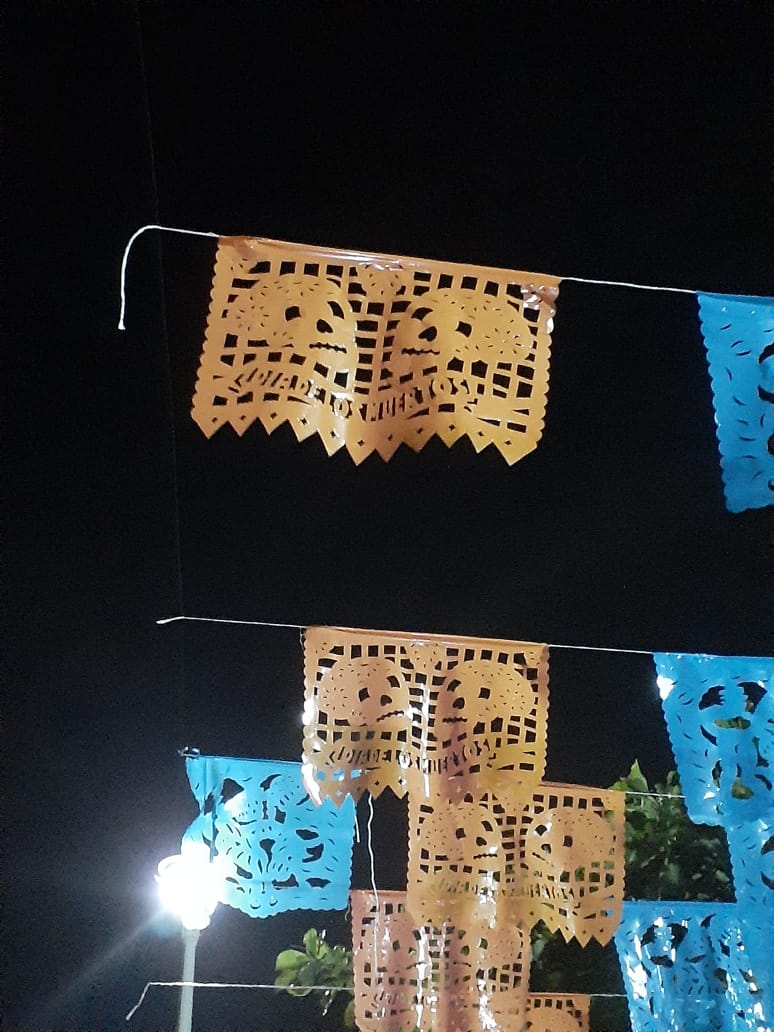
 Our son Chris sent us these photos of the plaza in his town on Sunday. They seem to be especially apt for the times we are all living through.

The Day of the Dead skulls have antecedents in ancient Mexico. A visitor to the Great Temple of the Aztecs in Mexico City will see the stone tzompantli (skull rack - in fact a sort of altar) that reminds us of the Aztec's practice of ritual sacrifice.

Cut coloured paper is a tradition that probably goes back to before the Conquest in 1521, since Indigenous people decorated sacred places with paper.

Mexicans remember their dead, but also indulge in some treats.

These were some of the treats on sale in the Pastelería Suiza, Colonia Roma, in Mexico City in 2019.

But 1 November is also a day for families to remember those they have lost. In this case, little Berta Pineda who lived for only just over three months. Let us hope that we will all celebrate El Día de los Muertos next year in better spirits.