Thursday, 29 October 2020

Sunninghill Scarecrows

There will be no groups of children roaming the streets of Sunninghill this Halloween. Instead, the Parent Teachers Association of our primary school has organized a trail of 47 scarecrows. Nobody seems quite sure why scarecrows were chosen rather than the more traditional British Guy for Guy Fawkes Day on 5 November. Perhaps the PTA wished to avoid any hint of the anti-Catholic sentiment that lies at the historical roots of Guy Fawkes Day.

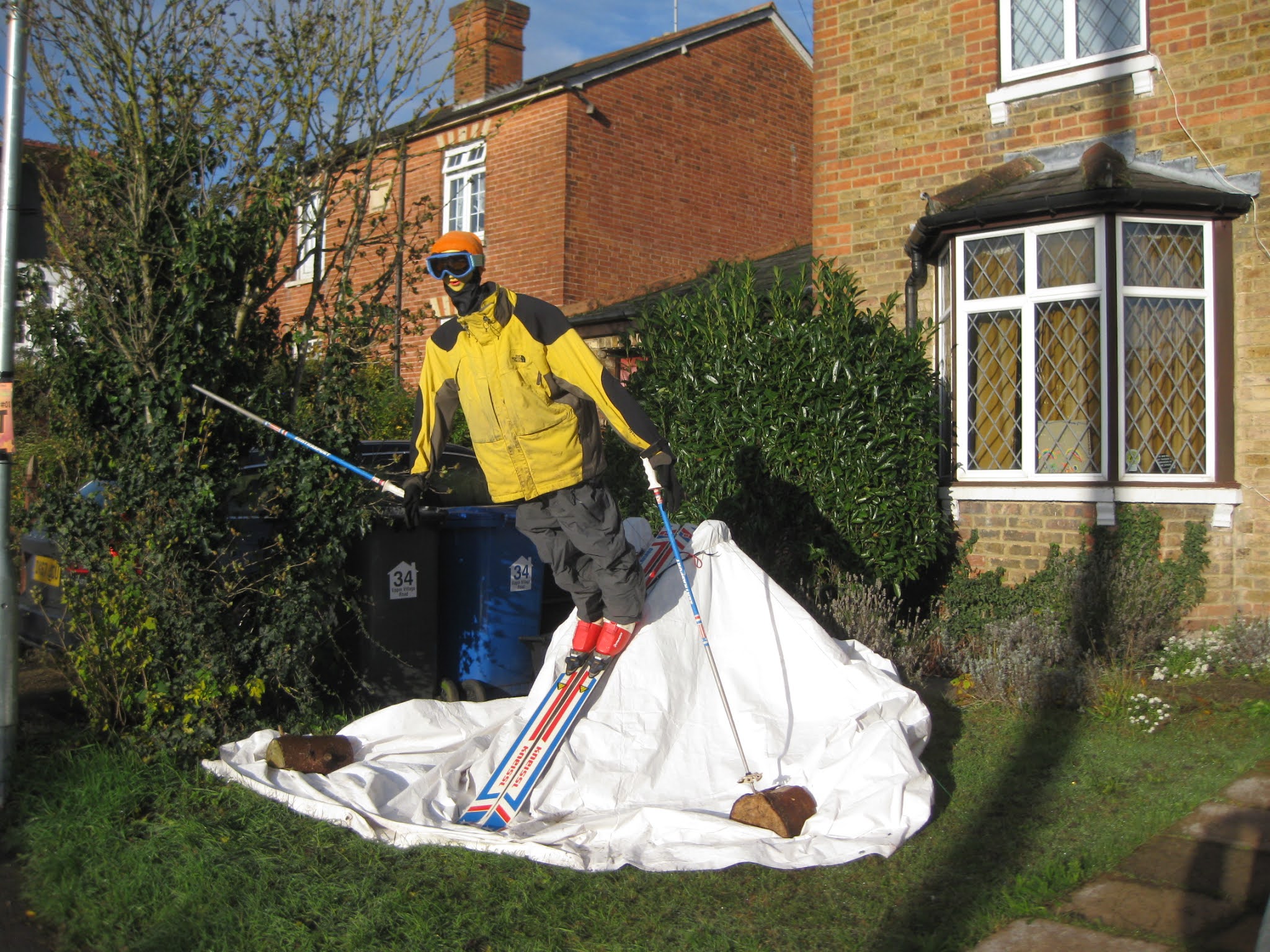
I have not managed to track down all 47 scarecrows, but here is a good sample.

Our young neighbour Thomas is a Star Wars fan


Another neighbour Finn likes dinosaurs

This is a recyclable, environmentally-conscious scarecrow

This installation is a reference to Julia Donaldson's characters Betty O'Barley and Harry O'Hay

Not really a scarecrow, but inventive

A working scarecrow

The apparently drunken bride and NHS doctor were, in fact, blown askew by the wind

Now, this is a traditional Guy Fawkes, to the detail of the carrot nose


This Rotary Club scarecrow is a reference to the annual New Year's Day wheelbarrow race, now postponed to May 2021

A radically untraditional nautical scarecrow

This presumably is a scared crow

The window display of the party supplies shop

Saturday, 17 October 2020

Bury My Heart at Pettistree


After seven months, we escaped the strictures of lockdown to visit my family in Suffolk, the county of my birth. I have not lived there for almost 50 years, but have fond memories of its quaint charms and sometimes severe beauty.


Saints Peter and Paul, Pettistree.

We rented a cottage in Pettistree, population c.190. Despite its size, the village has a 14th century pub, the Greyhound, reputed to be the oldest in Suffolk, and a 13th century church.  One of the glories of Suffolk is its many Medieval churches, often known as wool churches since Medieval Suffolk grew rich (or rather its landowners and merchants did) on wool. Pettistree’s church of St Peter and St Paul was locked, but we wandered the churchyard and found a curious inscription on a granite monument, the finial of which has broken off. Among those buried in Pettistree is Charles Peirson, born 20 or so miles to the north in Uggleshall in 1814, “Formerly President in this parish and for many years a citizen of New York”, buried in 1880, and his wife Julia Frances, who died in Houlgate in the Calvados region of France. Also buried here is Anthony Van Bergen, born in Coxsackie, NY, on the Hudson River, in  1827, died in Paris in 1912. The monument records his address in life as 118 Champs Elysées, Paris. Anthony’s wife Julia Augusta, daughter of Charles and Julia Peirson, lies here too since her death in 1897.


The Greyhound, Pettistree.

I was curious as to why an American who lived at such a fancy address, and his Suffolk father-in-law who had lived in New York, should be buried in a small Suffolk churchyard. Anthony and Charles it seems were both involved in the first American department store, Arnold Constable & Company, founded in 1825 at 91 Front Street, Manhattan. The Van Bergen’s had been prominent political and business figures in New York for generations stretching back to the Revolutionary War. Anthony became Arnold Constable & Company’s representative in Paris, where he also represented the Equitable Life Assurance Society. He was awarded the Légion d’Honneur. His children married well: one son to a prominent family of Buffalo, NY; another son to a descendant of a Scottish-American banker, Richard Irvin; and his daughter, rather grandly, to Count  Otto von Grote.


A thatched cottage painted Suffolk pink, Pettistree. This house is Vicarage Cottage, perhaps the former rectory.

I assume that Anthony had his body transported from Paris to Pettistree so that he could be buried with Julia Augusta, but exactly how the Peirsons came to Pettistree I have not discovered.


The Street, Pettistree. The owner of this house is evidently a dahlia specialist.

I remember another Suffolk grave from my childhood which was notable for another reason. It stood atop the fragile cliffs of Dunwich, about 20 miles from Pettistree, looking out over the cold North Sea. My memory is too vague to be certain, but the stone I remember is possibly the one that marked the last resting place of John Brinkley Easey, who died at Dunwich in 1826, aged 23. John’s grave was the last remaining trace of All Saints church, long lost to the sea by the 1960s. Modern Dunwich, no larger in size and population than little Pettistree, is what remains of an important Anglo Saxon town and one of the major ports of Medieval England.


St. James's Street, Dunwich. The first building on the left is the Ship pub. Dunwich museum is further along the street.

Dunwich makes its first appearance in history about 630 AD when King Sigebehrt installed Bishop Felix, a Burgundian cleric, there as the first bishop of East Anglia. Dunwich remained a bishop’s seat until 870. According to the Domesday Book (1086), around 1060 Dunwich was a manor of Edric de Laxfield, with a population of 120 burgess families (so, 500-600 people or more). The Domesday Book presages the causes of Dunwich’s eventual doom, since it records that the town had lost about half its cultivable land to coastal erosion in about 1070. The book also records a substantial increase in Dunwich’s population, to 306 burgess families. About 1200 the population has been estimated at 3,000.


Dunwich beach and cliffs, looking north to Dunwich, Walberswick and Southwold. The Medieval coastline was some distance out to sea.

History records a great storm on this coast in 1091, though how it affected Dunwich we do not know, but the need to protect the town from storms was much discussed in the 12th century. Remnants of a ditch and rampart dated to the 12th and 13th century can still be seen. Meanwhile, another threat appeared in 1173. While Henry II was absent in Anjou, his wife Eleanor, supported by King Louis of France, rebelled to place her son Henry on the throne in his father’s stead. A rebel force landed on the banks of the river Orwell to the south and marched across country to Dunwich, led by Robert Earl of Leicester. According to a poem written by the Bishop of Winchester:


Thus did the people of Dunwich defend themselves,

             As these verses tell which are written here.

And so stout-hearted were both great and small

             That Earl Robert withdrew completely discomfited


Dunwich beach and cliffs. We met two National Trust volunteers who had been photographing the cliffs to monitor continuing erosion.

Dunwich was on its way to becoming a major player in Medieval England, home to one of the most important ports, many ships and wealthy merchants. Their business was wool, wine, herrings, shipped to France, from where Dunwich ships returned laden with a variety of goods. They also indulged in a number of not very legal enterprises and fought hard with their neighbours, Blythburgh, Walberswick and Southwold to the north, to control trade. The shipping business was subject to the whims of international politics. In 1624 23 Dunwich ships were seized and held for a year in Bordeaux. Dunwich’s ship-owners and merchants were regularly called upon by the King for ships to pursue his war games. In 1229 he demanded 40 ships (he received only 30, but that was one eighth of the royal fleet) to wage war at Poitou.


Putative plan of Dunwich c.1280, from Rowland Parker, Men of Dunwich, Collins, 1978.

The other business of the Middle Ages was religion, and Dunwich had plenty of it. In 1200 the following churches were recorded:

            St Leonard's, built c. 1086

            St Martin’s, built probably after 1086

            St Nicholas’s, swallowed by the sea c.1355

            St John’s, demolished in 1540 before the sea could do the demolition work

            St Peter’s, close to the harbour, stripped of lead, timber and bells in 1702

            All Saints, which may or may not have yet existed in 1200

            There were also three chapels


This part of Suffolk was notable for some major friaries established by the religious orders. There was a small Benedictine monastery in 1200. By the mid-13th century the Black Friars and Grey Friars had arrived. There were other religious buildings as well, such as the Leper Hospital of St James, whose remains still stand. By the 13th century there was also a more general purpose hospital, Maison Dieu.


But Dunwich had a problem as the storm of 1070 presaged. The coast here was very prone to erosion  and consequent large-scale changes in the coastline. Some changes happened over quite a long time. For example, a shingle spit protected Dunwich harbour (but not the town) from the worst of the storms. This spit had moved southwards from Walberswick to Dunwich over a long period as tides and storms shifted huge quantities of stones. As well as protecting Dunwich’s harbour, it had also closed direct access to the sea from the River Blyth. Therefore, ships could reach rival ports to the north (Blythburgh, Walberswick and Southwold) only by passing through Dunwich’s waters and along the channel created by the spit. Dunwich thus controlled access to the ports of its principal rivals.


Disaster finally struck the night after New Year’s day 1286. There was an unusually high tide, although Dunwich was accustomed to flooding. But that night, and the next day and night, a ferocious wind from the east drove the high tides straight at Dunwich, overwhelmed the ramparts and destroyed large parts of the town. Greyfriars priory was completely destroyed. Two parishes disappeared entirely under the sea, two more were reduced  in size. Churches collapsed, homes and business premises were swept away. To cap it all, the storm opened direct access for Blythburgh, Walberswick and Southwold to the North Sea. This was not yet the end of Dunwich port, but it never recovered and over the centuries the sea took more land and buildings away.


Grey Friars, Dunwich, general view with gateway in the distance. This was the second site of the friary, occupied until the dissolution of the monasteries.

Plan of Grey Friars Friary. The church bottom right is All Saints, lost to the sea in 1920.

Perhaps John Easey went to his early grave assuming that his headstone would be a lasting memorial to remind later generations that this man of Dunwich once lived and worked there among others buried in the churchyard. In the unlikely event that it still stands (I could not find it when we walked the cliff) John’s grave is one of the few remaining traces of a Dunwich lost to the sea.


St Mary, Dennington. The church houses one of the finest alabaster monuments in England. Here lies William Bardolph (d.1441) and his wife. William was chamberlain to Henry VI. He fought at Agincourt.

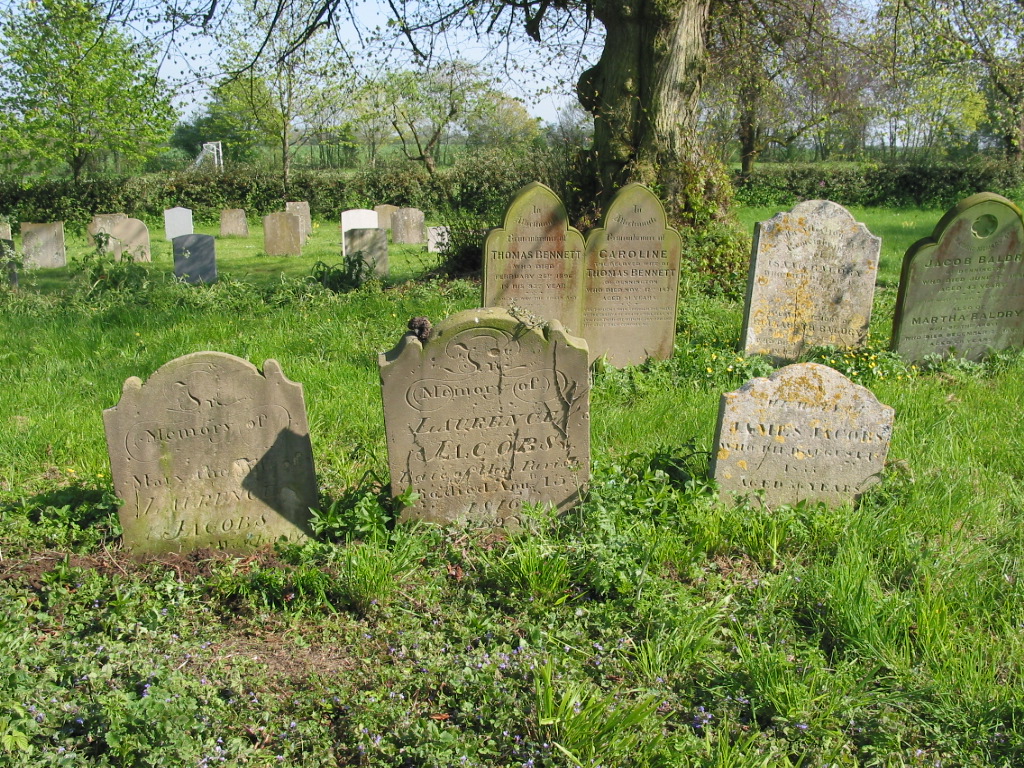
About 14 miles west of Dunwich is the village of Dennington, which has one of the finest of Suffolk churches, St Mary, a 14th century flint church. In 2006 we roamed the churchyard with my mother in search of a little Jacobs family history. A shout from one of our sons led us to the gravestones of Laurence Jacobs, his wife Mary and son James. Like many of my ancestors, Laurence and Mary were poor rural folk, which is about all we know of them. Their son Laurence, however, earned his living as a poulterer, and his son Charles, a blacksmith and Primitive Methodist preacher is my great grandfather. But that’s a story for another time.

The graves (left to right) of Mary, Laurence and James Jacobs, Dennington churchyard.


Friday, 2 October 2020

On the Trail of the Station Master of Wadi es Sarar


Since I wrote on 11 August about my father’s friendship with a station master in Palestine during World War II, I have been fortunate to meet digitally Dr Walter Rothschild. Walter, in addition to being a rabbi in Berlin, is the author of a PhD dissertation about the Palestinian Railways 1945-1948, and editor of Harakevet, a magazine about the history of Israel railways. Walter, in turn, put me in touch with Chen Melling, director of the Israel Railway Museum at Haifa, and the museum’s archivist Moshe Haviv. Chen deciphered a mysterious Arabic word in the dedication on the back of a photo of Anis Eliyas Abou Zayd and his family as “al-Estaff”, a reference to Doug’s rank: Staff Sergeant.


The family of Anis Eliyas Abou Zayd, March 1942

With their help I have managed to piece together a little more about the place where my father worked and his friend Anis Eliyas, the Station Master of Wadi es Sarar, also known as Nahal Soreq in Hebrew, and as Junction Station to the British military during the World War I. I have also stumbled across two more photos of my father, Douglas (“Doug”) Jacobs. This is, therefore, an update about what I have pieced together about a young Suffolk lad born in the village of Grundisburgh in 1912, who, aged 29, was whisked away to a very complicated Palestine and a landscape so very different from the gentle green fields of Suffolk.


The church of St Mary, Grundisburgh, 14th-18th centuries. Doug's parents are buried in the graveyard

Doug Jacobs, left, Friede (?) and an unknown soldier in Tel Aviv September 1941

Firstly, a photo taken on 5 September 1941 proves that Doug was in Palestine before that date, after surviving the disastrous rout of the British expeditionary force in France in June 1940. The photo shows Doug and a colleague at a restaurant in Tel Aviv, with a waitress who has served them a drink. On the reverse is this text: “All the very best for the two nice Englishmen from Friede [?], Tel Aviv Sept. 5th 1941.” If the waitress in the photo is indeed named Friede (this is Walter’s suggestion; the signature is not easy to decipher), short for Elfriede, she may have been from Austria or Germany and was fortunate to have reached Palestine before the war. The dedication infers that my father and his colleague were regular customers, about to leave Tel Aviv. Perhaps they had been on leave and were about to return to Wadi es Sarar.


Text on the reverse of the photo

Another photo on the front of a postcard, taken by Approved Military Photographer No.46, shows Doug in uniform with the three stripes of a Warrant Officer.


Official photo of Doug Jacobs 1941-1945

Doug’s station master friend is recorded in a list of junior staff of the Palestine Railway in 1930 as A. A. Zeid. He was born in 1898, so his childhood and early teenage years were spent under Ottoman rule. After World War I, British rule replaced the Ottomans. Anis joined the railway in 1924. In 1930 he was a Grade III employee with an annual salary of Palestine £132. He was ranked 51 in seniority of 71 Station Masters in his grade. The names of Anis’ colleagues in the 1930 list remind us that Palestine was a multi-ethnic, multi-faith territory, a reflection of a long history of trade, migration and wars waged by foreign powers. Among his colleagues were M. Cohen, a Ticket Examiner, N. Gurovitch (A Yiddish form of a Russian name), a Traffic Inspector, N. Dedeyan (Armenian), a clerk, E. Katz, M. M. Hussein, S. Filbert, N. Barkovitch (Slavonic), S. Kerry, F. Iskander (Iranian), all Station Masters.


Wadi es Sarar station, with possibly Anis Eliyas Abou Zayd centre

Chen and Moshe sent me a photo of five men and two women outside Wadi es Sarar. The portly man in the centre is the station master, quite possibly Anis Eliyas himself, although the photo is not clear enough to compare with our 1942 photo. Perhaps the woman to his left (our right) is ‘Wife’ of the family portrait.


With the help of Walter’s dissertation, I have been able to piece together a picture of the railway that brought my father and his friend Anis together. Palestine was a small country with a remarkably complex railway system, designed and constructed by, and in the interests of, a medley of foreign powers and organizations, with scant regard for the needs of the people of Palestine. The first line, Jaffa-Jerusalem, on which Wadi es Sarar was a stop, was financed by a French Catholic organization to take pilgrims to Jerusalem. It was cheaply built and narrow gauge, so it had to be rebuilt later to meet the military needs of the Ottomans. Other lines were constructed by French and Belgian interests or the Ottoman military. During WWI the Ottomans added a spur line from Wadi es Sarar to connect with a line that ran from Jerusalem to Beersheba and Sinai. The Ottomans also began a line west from Wadi es Sarar to take pilgrims to Mecca. The line also served Ottoman administrative and military needs. It reached Jordan, but there construction stopped. WWI bought more lines. The British built a line from Egypt into Sinai. The Ottomans built another from Tulkarm via Lydda (modern Lod) to Wadi es Surar. 


Wadi es Surar had thus become an important junction for strategic military purposes. In November 1917 the British attacked the Turks at Wadi es Sarar and seized control of the station and its junction. With the end of the war, the Palestine Railway came under British control. Most of the senior management, and some more junior posts, were British men employed by the Crown Agents in London. By the time Anis met Doug in 1941 the British had been managing the railway for 23 years. Our Station Master would have been long-accustomed to getting along with British superiors and colleagues. 


In WWII the main British base in the Middle East was in Egypt, but Palestine was a significant secondary base for operations in Syria, Iraq and Persia. Wadi es Sarar was one of five depots for ammunition and ordnance in Palestine. There was also an ammunition factory there. Between 1940/41 and 1941/42 military goods traffic in Palestine more than doubled. Between 1941/42 and 1943/44 it nearly doubled again. Doug and Anis must have been busy.

The rail system struggled to cope with the volume of traffic, so road transport was also essential. My sister recalls our father telling her that while he was in Palestine a new, inexperienced, officer was appointed. The officer was not happy with the way Doug organized the ammunition trucks, ensuring a substantial distance between each truck. He ordered his Warrant Officer to use a closer formation. Unfortunately, something set off an explosion in one truck, which in turn caused explosions in several others. 


Doug was suited by temperament to organizing people. His work was officially recognized twice by being “mentioned in despatches” and awarded the oak leaf decoration as a result, the first time in December 1941, the second in April 1942. On the second occasion a letter from the Director of Ordnance Services, GHQ, Middle East Forces, congratulated him “most heartily on being mentioned in General Wavell’s Despatches in recognition of the service you have rendered in the Middle East.”

I do not yet know exactly when Doug arrived in Palestine, nor when he left. We know that he was evacuated from St. Nazaire in June 1940 and remained in Britain for training, on the estate of the Marquess of Aylesbury in Wiltshire, for operations in the Middle East.  The Wadi es Sarar depot was completed by the Royal Engineers on 10 March 1941. An invasion of Syria was launched from Palestine in July 1941, and of Persia in August. Assuming that training lasted a few months, and allowing for transport to the Middle East, it seems likely that he arrived in early 1941 or Spring  that year. As for when he left, he was awarded the Africa Star, which recognized service in North Africa from 10 June 1940 to 12 May 1943. We know that he landed in France shortly after D Day in June 1944, so he probably left Palestine in the summer of 1943.


Doug returned home for good from Belgium in November 1945 to his young wife Alice and a baby son, Antony, born while he was in France and Belgium. He was a regular visitor to his mother in Grundisburgh where his name and those of his brother George and Leslie are recorded in the church.


The Roll of Honour in Grundisburgh church. George is G. E. Jacobs. Leslie is L. T. Jacobs (Royal Air Force). Doug's regiment is incorrectly listed as RA rather than RAOC

St Mary's Grundisburgh, interior


Angels on the roof timbers of St Mary, Grundisburgh, typical of Medieval Suffolk churches. These angels must have seemed a world away from Wadi es Sarar

During his time at Wadi es Sarar, Palestine was already a contested space. Doug was clearly aware of increasing tensions between different groups. He was once asked by representatives of one organization to sack his Arab workers. He refused. As an employer of local workers he was aware of the tensions that before the end of the decade would result in one of the most tragic and intransigent conflicts of the century.


What happened to his friend Anis and his family after Doug’s departure, or to his friend Friede, we do not know. However, the Palestine Railway ceased to exist at the end of the Palestine war of 1948. Trains were attacked near Wadi es Sarar by armed groups in January and February 1942. The 1948 left the station building in ruins. Its remains still stand, but Wadi es Sarar is now simply a passing point on the line.  Perhaps Anis survived these turbulent times. He may have remained in the new Jewish state or he and his family may have joined the great masses of Palestinians who fled into exile. In either case, as far as I know, my father never saw or heard from his friends again. 


A map of the Hulda area in 1942. The Jaffa-Jerusalem line runs down the centre of the map. Wadi es Sarar is to the south, not visible in this map (see map below)

I think we can suppose that 1945-1948 was a perilous time for Anis and his family. The photo of Wadi es Sarar station is in the archives of Kibbutz Hulda. Hulda takes its name from a Palestinian village named Khulda which existed nearby until the 1948 war. The land for the settlement was bought in 1905. The first settlers moved there in 1909. The farm was attacked and evacuated on orders from British forces in 1929, but resettled in 1931. It suffered further attacks 1936-1939. During the 1948 fighting Hulda was a base for  the Jewish military. Ani’s station was therefore in a hotly contested location. Google maps tells me that Wadi es Sara station is a 7.4km. walk from contemporary Hulda, so when intercommunal strife broke out the station will not have been far from any fighting.


Map of the Hulda area 1945. Wadi es Sarar is marked bottom right as Sara. Google maps suggests that the station was located slightly south of the point where the rail line crosses the main road to Masmiya and Deir Muheisin. According to this map there was no town or village associated with the station.


Thursday, 1 October 2020

Civil War Trivia


I am reading Herman Hattaway’s rather dull Shades of Blue and Gray. However, today an intriguing fact caught my eye which, I assume, explains the derivation of a term used in American English, but not by we Brits.


Fighting Joe Hooker

On 25 January 1863 Abraham Lincoln appointed Major General Joseph (“Fighting Joe”) Hooker (1814-1879) to command the Army of the Potomac. One of Hooker’s critics accused him of turning army headquarters into “a combination of barroom and brothel”. It seems that Joe liked his booze, but was not in act one for the brothel. Rather, he sought to reduce venereal infections among the Union troops by  confining prostitution in the Nation’s Capital to an area bounded by Pennsylvania and Constitution Avenues and 12th and 15th streets. Thus, the red light district was the area that now includes the White House Visitor Center, the US Department of Commerce, Federal Triangle subway station, the office of the Mayor of Washington D. C., and the US Environmental Protection Agency. The Boy Scout Memorial fortunately stands just outside the former red light district.


I never enquired why Americans refer to prostitutes as “hookers”. I assume that the term derives from Fighting Joe’s last name, a rather unfortunate legacy.

Thursday, 24 September 2020

Thoughts for our times: Carr, Carlyle, Cortés and Cleopatra’s Nose


I have been reading E. H. Carr’s What is History, originally a series of lectures given in Cambridge in 1961, and published by my old employer Macmillan. Carr writes, or rather speaks, with the fluid elegance of a great scholar who has thought deeply about questions which he explains with a light easy-to-read touch. He also has the scholar’s barbed wit when writing about his opponents, especially those at the University of Oxford. One of his themes is the relevance of history to the present and future.


Some of the passages in Carr’s book set me thinking about our times. Here are the passages and my thoughts, for what they are worth.


Thomas Carlyle (1795-1881), History of the French Revolution:


Referring to the terror: “Horrible, in lands that had known equal justice – not so unnatural in lands that had never known it.”

“It is unfortunate, though very natural, that the history of this period has so generally been written in hysterics. Exaggeration abounds, execration, wailing; and on the whole darkness.”


Protest (e.g. Black Lives Matter, protests in Mexico against “Femicide”) can be messy, disruptive, infuriating, destructive. It can provoke resentment. Protest cannot be entirely unlimited, but the causes should be understood and addressed. The destruction of property that has occurred in some Black Lives Matter protests in the USA is illegal. However, heavy-handed policing to score political points in an election is equally reprehensible and provocative. Still more provocative, and profoundly wrong, is to encourage armed, self-appointed enforcers of the laws that they choose to enforce (while ignoring laws that prohibit their actions) to oppose the protests. The question that has not been asked as a result is whether the destruction of property is more wrong than the failure to have taken, over a period of years, effective actions to prevent the deaths of black women and men at the hands of law enforcement, and armed white men who claim to enforce the law?


In Mexico City a group of women recently protested the murder of women (“femicide” is a term invented in Mexico because of the frequency with which women are murdered, frequently by their male partners) and the impunity of those who murder them because police rarely investigate the crimes effectively. Some of the women occupied the offices of the National Commission on Human Rights. A slogan was written on a portrait of Francisco  Madero, who led the Mexican Revolution of 1910 against the dictatorship of Porfirio Díaz, was elected President, but then assassinated by the military. He is known in Mexico by the sobriquet the “Apostle of Democracy”. President Andrés Manuel López Obrador (AMLO) has elevated Madero to a status near to sainthood. In his world view AMLO battles constantly against neoliberal conservatives. He therefore dismissed the protesters as conservatives. He has ignored femicide and therefore no action has been taken to address the problem.


The responses of presidents Trump and AMLO confirm that we surely live in an era of abundant exaggeration and execration, which sanctions behaviour in the public sphere that would previously have been unthinkable.


Karl Popper (1902-1994), The Open Society:


“Wherever the freedom of thought, and of the communication of thought, is effectively protected by legal institutions and institutions ensure the publicity of discussion, there will be scientific progress.”


When Mr Trump was elected I tried to reassure my dismayed American friends that the robust institutions of the USA would constrain the new president’s ability to subvert freedoms. Unfortunately, Mr Trump has proved to be exceptionally skilled in using freedom of expression to attack and undermine freedom for any except those who share his views. My optimism has proved sadly  unfounded.


For example, Secretary of State Pompeo recently published a draft report of the US Commission on Unalienable Rights. The commission proposes to base US human rights law on the rights enshrined in the Declaration of Independence. Any additional rights will be classified either as “worth defending” or as “not worth defending”. In Mr Pompeo’s vocabulary rights come in two kinds: unalienable and ad hoc.


Rights worth defending include freedom of assembly, freedom to own property, freedom of religion. However, the commission declared, after examining the 1948 Universal Declaration of Human Rights, that some of the rights contained therein are more important than others, and therefore that some are unalienable, others are ad hoc.


Now, the report states that “foremost among the unalienable rights that government is established to secure, from the founders’ point of view, are property rights and religious liberty.” These rights are inherently superior to civil and political rights such as freedom of speech and assembly and the right to vote. Other rights, such as reproductive rights and LGBTQ protections are classified as “divisive social and political controversies”. The creation of a hierarchy of superior and inferior rights in itself challenges a fundamental principle of international human rights law that has previously been unquestioned – that all rights are universal and equal.


We need not worry, says Mr Pompeo, because “America is special. America is good. America does good all around the world.”


A similar approach to human rights has been suggested by the UK government. The intention is to remove from UK law adherence to the European Convention on Human Rights (which the UK was instrumental in drafting) so that the UK can decide its own approach to human rights. Like the approach taken by the Trump administration, this undermines the concept of the universality of rights. Americans might have rights which UK citizens are denied, or vice versa. If an autocratic regime should deny to its citizens a right as fundamental as freedom of expression, the UK and the USA would lack moral authority to criticize such a denial of human rights since our governments would have declared that rights are a matter for national governments.


The current UK government is as fond of appealing to UK exceptionalism to justify itself as Mr Pompeo is of extolling the unique virtues of the USA, whether the purported exceptionalism is relevant to the question at hand or not. The Prime Minister was recently asked in Parliament whether the increase in rates of COVID-19 infections could be attributed to the inadequacies of the UK’s national testing  and tracing system, run by companies with no experience or qualifications in public health or epidemiology. The questioner observed that in Germany testing and tracing managed by experienced local government departments has proved to be far superior. The Prime Minister reached into his notes to find  the “bombastic answer à propos of nothing that turns a charlatan into a patriot”:                                                                                                                                                 “And actually, there is an important difference between our country and many other countries around the world, and that is our country is a freedom-loving country. And if you look at the history of this country over the last 300 years, virtually every advance from free speech to democracy has come from this country and it is very difficult to ask the British population uniformly to obey … guidelines in a way that it is necessary.”

I imagine that Mr. Pompeo’s founding fathers may have been surprised by this statement.


E H Carr (1892-1982): What is History?


Commenting on the nature of science, emphasizing that science does not claim to predict with certainty what will happen in a particular context, nor can it ever do so. Rather:


“Modern physical theories … deal only with the probabilities of events taking place.”

“If two or three children in a school develop measles, you will conclude that the epidemic will spread; and this prediction, if you care to call it such, is based on a generalization from past experience and is a valid and useful guide to action. But you cannot make the specific prediction that Charles or Mary will catch measles.”


In the UK we have heard government ministers state repeatedly that “we follow the science” as if there is one immutable, indivisible, incontrovertible and single scientific truth, and therefore all government decisions are beyond criticism. One frustrated minister declared in May that “If the science was wrong, advice at the time was wrong. I’m not surprised if people will then think we then made a wrong decision.” Ministers either fail to understand how science works and the very nature of scientific advice on which they claim to rely, or they use it as a convenient shield to avoid responsibility for their decisions.


There is a famous road sign in the UK that reads “Hatfield and the North” (so famous was the sign in the 1970s that a rock band adopted it as their name). Now, if you follow that sign up the M1 you will certainly end up in the north of England, but most people will have a more specific destination in mind, perhaps Barnard Castle, County Durham. Perhaps along the way you are hungry. You see a sign for Loughborough and leave the M1 in search of lunch. Later you decide that some sea air would do you good. You see a sign for Scarborough and leave the M1 again for a gentle stroll on the beach. You ask a fellow beach stroller for the best way to Barnard Castle, only to discover that it’s more than 80 miles away and you are due to meet your guest for dinner in one hour. When you arrive at the restaurant, your disgruntled guest is eating her dessert. You explain that you followed official geographical advice, but unaccountably the journey took much longer than you had expected. You hope that your guest accepts your explanation.


Your journey is quite a good metaphor for the government’s management of the pandemic. A politician is given advice by scientists concerning the general course that the pandemic is likely to take and steps that are likely to reduce the rate of infection. The politician then makes a range of policy decisions to implement the advice. However, the politician later decides that the pandemic is sufficiently under control to change some of the measures taking into account a variety of factors. If the result is that the rate of infection increases, that is a consequence of a policy decision (no doubt taken in good faith) not of the science. The scientists are responsible for giving the best advice possible in a climate of anxiety, the politician for deciding the best policies to implement the advice


Commenting on morality in history:


“History is a process of struggle, in which results, whether we judge them good or bad, are achieved by some group directly or indirectly … at the expense of others. The losers pay. Suffering is indigenous in history. Every great period of history has its casualties as well as its victories. This is an exceedingly complicated question, because we have no measure which enables us to balance the greater good of some against the sacrifices of others”

“modern India is the child of British rule; and modern China is the product of nineteenth-century western imperialism, crossed with the influence of the Russian revolution. Unfortunately it was not the Chinese workers who laboured in the western-owned factories in treaty ports … who have survived to enjoy whatever glory or profit may have accrued from the Chinese revolution. Those who pay are rarely those who reap the benefits.”


Black Lives Matter has made the judgement of figures from the past a topic of heated debate. This is a question with no easy answer. However, it is clear that the choice of figures to be judged and the verdict reached says as much about the preoccupations of our contemporary society as it does about the actions of figures in the past.


Let us take as an example Hernán Cortés, who led the Spanish conquest of Mexico. Cortés has always been harshly judged in the popular understanding of Mexican history, for he destroyed an Indigenous civilization of ancient Mexico, the Aztecs, and several others for good measure. You will be hard pressed to find a modern Mexican who has a good word to say about Cortés. However, Mexicans have not had to debate the issue of statues of Cortés, as Americans have debated (perhaps rather shouted at one another about)  statues of Confederate generals, for there are no statues to Cortés in Mexico. Nor are any streets, towns, buildings or institutions named after him. In the 21st-century public sphere he is non-existent, except when he serves the rhetorical interests of AMLO.


In AMLO’s view of Mexican history Cortés is the arch villain, a precursor Neoliberal Conservative. AMLO has criticized Cortés, for example, for being the first to hold a fraudulent election in Mexico by appointing to the council of the newly-founded city of La Vera Cruz (The True Cross). It is perfectly true that the procedure was thoroughly undemocratic, but it is equally true that Cortés acted as the representative of an absolute monarch, so democracy was not an option that was open to him, or any other European come to that. Nor were the regimes of ancient Mexico democracies. All rulers were absolute, and none too gentle in the manner of their autocracy.


From the point of view of a 21st century judge, there are plenty of charges that could be levelled against Cortés. Let’s consider just a few:

·      Mass killings: thousands of Aztecs, and Indians from some other groups who encountered the Spaniards on their march to the Valley of Mexico, died at the hands of Cortés and his forces. However, it is also true that Cortés was enthusiastically assisted by large numbers of Indians from other groups who had suffered at the hands of the Aztecs and thirsted for revenge. Many Aztecs were killed by fellow Indians. A crafty lawyer for the defence might argue that Cortés was liberating Indians from Aztec tyranny, or at least was no worse than the Aztecs.

·      Slavery: Cortés owned large numbers of Indians, enslaved for resisting (from a Spanish point of view) the lawful representatives of the King of Spain and of the Pope himself. Cortés’ lawyer might plead in mitigation that the Aztecs themselves practised a form of slavery, although it seems that their slaves were not considered to be the personal property of an owner as was the case of Spanish slavery, and it was possible for Aztec slaves to gain their freedom. Cortés’ slaves could never be given their freedom.

·      Religious intolerance and cultural vandalism: the Pope had given the Americas to the King of Spain on condition that he evangelize the Indians and treat them according to his Christian conscience. Cortés’ band was therefore diligent in destroying temples, sculptures (“idols”) and other cultural artefacts, which would now be considered the priceless heritage of the Mexican people. Our judge might dismiss Cortés’ lawyer’s defence that he was acting on the authority of the Pope to suppress heresy, as a cynical attempt to evade responsibility. However, Cortés could probably plead in mitigation that he was sincerely horrified by the ample evidence of human sacrifice in the temples, especially by the priests wore the flayed skins of their sacrificial victims.


We can safely predict that the judge will find Cortés guilty, but that leaves open two questions:

·      The Mexican nation is the direct result of Cortés’ actions in the 16th century. It was he who determined the location of the country’s capital. Biologically, the people themselves are a complicated mix of Indian and Spanish, with a good dash of African (more slaves) and Asian (some slaves, some not), added to in subsequent centuries by assorted Europeans and North Americans who decided to stage a little invasion of Mexico on some pretext or other. This does not excuse Cortés, but if we focus only on actions that are reprehensible by our standards we miss his foundational contribution to modern Mexico.

·      Should we ignore his other qualities, which contributed to his victory in 1521? Cortés was a supreme politician. He outwitted his superior in Cuba. He managed an unruly band of cutthroats with supreme skill. He understood the “politics” of Indigenous Mexico and allied himself with the Aztecs most powerful enemies. As a military leader he was decisive, resolute, undaunted by appalling setbacks, strategically and tactically acute. He also seems to have been a sharp businessman whom Mr Trump may well admire.

All of this makes Cortés an enormously important historical figure, however we judge him as a person. We can recognize his ugly deeds, we can if we wish condemn them, but can we therefore ignore his significance?


On causality:


Carr bats easily to one side the argument that Cleopatra’s nose proves the importance of chance in history. The idea is that if Cleopatra’s nose had been less attractive, perhaps an enormously ugly schnozzle, Marc Anthony would not have been besotted with her and the course of Roman history would have changed.


Carr goes on to examine a case study, which I have adapted here. Mr Jones gets in his car and drives a few miles to meet a friend in a pub. He intends to drink only a half pint, but the conversation flows and by the time he gets in his car to drive home he has had more beer than is wise or legal. His car had been serviced the previous day by a mechanic new to the job who had failed to check the brakes, which were faulty. As Jones rounds a bend near home, a little faster than is wise, Mr Robinson is crossing the street to the convenience store because he has run out of cigarettes. Jones’ car hits Robinson who breathes his last.


The question is who or what caused the death of Robinson. Was it Mr Jones excessive consumption of alcohol? Was it the negligent mechanic who had not noticed that the brakes were faulty? Was it the highway engineer who perhaps made the bend too tight? One possibility is that Robinson caused his own death since, if he had not been a smoker, or had ordered his cigarettes online, he would not be dead. If that defence were accepted by the court, perhaps all smokers who die in traffic accidents in future can be held responsible for their own deaths.


This set me thinking about Mr Trump’s grasp of causality in the context of the West Coast wild fires. The argument might go something like this. It was unusually hot, and has been unusually hot often lately. There were unusually strong winds, also an increasingly frequent occurrence. Lightning struck dry vegetation. A fire started. There was a good deal of dry matter on the forest floor (dead trees, fallen branches etc.) which burned fiercely. Now, there could have been no fire without lightning. The only plausible cause for the lightning is the unusually hot weather. The wind did not cause the fire, but was a contributory factor that spread the blaze over a wide area. The dry matter on the forest floor was similarly a contributory factor, but it was not ignited by spontaneous combustion. Mr Trump, however, keen to attribute the fires to something other than climate change, ruled that bad forest management was the only cause.  Whatever one’s stance concerning climate change, Mr Trump’s argument is simply illogical. Tinder alone cannot cause a fire. A spark is also needed. I suspect that if he were the judge in the case of Mr Robinson President Trump would have found him responsible for his own death, and liable for the damage he caused to Mr Jones’ car.


Carr’s fundamental argument is that we live in history. History shapes us, we shape history, and history says as much about us as it does about people of the past.