Tuesday, 22 February 2022

Of Knuckleheads and Panheads


Harley-Davidson riders are deeply attached to their motorbikes, an affection based to some extent at least on some aspect or other of the design and engineering. For example, there are Knuckleheads and Panheads. The names derive from two designs of piston-heads of Harley motorbikes. A panhead Harley is so named because the rocker box cover on the cylinder head resembles a camper’s cooking pan, whereas, the cover bolts and the curved shape of the cover gave the knucklehead its nickname.* This miscellaneous piece of information, of no great importance (unless you happen to meet a Harley rider), is the kind of knowledge that accumulated in my memory over 40 years of conversations with hundreds of people as part of my work as a publisher. I’ve been reminded of this by a letter from Ken Magri, who I met when he was teaching art history at American River College in Sacramento, California.


Armando Magri's 1936 knucklehead: the two knuckles are immediately below the tank

I was working for Thames & Hudson as the publisher of college textbooks. My early commissions included books for courses such as Greek Art and Archaeology, Roman History, Introduction to Archaeology. The owner of the company said to me one day that he wanted “something much bigger”. I suggested that he give me six months to research a course called Art Appreciation, which is a humanities requirement for a degree in any subject in many colleges in the USA, especially in the South and the West. I realized that I had found something bigger during my first visit to talk to an art appreciation instructor at Perimeter College in Georgia. The college taught art appreciation to 2,000 or so students every year, so, since art textbooks sold for $100 or more, if I could publish a book that was adopted by her college, just that one sale would be worth $200,000.
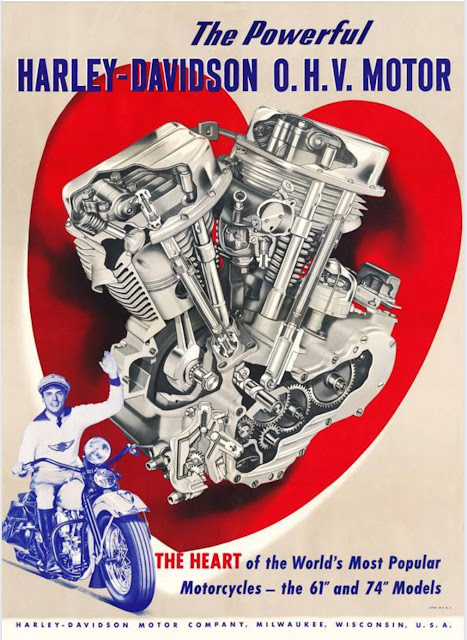
 

An ad for a panhead engine

I travelled on and one day drove from Berkeley to Sacramento. I met Ken at his office in American River College. I soon learned that Ken had once taught art history at Folsom State prison (famous for being mentioned in a Johnny Cash song). I figured that, if he had taught art to prisoners in jail for some very serious crimes, he must have a talent for teaching his subject. On my second visit, Ken collected me from my hotel to take me to the Harley-Davidson dealership, which had once belonged to his father Armando. The owners still had on display Armando’s collection of antique Harleys. It was there I learned to tell a panhead from a knucklehead. Armando owned a first-year model 1936 Harley knucklehead, which Ken sold recently for $133,000. I also discovered that Armando, as well as being a motorbike dealer, was a competitor on a motorbike racing circuit in northern California. Ken took me home to see some of Armando’s memorabilia. These include wonderful black and white photos of racing meetings and biker’s rallies: I recall a very period group photo taken, at Pismo Beach in 1926. Another memorable item is Armando’s metal “skid shoe” worn over the rider’s ordinary shoe, used for broadsliding, or putting your foot down in a turn. Ken also showed me a splendid orange 1950 panhead FL Harley with a sidecar that he was restoring for his son Theo (who at that time was in high school, so too young to ride it). Theo has ridden in the sidecar but has yet to ride the bike. Ken tells me that he has been scanning the family collection of almost 1,000 photos collected by his parents Armando and Lu, and their predecessors in the Harley dealership Frank and Gladys Murray, for the Harley-Davidson Museum collection.


A 1926 biker's rally at Pismo Beach

Ken retired in 2016, as I did, and began a new career as a journalist. His wife Teresa drew his attention to an ad from the Sacramento News and Reviews for a cannabis writer. Ken’s task is to write pieces to add some real news to 28 (sic) pages of cannabis ads. In 2018 Ken won 4th place for Investigative Reporting from the California Newspaper Publishers Association for two articles about counterfeit vape cartridges. The paper recently received a grant to publish articles about affordable housing, so Ken has diversified from cannabis to social issues.


Photo of a 1919 Harley-Davidson's dealer meeting. I assume that the dealers are wearing face masks as a precaution against the Spanish flu

My boss at Thames & Hudson once complained that I had by far the largest travel budget of any editor. I wonder if he would have appreciated my travelling to be educated about the finer points of Harleys. My response would have been that the man who taught me about panheads and knuckleheads had helped me to publish the biggest selling book in the company’s history. A book that continues to sell in its 4th edition.


Ken, by the way, is a Knucklehead.


* In our recent correspondence, Ken has been attempting, with limited success, to educate me in the finer points of Harley nomenclature and engine design. I have managed to understand that there are many more distinctions than simply panhead vs. knucklehead. Here is now Ken explained the question to me:

“For those who like to get technical, and there are many, the "evolution engine," which replaced the shovelhead, had its name shortened to "evo," but that referred to the whole engine configuration, not the cylinder heads. Some people have called evos "blockheads" but that nickname is not commonly used. As for the current overhead chain-driven twin cam engines, 1999-2016, I have heard them called "twinkies," but that's not a cylinder head" nickname. And folks who don't like the revolution engine, 2001-2017 called them the "showerheads" or "sprinklerheads." Funny nicknames, but again, not well known. Oh, let's see, I better mention that old Sportster engines from 1957 to 1984 were called "ironheads." But I own a 1977 Sportster and I didn't even know about that nickname until double-checking my information for you.


So, based on all of that, I wouldn't say it's just about knuckles and pans, except in the sense that many Harley owners are binary about Harley-Davidson. For example, some won't like any Harley made after...1948, or 1965, or 1984, 2001, or the Italian ones, or the non-V-twins, you get the point. 


So, other than all of those details above, when the nickname for the engine is based on cylinder head configurations, yes, "flatheads, knuckleheads, panheads and shovelheads" are the best-known nicknames.” 

Armando Magri on the flathead he rode at Daytona International Speedway in 1940


Friday, 11 February 2022

Wanted one hermit, previous experience desirable


Early Saturday mornings, as I prepare our breakfast, I listen to BBC Radio 4’s Open Country, which focuses on an aspect of rural Britain. On 22 January, the subject was Stoke Park Estate, 108 hectares on Purdown with views over Bristol. About 1338 the powerful Berkeley family of Berkeley Castle in Gloucestershire acquired the estate, but it was not until 1563 that Sir Richard Berkeley, MP for Gloucestershire, built the original house. By the 18th century the family had become still richer from a coal mining concession near Bristol. No doubt it was money from coal that funded the replacement of Richard’s house by Norborne Berkeley, 4th Baron Botetourt (1717-1770), about 1760, with an imposing residence in ‘Jacobethan Revival’ style, with splendid views across the landscape.


Stoke Park Estate and the c18th century house

Like many an owner of a grand country house, Norborne wanted an imposing landscape to provide an impressive setting for it. He commissioned a noted landscape architect of the time, Thomas Wright of Durham (1711-1786). Stoke Park is the best surviving example of Wright’s work. Open Country caught my ear with a curious fact. It seems that when one designed a magnificent park landscape, one needed an attraction to entice visitors. So, Norborne employed a hermit. I thought of Jayne Eyre responding to a gentleman’s advertisement for a governess. Perhaps Norborne advertised for his hermit in some publication where gentlemen’s hermits sought employment.            


Norborne’s employment of a hermit was by no means eccentric or novel. In the early 15th century Francis Paola, an Italian mendicant friar, is reported to have lived as a hermit in a cave on his father’s estate. In 16th century France estates included a chapel or another small building to house a hermit. The first was perhaps at Château de Gaillon whose hermitage consisted of a chapel, house and garden. Hermits caught on with British aristocrats in the 18th and 19th century. Charles Hamilton, owner of Painshill, prudently issued his hermit with a seven-year contract of employment, which must have included a termination clause, since the hermit was sacked after three weeks when he was discovered in a pub.      


Unfortunately, Norbert made some bad investments and was forced to accept an appointment as Governor of Virginia in 1786.  He died there two years later. The estate and the house were inherited by Norborne’s sister, Elizabeth, widow of the 4th Duke of Beaufort, and remained in the Beaufort family until 1915, by which time the house had become Stoke Park Colony for the mentally handicapped. The NHS took it over in 1948 until it closed in 1988.


Stoke Park hospital

During World War II, the park was a site for anti-aircraft guns to protect the city and port of Bristol. The concrete structures remain. Many years’ growth of brambles and ivy covered the artillery emplacements. Goats employed to clear the growth are a popular attraction for Bristol’s children, and so, in a sense, have replaced the 18th century hermit.


The story of Stoke Park’s hermit recalled my meetings with Buddhist monks in Japan. When we visited our son John in Kanazawa the mother of his host family took us to a monastery in the hills above her home. She called into the office where she was told that there was an Australian monk (“Australia-jin”) working in the garden who could tell us something about the monastic life. The monk was called away from his work. He wore a long robe of rough material and round his waist a censer which issued smoke to drive away insects (he could not harm or kill them). The Australian explained that he lied a simple life of meditation and work in the garden as preparation for his return to Australia.


Another encounter with a monk was quite a contrast. My colleague Ms Matsumoto had taken me to an exhibition opening in a small gallery on the fashionable Omotesando street in Tokyo. There I met a young monk, a relative of the artist, dressed in a splendid saffron robe and drinking a beer. I asked him about his life. He explained that he walked in the mountains and bathed in waterfalls. I asked him how he fed himself: simple, people gave him his meals. I commented that this seemed like a nice lifestyle if one could also join fashionable gatherings in Tokyo and drink beer.


On another occasion, I had taken my colleague Jane Turner, editor of The Dictionary of Art, to Asakusa, a large complex of Buddhist temples. We had paid a fee to choose a small stick on which was written something in Japanese characters, which you match to the drawers of a large wooden cabinet to select a sheet of paper (an omikuji) on which your fortune is written. I had suggested that we keep them until we might meet somebody who could read them for us. That evening we attended a reception. There I met another monk, also wearing a saffron robe, and sipping a drink. I asked him if he could read my omikuji. He agreed and told me that mine predicted good fortune. I found Jane and introduced her to the monk. She produced her paper. The monk shook his head and told her that he had rarely seen such a bad prediction. I am glad to reassure my readers that at the last report both Jane and I are alive and well, so perhaps misfortune was not her lot after all.


Choosing an omikuji at Asakusa

I had thought at the time of meeting the party monks that a drinking monk in fashionable gatherings in Tokyo was slightly incongruous. Perhaps they had a function rather like Norborne’s monk, to add something extra to the venue. This set me thinking about parallels in my own profession. I recalled that when renting office space in New York the usually hard-nosed agent would make a few (invariably small) concessions to attract a publishing client. Apparently, we attracted other tenants.


I recall being invited to a fundraising dinner for Friends of the Sir John Soane Museum in Soane’s house in Lincoln Inn Fields in the 1990s. At the time I was Publisher of The Dictionary of Art, which was how I met Peter Thornton the director of the museum. I found myself seated at a table with assorted wealthy Americans, Bridget Cherry, editor of Pevsner’s guides to the architecture of England and a very distinguished elderly member of the aristocracy. We three were meant to charm the moneyed guests out of their money. Unfortunately, the aristocratic lady became quite drunk so Bridget and I had to keep talking to distract the Americans from her inebriated state. Around the same time, I was invited occasionally to lunches at Sotheby’s. I would find myself at a table with the auction house’s finance director, owners of works he hoped would sell them at Sotheby’s and one or two characters like me who I suppose were meant to impart an air of scholarship far removed from the grubby subject of money.


As I commented in a previous post, the BBC, which enriches the culture of our country with a range of programming which will never be matched by for-profit broadcasters, and which provides this service for £0.44 per day, is a remarkable institution. For entirely ideological and self-serving reasons, it has long been threatened by elements of the Conservative Party, which are now in charge of the party and the government. The same faction has already undermined the British Council, another fine institution. It must not be allowed to destroy the BBC.

Sunday, 30 January 2022

Conversations with Maurice


During the lockdowns of 2020 and 2021 we spent more time in our small community, Sunninghill, about 30 miles from central London. This enabled us to spend more time chatting with neighbours with whom conversation had previously been limited to a “Good morning. How are you?” as we walked to the train station or returned from the local shops. One such neighbour is Maurice.


We had often seen Maurice busy about his garden or trimming his hedges. For several years we had seen his wife also, until her death a number of years ago. Maurice is quite deaf and does not wear his hearing aids outdoors for fear of losing them, so our lockdown conversations are sometimes limited to an exchange of greetings, an assurance that we are both well, and usually the instruction to give his greetings to my “good lady”. In one laborious conversation I learned that his birthday is in June and that last June he was either 99 or 100.


Our conversations with Maurice began during the first lockdown in Spring 2020 when we saw a ladder leaning against a lamppost in his garden. He explained that he had installed an extra light to reduce the risk of falling. Over the year he described his maintenance routine. In the Spring his niece brings him tomato plants which he grows in pots and then freezes for use year-round. Then comes the apple harvest. He invited us to help ourselves to apples from his trees. He explained that he had once left some outside in a box, inviting passers-by to help themselves. Instead, local boys staged an apple fight. He has a long holly hedge, which he trims every year using a home-made platform to reach the top and to measure the desired height of the hedge.


Over many conversations we have pieced together parts of Maurice’s long life. He was brought up by his mother not to marry, as he tells it. From an early age she taught him to cook, telling him that ”If a man can cook he will never go hungry.”


War offered Maurice independence from his mother. He enlisted as a deck hand in the merchant navy and joined the crew of 40 men on a small Swedish ship. When the crew discovered that he could cook, they appointed him ship’s cook, and were delighted to be served something “other than bloody fish”. They sailed to the far north of Canada and then down the coast of the USA ad on to northern South America. The ship was small enough to navigate up rivers that the larger vessels in wartime convoys could not. Their most frequent cargo seems to have been sugar, although on one occasion three aircraft were packed on the deck.


One destination was the Demerara River in British Guyana (now just plain Guyana). Maurice once spent three months cooking for the crew in tropical heat. The reason was that one crew member could no longer face the trials of a long ses journey home in convoys under the threat of German torpedoes or bombs. So, this colleague smashed the ship’s radio. It took three months for a replacement radio to reach Maurice’s ship. Cooking in intense heat made Maurice ill, so he was put off ship in New York and spent two months recovering in the home of relatives in northern New Jersey. He commented that he could have married there, but instead returned home to his mother.


Despite the fears of his colleague, Maurice told me, his vessel was much less likely to be sunk by a torpedo than the larger ships in the convoys. Since submarines carried a limited number of torpedoes, they aimed to sink the bigger ships carrying larger cargos. His cooking duties gave him spare time between meals to look around. On more than one occasion he saw a torpedo pass underneath his ship on its way to a larger one in the inner convoy. Thus, his ship was relatively safe until it neared Britain when German bombers were a more significant threat.


After the war Maurice ran his own small enterprises. One was the sale of plastic flower arrangements to entertainment and wedding venues. Another was the sale of scale models. He was also kept busy building the house where he still lives. He explained that he had no formal training as a builder or architect, but had observed construction methods during his travels and applied that knowledge to his home.


Maurice’s mother seems to have been successful in preventing him from marrying until after her death. Romance finally arrived on a bus trip. Maurice heard a woman weeping. He comforted her and discovered that she was recently widowed. The couple married and lived happily in Maurice’s self-built home. His wife wanted an aunt and uncle to move in, so Maurice expanded the house to accommodate them.


I recently visited Maurice to deliver a small Christmas cake that Jan had made for him. He was busy putting away supplies from his weekly supermarket shop and was wearing an extremely colourful jumper. He explained that his wife knitted one sweater for each day of the week.


When I ask Maurice how he is, he sometimes explains that he does not feel too well, but then adds philosophically that there’s nothing for it but to keep going.

Wednesday, 29 December 2021

Desmond Tutu and Reconciliation


Desmond Tutu was once invited to preach to a white congregation in South Africa. He told them that Africans were deeply grateful to them for the gift of the Bible. He added that “The only difference between us is that we believe in it.” The archbishop told this impishly humorous story in a talk at St Paul’s cathedral in the 1990s which my father-in-law and I attended. My limited experience of clergy is mostly of Anglican sermons in British churches, which somehow manage to detach Christian beliefs and morals from the personal and often avoid challenging personal behaviours. Tutu, by contrast, spoke from the heart with a simple, uncomplicated, utterly sincere belief in right and wrong, and in humans’ potential for good. At the end of his address in St Paul’s, he spoke of prayers ascending to heaven and lifted his hands and gaze upwards to the great dome with a look of joy on his face in an almost child-like manner which no learned British cleric could manage.


My other connection to Tutu was an indirect publishing one. In 2000 I published the international edition of The Report of the Truth and Reconciliation Commission of South Africa, which Tutu chaired. For the first time in my career, I consulted a libel lawyer who told me that the report contained multiple libels. Puzzled, I asked him what he meant. “Well, it accuses many people of murder, torture and other crimes. It could damage their reputations.” I protested that they had confessed to the crimes in public tribunals and had no reputations to damage. The lawyer was unmoved and advised against publication. Fortunately, my boss shared my opinion that this was ridiculous and we decided to publish. We did take one precaution against a lawsuit, however. The former President of South Africa, F. W. de Klerk, had attempted to sue the Commission over two references to him in the report. We decided to publish with those passages ostentatiously obscured with black ink and referred readers to the South African edition.


The launch of the Report at South Africa House, Trafalgar Square, London

We launched the Report at an event at the South African High Commission. One of the speakers was Dullah Omar, South Africa’s Minister of Justice, who survived an assassination attempt by the Bureau of State Security (BOSS), which substituted a placebo for his heart pills. He collapsed in the street but was saved by a doctor who happened to be nearby. Two other speakers came from South Africa, including a High Court judge. The campaigner and journalist Trevor Phillips, chaired the presentation of the Report. Behind the speakers was the banner, bearing the slogan “Truth. The road to reconciliation”, that the Commission had taken around South Africa to the places where it heard testimony.


The speakers: Dullah Omar second from right, Trevor Phillpis centre

After the event, the High Commissioner, who had been a young anti-Apartheid activist herself, hosted a dinner for the speakers at her residence. Those attending included three or four Labour Party members of the House of Lords who had supported the Anti-Apartheid Movement, my boss, me and Mike Terry, a secondary school physics teacher who sat next to me. Mike told me that he had been secretary of the Anti-Apartheid movement. When I asked him why he was now a teacher, he explained that campaigning was exhausting. He would come home to find Special Branch officers sitting in a car outside his home and his phone was tapped. Nevertheless, he led the campaign for 20 years. As the speakers and the High Commissioner chatted among friends, they clearly relished being in charge and able to make their own decisions, rather than being told by white people what they may or may not do.


As I read the Commission’s report, I was struck by the gratuitous, depraved cruelty, of the security forces of Apartheid. It was clearly not enough simply to kill and eliminate their opponents; they must be humiliated and subjected to unimaginable pain. The men (they were I think all men) who carried out these acts, presumably had families to whom they returned after a day of murder and torture. The report suggests that acts of oppression damaged not only the victims but the oppressors and torturers themselves. Thus, the Apartheid regime not only damaged its opponents but its servants also.


Archbishop Tutu’s sense of humour and enjoyment of dancing have been mentioned repeatedly in news coverage, but I have been thinking of him in front of the Commission’s banner listening to testimony of countless acts of state-planned human depravity. He must also have been a man of profound seriousness of purpose and of compassion for the victims of Apartheid, perhaps even for some of the perpetrators whose moral being it corrupted.

Sunday, 19 December 2021

Who hanged Father Christmas?


On Christmas Eve 1951 250 children gathered outside Dijon cathedral to see Father Christmas. But these children would not sit on Santa’s knee to hear a ho-ho-ho and receive a gift, for they had come to see him hanged and burned (in effigy of course). The clergy of the cathedral explained:


Representing all the Christian homes of the parish eager to fight against the lie, 250 children, grouped in front of the main entrance to the cathedral of Dijon, burned Father Christmas. It was not an attraction, but a symbolic gesture… A lie cannot wake up religious feelings in a child and is in no way a means of education. May others say and write that they want to make Father Christmas the counterweight of the Bogeyman. For us Christians, the festival of Christmas must remain a celebration of the birth of the Saviour.


The Archbishop of Tolouse declared: “Don’t speak to Father Christmas, for the simple reason that he never existed.” The formal position of the French church was:


The Father Christmas and the Christmas tree were introduced into the public schools although they are the reminiscence of pagan ceremonies related to the worship of Nature which do not have anything Christian; whereas in the name of outrageous secularism the crib is scrupulously banished from the same schools!


However, despite the opposition of the clergy of Dijon, Father Christmas was resurrected by the secular municipal authorities outside the town hall.


This event was the subject of an essay, Le père Noël supplicié (Father Christmas tortured) by a young anthropologist, Claude Lévi-Strauss. Lévi-Strauss argued that Christmas represents the glory of life, once one has made peace with the dead. He linked the Christmas celebrations to Roman Saturnalia and celebrations of the solstice.


I learned about the sacrifice of Father Christmas this morning from a BBC Radio 4 programme, Something Understood, hosted by Mark Tully, a former Indian correspondent for the BBC. These kinds of programmes are one of the glories of the BBC, whose independence and very existence is threatened by our malevolent, autocratic Conservative government. Our current rulers are just the kind of autocrats who would hang Father Christmas if he disagreed with their politics.

Friday, 3 December 2021

14,000 residents, one Virgin and 3 million pilgrims


To reach Talpa de Allende from the Pacific coast, you wind your way through the pine forests of the coastal highlands for a couple of hours. Briefly, the road descends across the broad, heavily cultivated Valley of Mascota, and then climbs again on its way to Guadalajara, Mexico’s second largest city. At intervals you pass roadside shrines, some of which have concrete benches and tables for weary pilgrims to rest and take refreshments. A right turn takes you on to the only road into and out of Talpa. The first glimpse of the town is a parking area on a high cliff above the valley. Here stands a chapel dedicated to a priest who died on his way to worship in Talpa. The road winds its way down to the valley and directs you to the main street, Independencia. The first-time visitor is surprised by the number of hotels on Independencia. Most Mexican towns of this size have one or two modest hotels, but Talpa has quantities – at least 31, of which 20 are classed as “economical”. Those that advertise a double room for 250 pesos (£10/$12) per night must be very economical indeed. But we had reservations at the brand-new Doña Francisca Boutique Hotel, Talpa’s equivalent of the Ritz.


Downtown Talpa

Before Spain colonized Mexico from 1521-1821, Talpa was a Nahua (the same ethnic group as the Aztecs) town called Tlalipan. Tlalipan’s residents were lucky enough to be left alone by the Spaniards until 1532 when a lieutenant of the thuggish Nuño de Guzmán appeared in the valley. However, nobody showed much interest in Tlalipan until silver was discovered in nearby Aranjuez. Suddenly, Spanish families arrived and the administration in Mexico City converted Indigenous Tlalipan into the Spanish municipality of Santiago de Talpa. Little more of note happened until, in a now independent Mexico, Talpa’s most prominent citizens sided with the anticlerical Liberals in the 1850s War of the Reform. In 1885 Talpa ditched its religious name and became Talpa de Allende in honour of one of the heroes of Independence, Ignacio Allende.


An ice cream shop on Independencia

A short walk to the main plaza tells you all you need to know about modern Talpa’s economy and society. There are restaurants aplenty. Shops selling huaraches stock huge quantities of leather sandals, surely more than enough for every one of the 14,000 inhabitants of the town. The sweet shops sell rollos, sausage shaped sweets of guayava or of a local bitter/sweet fruit called arrayán, some filled with cajeta (a caramel made from milk) or cajeta de guayava, and rompope, a sweetened alcoholic drink of various flavours There are also a few neverías (ice cream shops), so the Mexican sweet tooth is well catered for. Then, of course, there are the souvenir shops selling memorabilia – reproductions in various sizes of the Virgin of the Rosary, and assorted other religious items – for the business of Talpa is pilgrimage and little else.


Rollos and rompope for sale


The Famous Lefty retaurant, specializing in birria (a meat stew flavoured with chiles, a Jalisco speciality)


The plaza is dominated by a not particularly attractive basilica in Neoclassical style. At the entrance gate you put on your obligatory cubrebocas (face mask) and a polite gentleman checks your temperature. Once inside, you notice – sign of the times – that many of the pews are draped with the kind of tape you see at accident or crime scenes to limit the number of faithful able to sit down. Above the altar stands the diminutive (she is also known affectionately as La Chaparrita or “Shorty”) dark-skinned figure of the Virgin who, when there is not a pandemic, brings 3 million people a year to Talpa. The most devout among these walk 117km. along La Ruta del Peregrino (Route of the Pilgrim), particularly to celebrate the Virgin’s birthday on 7 October or at Easter.


The Virgen del Rosario on the altar

The parish church of San José de Talpa

The story of the Virgin begins in the 17th century, when Spanish priests walked or rode on muleback from church to church in their large parishes scattered across the mountains of modern Jalisco state. An indispensable element in a priest’s baggage was a lightweight, easy to transport Virgin. One priest carried a small Virgin made of corn stalks and orchid glue in Michoacán. After many years the Virgin was installed in Mascota, but it seems that she did not want to stay there, and persuaded her custodian to take her to Talpa. The people of Mascota recovered her, but again she persuaded her attendant to carry her to Talpa. By this time the poor little figure was badly decayed and it was decided to bury her in a well in the parish church of San José de Talpa, around the corner from the plaza. However, rays of light emitted from the well and the Virgin of the Rosary arose, no longer a figure of worm-eaten corn stalks, but a splendidly attired stone image. The miracle was witnessed by an Indigenous woman. [Miracles associated with Virgins are generally witnessed by an Indigenous person in Mexico. The most important of them all, the Virgin of Guadalupe, made herself known through an Indian man called Juan Diego.] A sign draws one’s attention to the miracle: “In this place the holy image of Our Lady of the Rosary was renovated. As she was not buried, the well remained as testimony of the miracle. Talpa, 19th of September 1644.” 

The altar of the chapel where the Virgin of the Rosary was transformed, now watched over by a copy of her image


La Chaparrita carried in procession


A tourist bus offers various excursions: to a coffee plantation, to the nearby maple woods, unique in Mexico apparently, or to the “Olmec” petroglyphs. Since the business of Talpa is Catholicism, we opted for the tour of seven chapels and Cristo Rey (Christ the King). Devotion to Cristo Rey would be a normal focus of worship in most Catholic countries, but in Mexico he attracts a fierce devotion rooted in the country’s history. For in the late 1920s the hierarchy of the Mexican church decided to oppose the laws of the revolutionary regimes that had restricted religious activities and nationalized church properties. Many libraries and archives in contemporary Mexico are housed in former churches as a result. Finally, the bishops decided to strike. Churches were closed, there were no masses, baptisms, religious marriages or burials, except for those carried out in secret by clandestine priests at great risk to their safety. For those who would like a flavour of these turbulent times Graham Greene’s account of his travels in Mexico, Lawless Roads, or his novel, The Power and the Glory, about a priest pursued by the regime and racked by doubts about his faith, are good and evocative reads.


The monument to Cristo Rey

The faithful responded by taking up arms, especially in western Mexico in small towns like Talpa. On a hill above the town, our guide told us, the federal forces executed captured cristeros. On that hill now stands the grandiose monument to Cristo Rey, a huge concrete obelisk topped with a blue half-dome on which Christ stands looking across the town. Behind him are two small chapels and a larger building for exhibitions or events.


In the Chapel of St Michael, the saint "throw[s] into hell Satan and the other malign spirits that wander the earth to damn souls."

We had dinner one evening in a cenaduría (dinner only restaurant). The business model is to serve a limited range of antojitos (delicacies/snacks) at inexpensive prices. We shared a table with a brother and sister. Their family, all natives of Talpa, but most now living and working elsewhere, had gathered for a one-year anniversary mass for their late mother. The brother now works at a huge cattle feed lot in California. His job is to drive up and down long lines of cows dispensing food so that they fatten up as fast and as cheaply as possible. Since COP26 was scheduled in Glasgow, I could not help thinking of the CO2 emissions produced by this charming man and his employers. However, the feed lot gives him a living he could not hope for in Talpa, and his sons were born in California so are now US as well as Mexican citizens. I thought it best not to discuss the environmental impact of his work. Moreover, he made it clear that he would much prefer to return to his terruño, and that his employer was muy codo (literally “very elbow”, meaning very mean, a phrase usually accompanied by tapping an elbow with the hand). Our conversation reminded me of our guide on the tourist bus, a young graduate in engineering from the Centro Universitario de la Costa or CUC in Ixtapa, Puerto Vallarta. Mexico produces plenty of well-trained professionals, but few professional jobs.


Huaraches for sale

Late in the afternoon, as we strolled round the downtown streets shopping for huaraches, we noticed a small group standing to the side of the basilica with loudspeakers, and then a number of municipal policemen descended from a van carrying firearms. This caused us some alarm. Were the officers going to suppress a small demonstration? Was a criminal about to be arrested in a shoot out? However, the police officers, formed disciplined ranks clutching their weapons at attention. The civilians also stood to attention opposite them, their right arm across their chest, while an officer slowly lowered a large Mexican flag as the national anthem (“Mexicans, when called to war, prepare the steel and the bridle”, etc. Stirring bellicose stuff.) blared out of the speakers. Civic patriotism is the other religion of Talpa, the ceremony organized by a descendant municipal government of the state against which the cristeros once battled.


The flag is lowered

The pandemic has, of course, been an economic disaster for Talpa no 3 million pilgrims. Our hotel, opened just in time for the lockdown measures, had only three occupied rooms: our two and the room of a couple from Oakland, California. They had requested a room overlooking the street, not realizing that at night the streets fill with people dining on tacos and other delicacies served by mobile vendors, traffic and the noise of music blaring from restaurants and bars. We had seen the man loudly protesting to the receptionist that his wife could not sleep. We met at breakfast next morning when we helped them to understand the breakfast options. I explained to them that social life in Mexico is always noisy, and in the centre of town much of it is conducted on the street.


Making galletas de nata (cream biscuits), another local delicacy

Talpa is not a particularly picturesque town, but its setting in a valley surrounded by verdant hills is stunning, the intense devotion to the Virgin is very Mexican, the tostadas, enchiladas, tamales, tacos and sopes served in the cenadurías are excellent, and the people hospitable. And the sandals are a bargain.

Rollos, Rompope Doña Chayo (vanilla, hazelnut, coffee and almond flavours), and furniture for sale


Monday, 15 November 2021

Caring and running for disabled children in Puerto Vallarta


I know a good deal about Mexico’s history. But my son Chris, who works for a charity, Pasitos de Luz, in the Bahía de Banderas tourist resort area on the Pacific coast, has learned about Mexico not from books and documents, but from his participation in the lives of Mexicans, from impoverished parents of disabled children to wealthy residents, the Canadian and American expatriate community, the state bureaucracies of Nayarit and Jalisco, local and national media, and his neighbours in San Vicente, Nayarit.


For example, during our recent stay in a hotel in Nuevo Vallarta, Chris chatted to the waiter who served us lunch and asked if he was de planta, meaning whether he was a year-round member of staff, or one of the many employed only for the six-month high season. This fortunate young man is de planta, but his colleagues who are not live especially economically precarious lives. Chris took us for a drive in the Ameca River valley, through the suburban towns beyond San Vicente. We noticed a number of smart buses emblazoned with the logo of the Vidanta Group, an enormously influential vacation resort company. Chris explained that these were taking resort staff home after the end of their shift. The homes were often public housing: small, identical homes built in rows, with no public space other than the street, and only a small concrete yard at the back, their whitewashed walls stained black in places. Chris told us that several of his Pasitos colleagues also live in these grim developments.

In the morning hotel workers sweep the public areas of the building, the gardens and the beach. The hotel business model is based on cheap labour.


If you are a poorly paid worker in the tourism sector, a disabled child is an unexpected economic burden, your home is almost certainly poorly ventilated (and certainly not air conditioned) in an exceptionally hot climate, and generally unsuitable for a child with special needs. In theory, the family might be entitled to help from the Sistema Nacional Para el Desarrollo Integral de la Familia (National System for the Integral Development of the Family), or DIF, the body charged with the constitutional duty of protecting the rights of children, “principally those who, on account of their physical, mental or social condition are vulnerable, to enable them to live a full and productive life.” I have seen DIF offices in towns with populations of only a few thousand people, so its network seems to be extensive. DIF issues identification cards that entitle disabled people to discounts in certain businesses. Chris tells me that DIF also offers therapy for disabled children, but charges a fee, which prevents the children of poor families from receiving vital support.


Pasitos de Luz celebrated its 20th year during the pandemic. Its registered legal name is

Mamás Unidas por la Rehabilitación de sus Hijos A.C. (Mothers United for the Rehabilitation

of their Children Civil Association). Twenty years ago, Pasitos was a cooperative of mothers

operating from a building in the Bobadilla district of Puerto Vallarta. When I visited

Bobadilla in 2014 it was bursting at the seams with equipment, a kitchen, a nursery, staff

and children. The front door advertised what Pasitos offered to parents desperate to

improve the life chances of their child: “FREE professional care for disabled children [with]

cerebral palsy, Downs syndrome, myelomeningocele, autism, impairment from meningitis

early years stimulation, special education, other syndromes, special nursery.” Care was

provided Monday to Friday from 7am to 7pm.


Chris at the Bobadilla building of Pasitos in 2014

 
The front door at Pasitos

Pasitos now operates from a spacious, cool and well-ventilated building, with spacious gardens, 
and recently a hydrotherapy pool, set among fields of watermelons and cucumbers just outside 
San Vicente. Physiotherapists help the children to lift their heads, to sit, to walk. They learn 
basic skills: at Bobadilla I met a tall fifteen-year-old boy who had recently learned to hold a 
pencil so that he could be taught to write. They are also given a nutritious breakfast and lunch. 
Such life-enhancing work does not cost a fortune in our terms – the annual budget is a little 
more than US$250,000 – but charitable giving is not a well-developed social practice as it is 
in the UK, the USA and Canada and raising that money is hard work. Much of the funding is 
raised at events for expatriate residents during the high season. Covid-19 stopped that funding 
stream dead, although Chris is now organizing the annual River Café Fashion Show, the 
biggest fund raiser, since March 2020. Pasitos survived by drawing on its very modest reserves 
and putting the staff on half-time work and pay. When the children returned in September some 
had regressed, so the pains-taking therapy had to begin again.
 
The new Pasitos building, known as The Castle

Chris has been touring gyms promoting his 21K challenge, to run from “Old Pasitos” in Bobadilla to 
“New Pasitos” on 11 December. His goal it to recruit from the gyms’ customers more sponsored runners. 
He tells me that the gym members understand the concept of a personal running challenge, but the 
dea of seeking sponsorship for a good cause is quite foreign to them. Nevertheless, a friend, 
Rodolfo, who is running the Mexico City Marathon in November will join Chris to run the 21 kilometres 
from Bobadilla to San Vicente.
 
Physiotherapist Eliseo teaches Alexis to walk. Both are blind

If readers of my blog would like to sponsor Chris, those in Mexico can give at: 
https://carreravirtual.recaudia.com/ayudadesdecasa/21k_2021/pasitos_de_luz/chris_jacobs, 

Readers in the USA and Canada can donate here: https://www.paypal.com/paypalme/pasitosdeluz

Readers in the UK should contact me at ianjacobsipswich@gmail.com. If you know of any 
organization, such as a local church, gym or disabled children’s group that might sponsor him 
please send them a link to this blog.
A session in the physiothrapist room

 
Thank you,
Ian Jacobs