Monday, 20 January 2020

Distressed or simply non-compliant: what’s in a word?


My sons, no doubt, will tell you that I  am frustratingly insistent about the precise use and meaning of words. That character trait came in quite handy when I was a reference publisher. Words, of course, can have multiple meanings, as can events. Events shape the words we use, the words we use shape events, and our choice of words can determine how history records events. I read a newspaper article last week in which very different words were used to describe a single event.

The article concerned a 48-year old Nigerian lady in Yarl’s Wood immigration removal centre, an institution run by a government contractor, in which people who are not British nationals are “detained” before being deported. The period of detention can sometimes be longer than a sentence for criminal activity. Yarl's Wood is not a nice place to spend time.

The Nigerian lady was raped in Nigeria when she was 7 years old, and again aged 17. The second rape resulted in a pregnancy. Her baby died aged six months. She has been diagnosed with PTSD and is asthmatic. She was under constant supervision to prevent her harming herself. She is on trial for biting three guards at Yarl's Wood and for kicking a fourth. On the day in question (as a lawyer would say) she had been scheduled for deportation. However, she insists that she had been informed by her lawyer that her deportation had been “cancelled”. It seems that, indeed, her removal had been deferred, but that the information had not reached the guards at Yarl's Wood.

The Yarl's Wood staff spent three hours trying to persuade her to leave voluntarily. She refused. The manager then authorized the staff to use force. Her removal was filmed, and when the Nigerian lady saw staff approaching with a camera she responded by removing all her clothes. She was then wrestled to the ground by the staff and held face down, covered with a blanket. She was heard on the film to cry “Leave my neck, leave my neck, please leave my neck.” She is claiming self-defence, saying that she was “thrown like a bag of cement” to the floor.

The defence lawyer asked the detention operations manager at Yarl's Wood if the use of force was disproportionate. He replied that it was not because the Nigerian lady was “extremely resistant and aggressive”, and because a financial penalty would have been incurred for failure to deliver her to the flight. Asked whether the woman’s removal of her clothes was a sign of distress, he replied “It’s a sign of showing non-compliance.” I suspect that it was both. My dictionary provides two definitions of compliant. The first is: “tending to be excessively obedient or acquiescent”. I would agree with the manager that the Nigerian lady was not excessively obedient nor acquiescent, but if I were the lawyer I would also have argued that it is perfectly possible to be both distressed and non-compliant. Removing one’s clothes in front of strangers while being filmed suggests at the very least apprehension. The guards also testified that she was very resistant and aggressive, which again does not preclude her being distressed.

It is easy to consider the Yarl’s Wood manager and guards cruel and indifferent to the Nigerian lady’s fate, but they are employed by a company contracted by our elected government ro detain and deport people. Perhaps the responsibility for her treatment lies elsewhere. The newspaper reports reminded me of reading the text of the South African Truth and Reconciliation Commission Report. I published the international edition in the 1990s. The report detailed appalling acts of cruelty and suffering. However, I was struck by a discussion of the effects of the murders, torture and other violations of human rights committed in the name of the South African state. This section of the report addressed the dehumanizing harm done to the murderers and torturers. The politicians who instructed them to carry out these acts suffered no such consequences. Nor did those members of the white community who elected the government. Those who carried out appalling acts on the instructions of the state, on the other hand, were severely damaged. This does not exempt them from responsibility, but it does set eh events in context.

The Report was the only book I had read for libel in my 40 years as a publisher. Macmillan’s libel lawyer called me to tell me that he recommended I not publish the report because it was full of libels. I replied that I failed to understand how I could libel men who had confessed to such crimes. The lawyer told me that the accusations in the book could damage the reputations of those named in the book and that they would be entitled to sue for reputational damage. My boss and I agreed that this was quite absurd and that se whould publish, but we did decide that it was prudent to obscure two brief mentions of the involvement of Prime Minister F. W. de Klerk, who had taken the Commission to court in South Africa. We ostentatiously blacked out the relevant text and added a note referring the reader to the uncensored South African edition. I later saw Mr de Klerk at a launch in Hatchards bookshop of his memoirs. During the speeches I stood behind Margaret and Dennis Thatcher, friends of F. W. I was tempted to mention the report to Mrs. T., but suspected that her guards might intervene, although probably less forcefully that the guards at Yarl’s Wood.

Saturday, 11 January 2020

Royal Windsor (not Meghan and Harry), Leonardo Da Vinci and Ancient Mexico (via China and Syria)


In case you were wondering, Jan and I are not monarchists, nor are we all agog about Meghan and Harry. A much more interesting royal topic is our visit a year or two ago to Windsor Castle with a friend and former author Ralph Larmann, and his wife Ella Combs, from Evansville, Indiana. The castle houses the Royal collection of prints and drawings, one of the finest in the world.
 
Dürer, Holy Family

Leonardo, Man Tricked by Gypsies
In preparation for our visit we were required to pass a security check and to state what we would like to see. Ralph and Ella asked for Dürer prints and Leonardo drawings. Once the security office had issued our passes, we were able to enter the castle without paying the usual charge and (since we were early) to wander into St George’s Chapel for some free sightseeing.
St George's Chapel, Windsor
At the appointed time we rang the bell at a door which took us into an area where a police officer checked our passes. Our companion during our visit was a young Italian art historian, who asked who would volunteer to handle the book of Dürer prints. Ralph volunteered and was taken away to wash his hands (no gloves required). We four constituted a group, which meant that we had exclusive access to the collection for one hour and forty minutes.
 
Dürer, Virgin and Child with an Angel Playing a Viol
The Dürer prints are kept in large bound books. Many are on religious themes: The holy Family, the Virgin and Child with an Angel Playing a Viol, The Apocalypse.
Dürer, Apocalypse
But there were also subjects such as A Knight, Death and the Devil, The Bath House. The expressiveness and the fine detail of the prints is quite extraordinary: one landscape featured a tiny goat, depicted in great detail sitting on top of a remote hill.

 
Dürer, A Bath House
Not even Ralph with his washed hands was allowed to handle the Leonardos, which were brought to us by the Italian lady. She had selected a range of works for us: landscapes, anatomical studies, designs for military devices and statues, studies for paintings, grotesques.
Leonardo, Storm Over a Hilly Landscape
I remember particularly a small study of a storm over a town in a landscape, drawn seemingly a great speed to convey the feeling of wind and rain. There was a design for a commission for an equestrian monument, which Leonardo apparently never completed. He was not good at customer service. There was a wonderfully evocative drawing of a man being tricked by evil-looking gypsies. My favourite was a gorgeous study of the Virgin and child for the painting in the National Gallery, The Virgin of the Rocks, and almost as beautiful study of a head of Leda.


Leonardo, Head of Leda

As a former publisher, I was struck by the variety of sizes and textures of paper. Leonardo clearly did not carry around with him an A4 sketchbook. So, before writing this I contacted my friend and great expert on the history of paper, Jonathan Bloom. In Renaissance Italy paper was made from linen rags of varying quality, textures and cleanliness, which meant that sheets could vary in colour and texture. The rags were soaked in water and beaten into pulp by hammers, usually in water-powered mills. Then a mould was dipped in a vat of wet pulp, shaken to distribute the fibres evenly and left to dry. Thus, sheets were individually made, and the process required plentiful raw materials (rags), plenty of clean water, a good deal of manual labour, and time to dry the paper. Large sheets were difficult to make since they required large moulds which were heavy and difficult to handle. This made paper expensive. However, the alternatives were papyrus made in Egypt from reeds, which provided an inferior writing surface, or parchment which was expensive because an animal had to be killed to provide the raw material (skin).

Jonathan tells me that paper was made to standard sizes quite early on. There was a specification of paper sizes in Bologna in the 14th century. Leonardo evidently had his eye on cost. He bought large sheets of cheap paper for his cartoons (designs for frescoes) but more expensive smaller sheets for other purposes. Therefore, he probably bought sheets of standard sizes. Perhaps the variety of sizes of Leonardo’s drawings was the result of cutting sheets to the size required so as not to waste an expensive surface.

Paper was invented in China where it was made from a variety of plant materials. Buddhist monks carried the technology to Korea, Japan and Vietnam, and probably to India. Paper making spread to the arid lands of Central Asia where the plants used in East Asia did not grow. Rags were a more suitable and available raw material. Paper manufacture reached Syria around 800AD. Muslim papermakers used both plant raw materials and recycled textiles to make paper. They spread the technology around the Mediterranean. Paper making using rags was established in the Iberian Peninsula by the 12th century. Such was the strategic importance of rags that King Jaume of Aragón (who reigned from 1213-1276) banned its export. Manufacture in England began around 1500, but a decline of linen production because of the Civil War in the early 1640s temporarily interrupted paper making. Here too the government acted to preserve strategic rags: the dead could be buried only in woollen clothing or shrouds.

The peoples of ancient Mexico were already “peoples of the book” centuries before the Spaniards introduced their own paper. Mexican paper was made from fig bark using a beater to hammer it flat. Paper was used for recording taxes and for general administrative purposes to manage society and government. It was also used to document the history and genealogy of ruling elites and to  record religious texts. Paper also had sacred uses and was therefore highly prized. Mexican did not bind sheets of paper to make books of the kind we are accustomed to. They glued sheets together to make long folding paper “screens” (known as códices) that could be unfolded one page at a time or displayed opened to full length to be read or recited. The Mayans had an elaborate writing system, but in Central Mexico pictographic writing predominated. Scribes were experts in the meanings of pictographs and also served as expert readers and well as writers.
 
The Mixtec Codex Nuttall, British Museum, made before the 1519-1521 Conquest
We are accustomed to think of printing as the first revolutionary information technology, but Jonathan points out that paper existed long before printing. Paper and its use for drawing and writing was the first global “disrupter” technology. The arrival of paper stimulated the great flowering of Medieval Islamic literatures and learning. The Spaniards used paper as the instrument through which they administered a vast empire that spanned three continents. A government official sent to Mexico to inspect the work of a senior official could use almost 50,000 sheets of paper.
 
The Mixtec Codex Selden or Codex Añute, Mexico after 1556, Bodleian Library, Oxford

In Mexico, the paper-based culture of the Spaniards met another society for which paper was an essential technology. The indigenous people started producing their own documents on European (as well as Mexican) paper within a few years of the Conquest of 1519-1521. Scribes still wrote pictographically, but now added glosses in Náhuatl (the Aztec lingua franca) and Spanish, for use dealing with royal officials or in the courts. The Spanish legal system officially recognized these pinturas (“paintings”). In the hands of a resourceful indigenous leader (or in less than a century the odd Indian lawyer) paper became a tool to protect the community and resist abuses.

I wonder what Leonard would have made of the books of ancient Mexico.

If you would like to learn more about paper an excellent place to start would be Jonathan Bloom, Paper Before Print, The History and Impact of paper in the Islamic World, Yale University Press, 2001.  

Wednesday, 1 January 2020

Wheeling in the New Year in Sunninghill

To wish you all a Happy 2020, today's item is almost entirely pictorial. When we moved to Sunninghill in 1982 there were four pubs within less than a five minute walk from our house. Starting more than two decades ago, a group of drinkers decided to stage a wheelbarrow race which stopped at each pub for a pint. At some point the participants added a fancy dress element and collected money for charity. Here are some photos from this year's race. A Happy New Year to you all. Please stay in touch throughout 2020.


Our neighbours the Brewer family waiting for the start. Note the jelly fish


A local electrician Dilwyn Thomas and his wife


Can you spot the real vicar?

Looking for the Yellow Brick Road

Bananas on the run. Brits love bad puns (just ask my sons)

A team urging us all to Moove it moove it  
British reserve disappears when we indulge in a little cross-dressing

Greta Thunberg makes her first appearance in Sunninghill

Sunday, 29 December 2019

New Year Resolution: No More Criminals and Migrants


As 2019 ended, I recalled two interviews that I had heard on BBC radio. The first was with the pastor of a church in Texas, explaining why his congregation supported the separation of children from parents who had been apprehended crossing the border with Mexico. The pastor explained that if the police raided a drug den in Los Angeles, for example, the children would have to be separated from Mummy and Daddy to be cared for by Social Services. Similarly, when Mummy and Daddy cross the border, they have broken the law and the children must be separated from them. I consulted a friend who is a retired New Jersey judge. He told me that crossing the border without the correct papers is a misdemeanour, which in New Jersey includes offences such as spitting in the street, punishable by imprisonment only after three offences.

The second interviewee was a stand-up comic who had been a volunteer with a charity that supports people living near Calais, who are seeking to get to the UK. Some of these people at least are children, separated from other family members during a long and perilous journey, and who are trying to join family members in the UK. The British government has an agreement with France to prevent their reaching the UK and has spent considerable sums to do so. I suspect that little or nothing has been spent to make life more tolerable for people stranded between two unwelcoming governments. The comic explained that she had first volunteered when the people she helped lived in temporary structures known as the “Jungle”. Subsequently, under the terms of the agreement between the two governments the “Jungle” structures were destroyed to “encourage” the residents to seek refuge in the French government’s “reception” centres. However, many residents soon returned to live in tents. Apparently, the Compagnie Républicaine de Sécurité (riot police) now slash the tents during the night and remove the shoes of those asleep in them, including the shoes of children. This is a rather heartless deterrence strategy.

The comic told of meeting a young Syrian man who was homeless in the UK while he waited for his asylum claim to be assessed. He was an architect, a graduate of a fine university in Damascus, but now homeless for reasons with which we are all familiar. As their friendship developed, the comic came to realize that the Syrian architect was not in any real sense a “migrant” but quite simply a person struggling with circumstances that we can barely comprehend, who had lost the right to live in his own land and was seeking a place on Earth that would give him a temporary refuge. In other words, “migrant” was not his identity, his personality, his profession, still less his identity. It is just a lazy word we use to lump together as one amorphous whole individuals struggling with misfortune.

This made me ponder that I was twice a “migrant”. The first occasion was from 1974-1976 when I was a research student in Mexico. On the second occasion, I arrived in Washington, D.C. in 1977 to set up a small Delaware corporation, Grove’s Dictionaries of Music, Inc., in its turn a subsidiary of a Hong Kong corporation, owned ultimately by Macmillan Publishers. In Mexico I was a pale-skinned rarity, especially in small mountain towns which I visited to meet the few remaining veterans of the 1910-1920 Revolution. I was asked “Do you have tea at 5pm every day?” or “Is it true that the English bathe only once a week?” Once it was evident that I was not a gringo, I was readily stereotyped. I was equally noteworthy when I visited a Texas college campus, or my printer in Virginia. My accent and strange choices of vocabulary marked me out as different, but in America gave me much more prestige than was afforded to a Mexican chamber maid, or a Central American farm worker.

I also once received a criminal conviction: for driving without due care and attention, an offence that probably qualifies as a misdemeanour in the USA. I wonder if the Texas pastor would have recommended a referral of my sons to Social Services.

So, my New Year’s resolution is not to label anybody a migrant or a criminal, but to attempt to see the person. And I will do my best to encourage others to avoid fitting labels to people who have qualities that labels do not describe.

Saturday, 14 December 2019

How does the general election result matter?


This may be of more interest to friends beyond the UK, but I hope all will find something to provoke thought, even if you disagree.

The day after the general election we drove to Suffolk to visit my family. As I waited to pay for car fuel, a European lorry driver came into the shop clutching a 50 Euro note. He did not join the queue waiting to pay. A British driver called out “Oi mate there’s a queue here.” The other driver tried to explain that he just wanted to ask a question (he was unsure whether he could pay with Euros). The British driver responded “For f***k’s sake. Bloody ignorance. Good job we voted to get out yesterday.” This was the first reference I have heard to the election beyond the media. I cannot claim that this incident was typical, but it does illustrate one strand of the emotions aroused by Brexit.

Brexit                          

The election results mean that the UK will certainly leave the EU from a formal perspective on 31 January. Certain arrangements will continue for a transition period, which in theory ends on 31 December 2020. After that, all depends on negotiations. In the meantime, there remain many uncertainties, particularly for UK citizens who live in the EU (like our youngest son) whose rights are immediately reduced and far from clear, and for EU citizens in the UK.

By casting the Brexit decision as a Yes/No or Remain/Leave choice, the Conservative Party created two political camps with opposing views. Now, there are, of course differing views on any political issue. For example, one can have different views about the rate at which we can moderate CO2 emissions, or how to prioritize transport investment. As the subjects are debated, policies can change in either direction. Brexit is fundamentally different in that it is an either/or choice for ever, or at least for a very long time. One section of the population wins and another loses everything. In the post-referendum political debate, the Conservative Party has been the party of Brexit, effectively telling those opposed to Brexit that the pro-Brexit faction has taken charge and Brexit opponents no longer have a say. A new noun was invented (“remoaners”) to label those who dislike Brexit as “bad losers”. No possibility of reconsideration or re-evaluation of the decision has been permitted. The Prime Minister’s first statement, after winning the election, that remoaners should “put a sock in it” reflect this attitude precisely. His subsequent speech was more conciliatory, but I suspect that reconciliation will be difficult in the short term at least.

It should also be noted that Brexit was not supported by Scotland, Northern Ireland, London and other large cities. Brexit was also supported disproportionately by older voters and opposed disproportionately by younger voters. Thus, Brexit is a project of the English regions outside major urban centres and of a generation who will be less affected by Brexit than its younger opponents.

The Labour Party

For about the last 100 years the Labour Party has vied for governmental power with the Conservative and Unionist Party. The principal third party, the Liberals (now the Liberal Democrats), has been a voice for change and new ideas, but without any role in government apart from the five years of coalition 2010-2015. In short, the Labour Party has been, and still is the only alternative to the Conservatives.     

Labour’s origins in the late 19th- and early 20-centuries was deeply rooted in trade unions, the cooperative movement and Methodism. And, geographically, the party’s heartlands lay in the Midlands, Northern England, the Welsh Valleys and Scotland’s cities. These were the coal-mining and industrial areas where working-class solidarity was a bedrock of society. When I reached voting age in 1970, it was still common for Labour MPs to rise to political office by being union officials. The 21st-century Labour MP is now much more likely to be a lawyer or other professional. The party’s share of the vote in its old heartlands has declined as its leadership has had less in common with its heritage. Tony Blair, for example, was a privately-educated, Oxford-graduate lawyer who  represented Sedgefield in the County Durham coal-mining area. In this election, the Conservatives defeated the Labour Party in Sedgefield and elsewhere by targeting the pro-Brexit, largely older, voters in places such as Sedgefield which elected a Conservative MP for the first time since 1930.

The Results

There are 652 MPs. The Conservative Party received 43.8% of votes cast and won 365 seats, about 58% of MPs. Labour received 32.2% of votes and 203 seats, about 32% or so of MPs. However, the Liberal Democrats with 11.5% of the votes have only 11 MPs, while the Scottish Nationalist Party (SNP) with 3.9% of votes has 48 MPs. The Northern Irish Democratic Unionist Party and Sinn Féin had about 10% of the number of votes received by the Liberal Democrats  but have 15 MPs.  Similarly, Plaid Cymru, the Welsh Nationalists received a tiny number of votes, about 5% of those received by the Liberal Democrats, but have 4 MPs, more than a third of the number of Liberal Democrat MPs.

In short, where a party receives its votes, can have a disproportionate effect on the number of MPs elected. By winning more votes than Labour in Northern England and Wales and the West Midlands, the Conservatives were able to win a larger proportion of MPs than the party’s share of votes. The disproportionate share of MPs compared to votes is still more marked in the smaller “nations” (as Scotland, Northern Ireland and Wales are now termed) than in England. This raised serious questions concerning national unity.

Scotland

Not long ago, Labour dominated Scottish politics. Indeed, it was Labour that devolved power to form the Scottish Parliament to placate emerging nationalist sentiments. There are 59 Scottish MPs, of which SNP has now 48. The Conservatives (who once had scarcely one) now have 6, the Liberal Democrats 4 and Labour a single seat. Moreover, the SNP is the governing party in the Scottish Parliament. The SNP lost the Scottish independence referendum in 2014. However, Scotland voted to remain in the EU and is being dragged out by England. A strong nationalist party combined with resentment against Brexit and the English creates a climate in which independence sentiment can flourish. Another independence referendum is not imminent, but is likely within the decade. If Scotland eventually leaves the UK, Brexit and the Conservative Party’s Brexit obsession will be in large part responsible.

Northern Ireland

Northern Ireland exists as a compromise solution to the movement for Irish independence from Britain in 1919. Contending unionist and Irish nationalist interests drive Northern Irish politics. The Good Friday Agreement of 1998, to some extent constrained the potential for conflict, at least for armed conflict, but has recently been under severe strain. Now, the Republic of Ireland is a signatory of the agreement and plays a part in maintaining it.  Since Ireland is a member of the EU, the status of the border and of customs and trading arrangements between  the Northern Ireland and the Republic of Ireland, constitutes a volatile element of Brexit, an element concerning which Conservative Party Brexiters were both ignorant and indifferent when Brexit negotiations began. The issue prevented approval of Mrs. May’s agreement with the EU and ended her Prime Ministership. Mr Johnson’s achievement of a revised agreement was the basis of his success in this election.

However, the picture is complicated. After her failure to win a majority in the 2017 election, Mrs May relied on the support of ten Democratic Unionist MPs. The Democratic Unionists were resolutely pro-Brexit, although Northern Ireland voted against Brexit in the referendum. They insisted that the EU agreement should not in any way treat Northern Ireland differently from the rest of the UK. Nationalists were resolutely opposed to Brexit. The EU insisted on an arrangement that prevented the reimposition of any kind of border between the Republic and the North as a result of Brexit. Therefore, Mrs May negotiated the Northern Ireland “Backstop” (a contingency device to prevent imposition of a border if trade negotiations with the UK failed). The Backstop was fiercely opposed by the committed Brexiters in the Conservative Party and by Mr Johnson. Mr Johnson’s agreement creates a special customs/trade status for Northern Ireland, which is fiercely opposed by the Democrat Unionists.

In the election the DUP lost 2 of its 10 seats in Westminster, nationalist Sinn Féin retained 7 seats and the nationalist SDLP gained 2. Thus, there is now one more nationalist MP than unionist. So, Brexit and the election has altered the balance of power and sentiment between pro- and anti-nationalist groups with cosenquences that could, in the long run, further threaten the unity of the UK.

In short, Mr Johnson may be pleased with his victory and his rout of Labour, but the consequences for our nation that result from the Brexit obsession may be very serious.


Wednesday, 11 December 2019

Aphrodisiac elections


Jan and I will mark X next to our chosen candidate for our constituency tomorrow. We can walk through winter rain joyful in the knowledge that starting Friday we can engage in a prolonged period of erotic enthusiasm. This is what our current Prime Minister has promised us if he is chosen to lead our country. He tells us that he correctly predicted before the 2012 London Olympics that the Games would be such a success that Britons would become so hyperactive in the marital bedroom (or in his case anywhere else, one gathers) that the birth rate would increase substantially. He likewise predicts that Brexit will stimulate further reproductive excitement.

Who could resist voting for a man possessed of such priapic predictive powers? However, it seems that in 2013, following the Games, the birth rate fell. Perhaps the British electorate will suffer a profound Brexit anticlimax.

In case my friends overseas think that I am making this up and that nobody running for public office, let alone an aspirant to lead our country, could say something so preposterous, let me introduce you to “Boris being Boris”. This is the phrase used by his Conservative party colleagues to reassure the public that he is just a jolly British eccentric, a political Billy Bunter, whom we should so love that we fail to consider whether what he says is true or not. “Boris being Boris” is a carefully constructed contrivance designed to allow him to lie and dissemble shamelessly without any consequences.

The reference to the 2012 Olympic Games is part of this contrivance, because Mr Johnson was Mayor of London during the Games. He was therefore constantly in the media and claimed credit for the success of the Games. However, he was first elected Mayor of London in 2008, after the Labour government had won the bid to host the Games. The planning and most of the execution was carried out by Labour politicians. Thus, Mr Johnson can claim little credit for the Games, but that does not prevent his doing so.

Behind the jolly japes, untruths and boundless bluster and false bonhomie, lies an ugly intent. During the tenure of the Conservative government the number of foodbanks in our country has increased many fold. The uncomfortable fact that destitution and hunger have increased under Conservative rule does not quite fit the jolly japes picture. When one of Mr Johnson’s colleagues, the Home Secretary Priti Patel was challenged about the increased reliance on foodbanks to feed families, she stated that the government bears no responsibility for increased destitution. This, she declared is the responsibility of local governments whose funding has been decimated under her party’s rule. Do you think she cares or that a government in which she is a senior minister will do anything toreduce poverty?

The party that now promises us a “Points-based Australian-style immigration system”, has been responsible for deporting British citizens (who just happen to be of Caribbean heritage) because they could not produce sufficient documentation to satisfy Ms Patel’s department. In other words, the government does not have to prove that one is a citizen with full citizen’s rights, the citizen must prove it (unless he or she is of the correct colour). Recently, the Supreme Court ruled that Ms Patel’s department has illegally imprisoned victims of torture seeking asylum, with inestimable damage to their mental health. And the Conservative Party manifesto promises to make life difficult for Gypsy and other traveller communities.

Can anybody guess for which party I will cast my vote tomorrow?

Tuesday, 3 December 2019

Divided by Two Languages


The truism that the UK and the USA are two countries divided by a common language formed a leitmotiv of my working life, since I spent a good half of my time in publishing in North America. I must confess that I rather shamelessly used my exotic accent and formal suit and tie, to ensure that a visit from Ian Jacobs was a memorable affair. But I still had to make sure that I used terminology that was readily understood. In my last job at Thames & Hudson, I regularly referred to Vincent Van Go (in Japan I learned that he is Gogo), and had to remind myself that he was Van Gogh whenever I had a meeting in London.

Jokes abound of ignorant Brits in the USA failing to ask for an eraser or looking for a lift. But, of course, the differences are not simply a question of linguistics. I recall an urbane music publisher who was from the Deep South, explaining to me and our Yankee colleagues that where he came from, the polite way to accept an invitation is to reply “I don’t care to at all”. The phrase had the opposite meaning to that understood in New York City. Behind the language differences are real, and often profound differences of culture, even within the same country. Yankees may have fought a Civil War, but folks from Tennessee or Texas valiantly defended their homes against rapacious northerners in the War Between the States.
 
The pledge of the Children of the Confederacy defines the War Between the States
Last year, while on holiday in Spain, we sheltered from a downpour in a shopfront in Valencia and got into conversation with a Spanish couple who were also waiting for the storm to abate. I did not hear one remark and used the standard Mexican phrase that means “Excuse me”: mande usted (literally, “instruct me” or “give me orders”). In Spain a more direct ¿Cómo? or ¿Qué? (”what?”) is used. Our Spanish acquaintances explained to me that my Mexican phrase is considered to be servile. I could have replied that, to my ears, Spanish directness smacks of plain rudeness, but we did not pursue that topic of conversation any further.

Just as a Brit has to re-learn his native language in the USA, when I arrived in Mexico proudly speaking Castilian, my friends suggested that it would be much more agreeable if I were to speak like a Mexican. There are probably considerably more differences of vocabulary between Mexican and Castilian Spanish than there are between British and American English. A drinking straw is a popote not a pajita. You catch a  camión (literally a truck) rather than an autobús, and the verb you use for to catch is never coger (English f**k) but agarrar ("grab"), conseguir ("get hold of") or tomar ("take").
 
A road sign to the Central Camionera, officially known as the Central de Autobuses
It is perhaps in the social graces that a foreigner first notices that the differences are far more than merely linguistic. Mexicans retain the use of the formal usted (derived from the antique phrase vuestra merced, or “your honour”) and the familiar tu to say "you", a distinction shockingly abandoned in contemporary Spain. In addition to learning whom to address as usted, the newcomer soon learns to litter his speech with titles and honorifics. You do not ask for señor Sánchez, but for licenciado (a person with a first degree), arquitecto, ingeniero, doctor, maestro (somebody of superior education), señor director and the like. The use of first names is for friends and close colleagues, rarely for new acquaintances unless permission is explicitly or implicitly given, and certainly not to address social superiors. In other words, language expresses quite an elaborate social hierarchy.

At this stage you might agree with the Spaniards that all of this is much too servile. But these language conventions are an integral element of a society in which politeness, respect, consideration and an instinctive generosity towards, and desire to please, new acquaintances is quite profoundly and sincerely felt. Of course, in crowded and stressful urban environments, an elbow in the ribs to get on a bus, or a rude remark if displeased with someone, is quite common, but nevertheless a visitor is much more keenly aware of courtesy than in Spain.

In fact, in the days of the Spanish empire, Spaniards had a phrase: “As courteous as a Mexican”. I think that there are quite profound historical reasons for this rhetorical and social formality. In Aztec Mexico a ruler was known as a huey tlatoani (“the man who speaks” or “orator”) and rulers were depicted in ancient manuscripts with speech signs coming out of their mouths. Mexican society began to take shape when prehispanic ritualized behaviour met Spanish social and rhetorical norms in the 16th century. Some colonists accumulated fabulous wealth. Those who did not had to find positions in the households of the wealthy or seek government appointments. In either case, seeking favour required plenty of deferential forms of address to people of higher social status, while maintaining one’s superiority to indigenous people or African slaves. So, ingratiating yourself was important and adequately deferential forms of address were keys to success.
 
Ahuitzotl, tlatoani of Tenochtitlan. Note the speech symbol
Today, if you are invited to a Mexican’s home for the first time, when you arrive you will be addressed with a phrase such as Aquí tiene su casa (“Here is your home”) or Esta es su casa (“This is your home”). Such phrases are a social ritual, but they reflect sincere pleasure and pride that you have agreed to enter the home. I was told a joke about this language. A Mexican says to an American acquaintance “It would be a great pleasure to have dinner with you where your home is” (Sería un gran placer cenar con usted donde tiene su casa). A date and time is agreed. That day the Mexican host devotes many hours to preparing a sumptuous dinner. But his guest never arrives, because he is at his own home spending many hours preparing an American dinner for his new friend. The American is also disappointed that his expected guest fails to show up.

Commemorative stamp of the Abrazo de Acatempan

Artist's impression of the abrazo de Acatempan
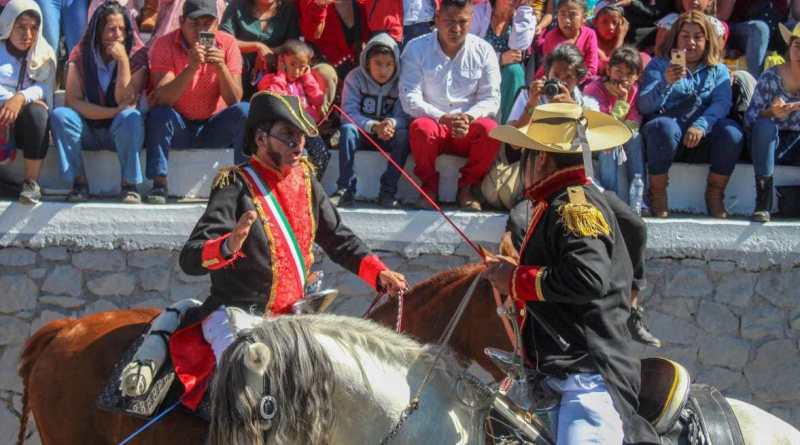
Then, of course, there is the Mexican abrazo. Every year in the small town of Acatempan, Guerrero, the locals celebrate, with great pageantry, perhaps the most significant abrazo in Mexican history. On 10 February 1821 two military leaders met in Acatempan. On one side was general Vicente Guerrero, leader of the rebels seeking independence from Spain. On the other was the royalist general Agustín de Iturbide. The two generals reached an agreement to consummate Mexico’s independence (Iturbide became Emperor Agustín I, although he did not last long as emperor) and sealed the deal with an embrace.
 
The reenactment of the abrazo de Acatempan
I must confess that as a reserved Englishman for whom a handshake was intimate, liberally embracing men took some getting used to. But upon arrival at a party, or a business meeting, embrace one must – repeatedly until all other men have been embraced. The right arm goes over the shoulder of the other man, the left under his right arm, and both pat one another’s backs. They say that the patting was originally a way of checking whether the other man was armed. I can remember social occasions when it took a good few minutes to kiss all the women and embrace all the men. Then another guest would arrive and another few minutes were spent kissing and embracing.