Tuesday, 14 May 2024

Wheelchairs on Eurostar: a small victory


The blog of 9 April told the sorry tale of our friend Cedric Álvarez and the lack of support for wheelchair users on Eurostar services at St Pancras Station. Thanks to the journalism and determination of the redoubtable Anna Tims of the Observer, Eurostar has taken steps to improve its support of wheelchair users. The old-fashioned printed newspaper still has some power to encourage change.


Anna recently received this statement from Eurostar:


“Thank you for bringing this to our attention as well as other discussions we've had over the last month or so. The experience of this customer and your outreach has prompted us to take a very close look at accessibility, which is a top priority for Eurostar. We understand the challenges faced by customers with mobility needs, and we are committed to providing a safe and inclusive travel experience for all.


I'm pleased to inform you that, effective May 8th, Eurostar has updated its processes regarding accessibility assistance at St Pancras. Customers will now be assisted in their own wheelchairs, provided their equipment passes a Health Check (visual attached of this process) This measure is aimed at ensuring the safety of our customers and staff while accommodating individual mobility needs and providing a much better experience, bringing SPI into line with other stations for a more consistent service for customers.


To support this initiative, we have already trained over 60 staff members, and this training will be conducted every 12 months, with regular refresher courses as needed. Our Customer Assistance Team Members have been briefed on these changes, and our partners at the European Business and Service Centre (EBSC) are updating their information accordingly. Pre-travel communications will also be amended to explain the elements we will be checking.


The new guidelines have been developed in partnership with our Safety and Legal teams, and we will continue to work closely with Office of Rail and Road (ORR), ensuring compliance with industry standards.


We understand the importance of transparency and would be delighted to welcome you and a some of the customers to visit us and observe the training sessions firsthand. This would provide an opportunity for you to see the measures we are implementing to prioritise the well-being and needs of our accessibility customers.


Please feel free to reach out with any further questions or concerns. 


We value your feedback and are committed to continuously improving our services.”


Cedric and his mother Chantal will visit London at the end of June with tickets provided by Eurostar by way of apologies and we will celebrate our small triumph with a lunch and an afternoon at the theatre. And other wheelchair users will receive improved service.


Saturday, 11 May 2024

How to make people poor


I was born in a house in Swinburne Road, on Whitton council estate, newly built on the northern edges of Ipswich, in 1952. Whitton’s new houses, on roads named after poets and literary figures (Byron, Chaucer, Defoe, Shakespeare, Spenser and so on), were intended for the families of men recently returned from service in the war. My father, Douglas (Doug) Jacobs, had been absent for much of the war in France until the great retreat of Dunkirk, Palestine, and France and Belgium after D-Day. When my eldest brother was born in 1945 Doug was overseas. My sister was born in 1946. Doug was happy to be a council tenant, but his wife, Alice was determined that our family would own its home, and had saved his army pay to accumulate a deposit. She achieved her ambition five years after my birth. My family. Was not well-to-do, but my mother’s careful management of the family’s income kept us well-fed and clothed (Doug was good with numbers but not with money). But if my mother had not been so thrifty my parents could have lived securely in Swinburne Road until their deaths. My first school, a modest walk from the newly-built home in Ely Road that Alice and Doug purchased, was set in another large area of council housing, so many of my schoolfriends lived in council houses. These families, no doubt, were not especially prosperous kike the Jacobs family, but they lived in secure housing at affordable rents.


In 2024 Britain things have changed. The prosperous can still live in decent homes, mostly privately owned, but for the poorer members of our society employment, incomes and housing are precarious, the long-term publicly-provided home is a vanished relic of a very different past. Destitution, child poverty and homelessness are increasingly common and accepted as regrettable facts of economic life. The minister responsible for housing, an unctuous, pervasive character called Michael Gove, has stated that he feels regret when he sees the (steadily increasing) statistics of homeless children, but his only answer is to boast of the number of ‘affordable’ homes for purchase to enable families to ‘get on the housing ladder’. This evades the most pressing housing problem for the homeless and poor: the complete and deliberate lack of publicly-provided homes at rents that people can afford.


Things began to change in 1980 when the government of Margaret Thatcher introduced the “right to buy” policy which has systematically destroyed the provision of rented public housing. Tenants could buy their homes at a discount of 33%-70%. Councils, which were obliged to sell, also provided loans to finance the sale. The council received only half the discounted purchase price, and rather than use the proceeds to build replacement public rented housing, were obliged to use the revenues to reduce debt. Moreover, tenants’ legal right to buy their homes at subsidized prices, was an insuperable disincentive for local governments to build public housing since the Thatcher reforms made this a loss-making investment.


The provision of public rented housing reduced rapidly and many right to buy homes, after a qualifying period, were sold, frequently to private landlords. The minister responsible for this policy, Michael Heseltine, stated that "no single piece of legislation has enabled the transfer of so much capital wealth from the state to the people." The long-term result of the policy has been to create a large (almost 20% of the population) of private landlords, who charge the market rent, not the affordable rent charged by councils. And the quantity of publicly-owned housing has been radically reduced. In effect the transfer of wealth that Mr Heseltine considered to be a roaring success was not to ‘the people’ but to the property-owning class.


The contribution of this policy to the manufacture of poverty can be outlined as follows:

·      An increasing proportion of people who cannot afford to buy a home in a society whose economy is founded on an ever-increasing value of housing as a ratio to income.

·      Landlords who control the rental market can, and have, driven up the real cost of renting as a proportion of income. Moreover, rentals are extremely short-term and insecure and tenants’ rights effectively minimal because such rights as they have are very difficult to enforce in a market in which the landlords have enormous power.

·      The state, which Mr Heseltine rejoiced has transferred capital to “the people” has, in fact transferred it to private investors. Moreover, the state continues to do so because the many people who cannot afford private rents receive (if they are lucky) rental support from the government. In short, the government subsidizes the inflation of rents. As rents inflate, a greater proportion of the population is unable to afford them, so they become insecure tenants, seeking less expensive places to live when the landlord increases the rent. Or landlords evict tenants who cannot pay inflated rents in order to charge more.

·      However, the government has not increased the rental subsidy to accord with the levels of rent charged, so rent consumes more and more of the income of even the poorest.

·      Those who cannot afford the rents, or who simply cannot find a landlord who will rent to them (for example, because they receive government housing benefit) become homeless. The very councils, which have been obliged to sell and reduce their public housing stock, are then obliged to provide housing for homeless individuals and families. So they pay inflated rents to private landlords or the owners of hotels and bed and breakfasts. This housing is often of poor quality and in many cases simply not decent or safe.

·      This emergency rented accommodation is frequently insecure, and may be long distances from family, friends, school and work, sometimes in another city.

Thus, the Conservative Party has engineered the largest transfer of wealth from the state to the people, and then to a class of private landlords, and in the process has systematically immiserated a substantial proportion of the population.


Another of Mrs Thatcher’s contribution to creating poverty was the political and fiscal consequences of the Community Charge, commonly known as the poll tax, implemented in Scotland in 1989 and in England and Wales in 1990. It replaced a tax commonly known as “the rates,” a property tax, which was based on the notional rental value of a property. This tax had become unpopular but nevertheless to some extent was proportionate to the asset value of the property. The new tax was a flat per capita tax to pay for local government: the rich and the poor paid the same tax. The poor were taxed more and the rich less (as a gleeful member of the House of Lords told me at the time). The political opposition to the tax effectively ended Mrs Thatcher’s career in 1990, and the tax was replaced in 1993 by a curiously hybrid tax, the Council Tax. The tax is personal to an extent, since the residents of a home occupied by two or more adults pays the full tax, while a property occupied by one person pays a reduced rate. However, the rate at which the tax is charged is based on the property’s 1991 value classified into bands A-H, H representing a value of £320,000. Since the valuations have not been updated, and since high value homes are now worth vastly more than £320,000, the tax on the wealthy is very low, while residents of low value properties pay much more as a proportion of the value of their home, and generally of their income.


Housing and taxes are not the only tools used by the Conservative Party to manufacture poverty. When the party returned to power in 2010, it adopted rhetoric and policies hostile to recipients of state benefits, in order to label its opponents as supporters of the feckless, lazy poor. The rhetoric was of “skivers” staying in bed while their employed “striver” neighbours went to work. New doctrines of fairness were created. It’s not fair for recipients of benefits to receive child support in proportion to their number of children, so support is provided only for the first two: the result has been increasing child poverty. A tenant who rents public housing may only have the number of rooms dictated by law – it’s not fair for the poor to have ‘too many’ rooms. Thus, a couple whose children have left home, and as a result has one or more bedrooms deemed to be no longer required, must pay extra rent or leave. Moreover, in order to fund tax cuts benefits have not increased at the same rate as inflation because the government’s policy is to force the supposedly workshy into work. Anti-trade union laws, employment laws that hav promoted highly insecure jobs and other government policies have further contributed to increased inequality and poverty.


The result is a society in which the number of people dependent on food banks has steadily increased. Moreover, many families can no longer simply not afford food, they cannot afford the energy required to cook a meal, to buy beds or bedding, new clothes, and other essentials of life. Poor families increasingly live in cold, damp, mouldy, rat and cockroach infested insecure and temporary homes. And, of course, Mr Gove regrets that there are many homeless children. I am sure that many social and economic problems worried the residents of the Whitton Estate in the 1950s, but at least families like mine had access to a decent and secure rented home.


As I was writing this, I received an email from a Latin American listserve that I belong to entitled “Poverty increases in Peru due to corruption and bad governance.” It seems that Peruvian government statistics record that 29% of Peruvians live in poverty (according to the Joseph Rowntree Foundation the figure for the UK is 22%, although I suspect that Peruvian poverty is more severe than that of the UK). The author of the email (Enver Machel Figueroa Bazán, an economist at Syracuse University) writes: “The symbiotic association between the most discredited political groups linked to drug trafficking and illegal mining and the most incompetent and corrupted operators within the public administration has produced some of the wrongest [sic] and most damaging public policies, aimed only to keep big groups of people in a situation of vulnerability, with the intention of capturing their votes for the coming general election of 2026 by giving them direct cash transfers.”

Moe than one million Peruvians (Peru’s population is 34 million) live without access to potable water, sewage, employment, education, health care and banking services. Perhaps the groups that achieved control of the Peruvian Congress in 2021, who Figueroa Bazán blames for increased poverty in Peru learned a few lessons from Mrs Thatcher and her fellow Conservatives.

Tuesday, 9 April 2024

Más allá de le Esperanza – Eurostar and wheelchair users


A few years ago, I was asked to read the script for a new play, entitled Más allá de la esperanza. The literal translation of the title is Beyond Hope, which in English implies that there is no hope, a connotation that is not shared by the Spanish title, which can imply that something positive lies beyond mere hope. The play’s principal character is a disabled young man who, despite suffering from discrimination, is determined to show what he can achieve, and to prove that his life is capable of more than empty hopes. The writer was a young Mexican actor and playwright, and the play was part of his graduation requirements.


A poster for a production of Más allá de la esperanza in Guadalajara

As I read the script, I was reminded of a young man Jan and I met when we walked to the bakery near our apartment in Zamora in 2018. We would often meet him sitting in his wheelchair on the pavement outside his family home, sometimes eating one of the sweet rolls made in great quantities at the bakery. I suspect that, if we were to return to Zamora, we might find him still sitting there, for Mexican society offers very little beyond empty hope to wheelchair users unless they are born into wealthy families. They can’t use public transport with ease because buses are not accessible. Jobs are hard to find because most workplaces are not adapted for them. Even if they are able to propel their wheelchair, or if it is motorized, they can’t go independently for a stroll because the pavements are too steep and irregular, and in some case simply absent.


A poster for an adaptation of Alice in Wonderland, written and performed jointly by Cedric and a friend

Our friend Cedric, who wrote Más allá de la Esperanza, was the first disabled student to be admitted to the theatre department of the Universidad Autónoma de Guadalajara (UAG). The department is in a rather splendid colonial building, and is therefore thoroughly inaccessible to wheelchair users. Worse still, the faculty were even more forbidding when they realized that their new student uses a wheelchair, and can walk a short distance only with some difficulty. They did all they could to persuade Cedric to abandon his ambition to make a life in theatre – his final performance was given a bad grade because his teachers considered it too upsetting to see a disabled person walk on stage.


Cedric in one of his more flamboyant roles

But the scepticism and hostility of his teachers never diminished Cedric’s determination and self-belief. He is now studying for a postgraduate theatre degree in Paris. A few weeks ago we met him London: he had travelled on Eurostar to see two plays, Stranger Things: The First Shadow and Little Big Things. The latter is the work of a disabled writer, is performed by disabled actors and was produced in the only theatre in London that is fully accessible in front of house and behind the scenes. This was the first time that Cedric had travelled independently – relying on the ‘accessibility’ service provided by Eurostar to get him from a Paris taxi to the train, and at St Pancras in London to take him from the train to a taxi and on to his hotel.


As we settled into an ample Iraqi breakfast at the Samad Al Iraqi on Kensington High Street (before visiting the Leighton House museum, around the corner on Holland Park Road, and fully accessible since its refurbishment), an excited Cedric told us that Little Big Things had changed his life. For he had seen what is possible for disabled actors – including a performer in a wheelchair flying across the stage. This play proved to him that a professional career could indeed lie beyond the realms of mere hope.


Then he told us a curious story. He had booked ‘assistance’ on Eurostar. In Paris he had been pushed in his wheelchair to the train together with his suitcase and helped onto the train. When he arrived in London, staff helped him off the train and he sat in his wheelchair, expecting to be pushed to a taxi which would take him to his hotel. However, the Eurostar London staff explained to him that, because of a new policy, they were not allowed to push his wheelchair. Cedric would have to propel it himself, but he explained that he could not do that. After some discussion, the Eurostar ‘assistance’ people asked if Cedric would mind their taking photos of him for their boss and then they pushed him to his taxi.


We decided that it would be wise for us to accompany Cedric to the ‘Assistance’ check in at St Pancras in case of any difficulties on his return. After he had handed over his ticket, the man at the ‘Assistance’ desk asked if I was Cedric’s companion. I told him that Cedric was travelling alone. He then explained that Eurostar staff could no longer push the wheelchair. We showed him the confirmation of ‘assistance’ that Cedric had received, and explained that his wheelchair had been pushed in Paris. The ‘assistance’ man replied that in Paris agency staff who were trained to deal with wheelchairs were used, but not in London. However, after making a phone call, he announced that if Cedric would catch an earlier train he could be pushed in his wheelchair.


Jan and I were incensed by Eurostar’s treatment of a passenger who needed support. Had the London staff not relented, Cedric would in effect have been stranded in London because the same company had different policies at different stations, but neglected to inform its passengers – indeed Eurostar had promised him in writing a service that it had no intention of providing. Moreover, having been inspired by Little Big Things, Eurostar put Cedric firmly in his place as a disabled person who could not travel independently: the message was that Más allá de la esperanza there is, after all, nothing. So, I wrote to the consumer problems column of the Observer.


I received a reply the next day from the redoubtable Anna Tims, who investigates problems and writes the column. Eurostar wrote to Cedric to say that “the team in Paris is not directly employed by Eurostar and an external company is used to offer assistance for our customers. This company is licensed to assist customers with reduced mobility and the staff are trained on [sic] how to manage wheelchairs safely without risk of injury towards [sic] the passengers or the members of staff. Unfortunately, this is not the case in London, and as such staff are not able to offer customers to push their wheelchairs.” In other words, Eurostar London intentionally offers its passengers who require assistance an inferior level of service than it offers in Paris. In practice, this renders the assistance service in Paris useless, since, when the passenger arrives in London, no help at all is provided. (Anna's article is at: https://www.theguardian.com/money/2024/apr/08/left-stranded-and-humiliated-by-eurostars-new-wheelchair-policy?CMP=share_btn_url)

Anna pointed out to Eurostar the difference in service offered in London and Paris, but the company declined to comment. She also pointed out that Cedric’s experience seems to be a breach of contract since the information he was given about Eurostar’s ‘assistance’ makes no mention of the restrictions in London. Furthermore, the company drew her attention to its accessibility policy, which similarly makes no mention of the restrictions. She reported Eurostar to the Office of Rail and Road, “which requires licensed operating companies to publish and abide by equitable access travel policies”, and to London TravelWatch, which campaigns for the rights of passengers. I hope that Ana’s efforts will persuade Eurostar to change its policy, but meanwhile the company has offered Cedric and a companion free return tickets to London. So we will see him again at the end of June, together with his mother. Nevertheless, he will no longer be able to travel independently on Eurostar.


Cedric rarely brings up the subject of disability in our conversations, but we had discussed the topic over breakfast before he told us of his experience at St Pancras. I asked him for his opinion of a recent controversy concerning a production of Richard III at the Globe in London. The decision to assign the part to an able-bodied woman was criticized by some on the grounds that only a disabled actor can express authentically the experience of being disabled. Others disagreed, arguing that the very definition of acting implies conveying characters and experiences that are not those of the actor. Some noted the casting of a woman in a traditionally male role, an increasingly common practice in contemporary theatre, as evidence that actors portray that which they are not. Cedric’s view was far more practical: theatre offers very few specifically disabled roles, so if a disabled role is given to an able-bodied actor, the employment prospects of disabled actors (already very limited) are still further reduced.


Our friendship with Cedric has taught me that it is very difficult to truly understand the life experiences of a disabled person, although it is not difficult to understand the need for ramps, kneeling buses, accessible toilets, braille signs in lifts, hearing loops and so on. On the other hand, the management of Eurostar either lack the imagination and wit to provide to a truly accessible service, or they simply don’t care.

Cedric with fellow students in Paris March 2024: the group has been organizing a series of conferences


Monday, 25 March 2024

Cambridge Ancient, Old and New


In September 1970 my aunt Dorothy drove my mother and me to Cambridge, where I was to begin my studies for a degree in Modern and Medieval Languages (MML) at Downing College. A vestige of the Medieval monastic origins of the university was a requirement that all applicants should have an ‘O’ Level in Latin, no matter the subject they would study. [CORRECTION: Judy Allfrey tells me that Cambridge and Oxford abandoned the Latin requirement in 1960. Perhaps my memory is faulty, or perhpas the MML faculty required it.] This was, in fact, useful for me (studying Spanish and French), but less so for my school friend Jon Crosby whose subject was materials sciences. One curiosity of the MML tripos was the requirement that the ability of students to actually speak the two languages that they were about to study should be tested one week before the course began, and never again examined. Thus, I found myself in a Downing College where the only students were other MML initiates, and made my first new friends, including my future best man, Robert Wilson.


In the 1970s access to university education in the UK was severely rationed, as a matter of policy, to a very small proportion of those who left school education. Access to the universities of Cambridge and Oxford was possible for a still smaller, carefully selected,  proportion of the population. For women the rationing was still more severe: only three of the colleges were for women, the rest, like Downing, were all male. Funding, however, in my case at least was generous. My local authority (in Ipswich) paid my tuition fees directly to the university and its colleges, and, because my parents’ income was very modest, I was given a very adequate term-time grant, and my parents were given a grant to maintain me during the vacations (my mother shred this grant with me). The tuition of student friends from wealthier families was paid in full, but their maintenance grant was reduced to reflect their parent’s income. If their parents did not top up their grant, they were less financially secure than I was. My final exam results gave me a legal right to three years of graduate research funded by the Department of Education in London, including travel and additional funding for the time I spent in Mexico.


The gender divide between colleges, in addition to being unjust as far as female applicants were concerned, was already socially outmoded. And on occasion it had absurd and sometimes hilarious consequences. For example, guests (meaning principally female guests) were required to leave the college by 11pm when the porters would lock the gates. I imagine that few students regretted a female guest being obliged to stay the night because the gates were locked. And Downing students who did not return to their rooms by 11pm had a convenient alternative to the locked gates. At one end of the college’s grounds was the Downing Street science site, separated by a fence of iron railings, one of which was always missing (and when it was replaced another was removed) so that students could get back to college through the gap in the railings.


Rather more ridiculous was the dining tradition attached to the lectures of the Maitland Historical Society, founded in 1920.  The lecture had always been given by a male speaker, but, while I was at Downing, for the first time a woman was invited to lecture, and as was traditional on a Wednesday. This caused a serious problem since the college statutes (which could be amended only with the agreement of the monarch) stipulated that women could dine on the college Fellows’ High Table only on a Saturday (and only at the invitation of a Fellow who was not the husband of the female guest in question). So, the question arose: what to do about dining the female lecturer? The distinguished Fellows met to consider the problem and debated three options: 1. Not to give the lady dinner; 2. To declare the lady to be a gentleman; 3. To declare the Wednesday to be a Saturday. The combined superior intellects of the Fellowship decided, after much discussion, to declare Wednesday to be a Saturday. This was also a college which called its students “gentlemen”, but termed its staff, who included “bedders” who cleaned the rooms and made the beds of the gentlemen, those who cooked or served their meals and so on, “college servants.”


A few days ago I returned to Cambridge to attend the memorial service for Dr Geoffrey Walker who taught me English to Spanish Translation, the Conquest of Mexico, and Latin American History from 1970-1973. Geoff and his wife Ana had been friends ever since. Geoff began his academic career with a PhD (completed in 1963 and published in 1979 as Spanish Politics and Imperial Trade, 1700-1789, by Macmillan, for whom I was working at the time) about the trade between Spain and the Americas in the 18th century. Geoff met a charming young Catalan woman, Ana. They fell in love and were married at the monastery of Montserrat in Cataluña. While studying in Madrid in 1958-1959 it seems that Geoff met Juan Carlos, the King of Spain, as I learned at the memorial, in a nightclub. Geoff became a founding Fellow of a new (all male) college, Fitzwilliam College, in 1966.


He switched the focus of his academic studies to Catalan language, literature and culture, and became an important figure in the development of Catalan studies in the UK. For his role in promoting Catalan culture he was awarded the Cross of Sant Jordi. He also received the Order of Isabel la Católica after organizing the visit of King Juan Carlos and Queen Sofía to Cambridge in 1988. Geoff, as a tribute at his memorial noted, was of the generation of university teachers, for whom teaching was more important than research (although his output of publications was considerable and wide-ranging) before the UK government’s Research Excellence Framework emphasized research at the expense of teaching. He also smoked his pipe during interviews with applicants to Fitzwilliam and served sherry in student meetings. This marks him out as having his feet firmly planted in a Cambridge that no longer exists, although he enthusiastically supported the admission of women to Fitzwilliam in 1978 (Downing did not get round to this until 1980). He once told me that an argument deployed by those who opposed the admission of women was that this was simply impossible because none of the college rooms had full-length mirrors. Today, the toilets in the college are labelled “all genders”, so things have certainly changed, with the notable exception of those reserved for Fellows, which are still labelled “Ladies” and Gentlemen”.  I don’t know what arguments were made in Downing’s case, but I recall being told by the college Chaplain, with a note of surprise in his voice, at a dinner in the 1980s that the women even manged some of the college societies.


The morning after the memorial, I rode the U1 bus through a district of Cambridge that was entirely new to me. For the university is no longer the rather stuffy pipe-smoking, sherry-serving, mostly men-only Cambridge of my days. Cambridge is now a centre for scientific and technological research that has attracted international investors. The Cambridge of 99,000 people in 1970 has become a city of 146,000, and of global significance, in 2021. Housing and infrastructure have not matched this population growth, which has become a problem for the university, especially the cost (and scarcity) of housing. One response to the population pressures is the new suburb of Eddington, built by the university, to provide houses for the wealthy and apartments (for a three-year period) for students and university staff, complete with a Hyatt hotel, and fashionable cafés and restaurants. And between Eddington and the old city centre, are large new buildings that resemble corporate headquarters, but that house the science and technology departments of the university, all moved out from the buildings in the centre that they occupied when I was a student. The investments must be staggeringly large.


Chatting to the bursar of Fitzwilliam during the day of the memorial, I realized that much has changed in the nature and balance of power in the university. For example, humanities (such as my department of MML) are now much downgraded in importance, funding and student numbers, while money and student numbers pour above all into science and technology, and on a smaller scale career-oriented subjects such as law and economics. The funding has also changed. The college receives tuition a payment of £4,600 from the central government (the university receives the same amount. This figure that has not increased for years, since it is passed onto the students as a loan, so it is politically unpalatable to do so. The amount is insufficient, so the college tops this up by some £3,500 from its endowment. Students receive a loan for their maintenance costs, which has increased by only 2% a year (inadequate to cover costs but also added to the student loan). So, the student has become a consumer and the college a supplier. And inadequate funding means that some students suffer financial hardship and need support from the college and the university. Students are permitted to work a small number of hours during term-time to supplement meagre funding, something that was unheard of in the 1970s.


Another change is a considerable change in student dining. When I was a student, I paid a fee every term to cover the cost of lunch and dinner. Since the food was paid for, students almost always ate communally in the college hall, unless something truly awful (“chicken Stanley”, named after the college Steward drove many of us to a local Indian restaurant). Now lunch is served only in the final (exam) term of the year. Student meals are subsidized, those of the Fellows are priced at cost, and the college makes its margin from meals served to conference delegates, or students from other colleges. Fitzwilliam has enjoyed a mini-boom recently: neighbouring Churchill College has ceased to serve meat, so its carnivores eat in Fitzwilliam.


Despite its astonishing growth, Cambridge’s ancient past lives on in a number of ways. John Latham, who picked me up from the new Cambridge North rail station and drove me to the events of the day, told me that he had just become chair of the trustees of Hobson’s Conduit. I must confess that I had no idea what he was referring to until he asked me whether I remember the deep gutters that run along both sides of Trumpington Road as it reaches the city centre. The Conduit was first proposed in 1574 to solve the sanitation problems caused by the King’s Ditch. The Ditch was dug in the 13th century on the orders of Henry II to defend the southern and eastern boundaries of Cambridge, but the stagnant water due to a lack of drainage was a source of health hazards. Moreover, Cambridge needed a supply of clean water. So, between 1610 and 1614 a watercourse was constructed from springs at Nine Wells, near Great Shelford, to bring water to the city’s marketplace (via the Trumpington Road gutters), and to drain the Ditch. Thomas Hobson endowed the Hobson Conduit Trust to manage the waterway, and (so John Latham tells me) the Lords of the Manor gave the trust a 1,000-year lease. The trust has ancient legal powers that require. It to approve any developments along the Conduit that could adversely affect it. In 21st-century boomtown Cambridge this is a substantial power and an onerous duty.


Hobson, by the way is famous as the origin of the phrase ‘Hobson’s choice.’ He owned a livery stable whose horses delivered mail between London and Cambridge. The horses were also rented to students and academic staff. To ensure that no horse was overworked, Hobson instituted a rota so that each horse had a period of rest. Thus, when a customer rented a horse, he was obliged to take the next horse on the rota. The alternative was not to rent a horse at all – hence Hobson’s choice.


As I shared memories of Geoff Walker and ana with others at the memorial, I remembered Geoff telling why he decided to retire. In his translation class, he had always assigned an extract from The Mill on the Floss (as I well remember). He decided that his Cambridge had changed just too much when a student complained that the translation exercise was “weird” and told Geoff that she would complain to her Director of Studies.

Tuesday, 12 March 2024

Justice, Human Rights, International Law and Individual Liberties


I have been reading Gary J Bass’ recent book (a birthday gift from Jan), Judgement at Tokyo, a study of the Tokyo war crimes trials and how they reflected the political climate in which modern Asia was made. During the phase which dealt with Japanese war crimes in China, a defense lawyer argued that the atrocities that Japanese forces committed in Nanjing were no worse than the  rape and plunder of which Chinese troops had also been guilty. Sir William Webb, president of the eleven judges, “sharply added that the rape and murder of civilian women could never be legitimate reprisals, no matter what Chinese troops might have done elsewhere.


Nanjing, Bass notes, was “the most notorious case,” but “All across China, villages had been devastated by aerial bombings or artillery bombardment, set on fire, with civilians shot dead.” However, although the trial exposed appalling Japanese crimes, “a whole category of evidence would never be appraised: aerial bombardment. Japanese bombers had pounded cities and towns across China … Yet because such aerial bombardment was not then clearly forbidden by international law – and also because the Allies did not wish to invite discussions about their own bombing campaigns – this evidence would never feature in the Tokyo trial’s judgement.” [my emphasis]


In other words, one crime does not justify another, and what is considered a crime and what is weighed in judgement is not a simple act of impartial justice, but also a highly political judgement.


This set me thinking about Israel and Gaza, especially in the context of the weekly enormous demonstrations in London and the use which politicians have made of the protests for their own ends. Unsurprisingly, many Israelis are consumed with the appalling crimes of Hamas on 7 October 2023 and the pursuit of those responsible. However, one wonders what Sir William would have said about the ferocity of Israel’s assault on Gaza, the withholding as a matter of government policy of food, water and electricity from the civilians of Gaza, reports of the targeting of civilians by ground forces, allegations of inhumane treatment of detainees, increasing numbers of deaths in the West Bank (not only in Gaza), murders and harassment of Palestinians by “settlers” (surely a euphemism for violent thugs at best).


The demonstrations, especially in London, against the devastation and deaths in Gaza have been eagerly seized upon by the Conservative Party to accentuate an attack on dissent and rights to protest, initiated in recent legislation which has already infringed rights of free speech and protest.


Once case would be laughable, if it were not indicative of the casual persecution of individuals which Conservative politicians seem to think is justified in the fight against “extremism”. This case involved a young student who participated in an episode of University Challenge (for my non-British friends, this is a long-running TV quiz show). A team of four students (two male, two female, one of whom covered her hair) chose as their mascot a toy octopus. The student who covered her hair, also wore a jacket, the colours of which some considered to be “similar” to the colours of the Palestinian flag. This female student sat slightly to one side of the octopus, while a male student with curly red hair sat at the same distance on the other side. Lady Jacqueline Foster, a Conservative member of the House of Lords, wrote on X a demand that the female student be expelled and arrested [my emphasis]. Her reasoning was that the octopus was an antisemitic symbol (apparently, the tentacles of an octopus are used as a metaphor of the way that antisemites consider that Jews control the media, business etc.) As far as I can tell from the press coverage, the only reason that Lady Foster concluded that the female student was responsible was that she was sitting close to the soft toy and that her appearance suggested that she is a Muslim. However, the red-haired young man who sat equally close to the octopus was not suspected of antisemitism, and the other two members of the team were not under suspicion because they were seated further away from the toy. Lady Foster’s facile and deeply prejudiced judgement (if she can be credited with possessing that quality) is characteristic of the current government and its legislators. As it turned out, the four members of the team jointly chose the octopus, and the episode was recorded before the October acctaks.


At about the same time as Lady Foster advocated immediate retribution without any evidence, the government minister responsible for science and technology wrote to Research England, a committee that advises the government’s science funding body on matters of equality, diversity and inclusion. The minister, Michelle Donelan, demanded that two scientists recently appointed to Research England be investigated on the grounds that they had “shared some extremist views on social media”. It would seem that Ms Donelan’s rush to judgement demonstrates that judgement may be a quality which she lacks, like Lady Foster. For, not content with writing to Research England, she posted her letter on X. Had she been content to simply send her letter and wait for the results of an investigation, which would have exonerated the two scientists, no more would have been heard of the matter. However, she posted the letter on X, was threatened with legal action and the government has been obliged to pay damages to one of the scientists.


It is worth bearing in mind these two incidents, at once nasty and fatuous, when we consider the Prime Mister’s recent speech (unusual because he spoke outside 10 Downing Street) which claimed that “extremist groups are trying to tear us apart.” Lady Foster and Ms Donelan would seem to be doing their bit to “tear us apart”. They are ably assisted by the former Home Secretary Suella Braverman who has decided that demonstrations calling for the ending of the slaughter of civilians in Gaza are “hate marches” and has derided those who eat tofu or read The Guardian (as Jan and I do: read The Guardian, not eat tofu). A former deputy chairman of the Conservative Party has likewise done his bit by telling us that Islamists have taken control of the Mayor of London. The Mayor’s last name happens to be Khan, which surely labels him as an unreliable type just like the student wearing a headscarf while being in proximity to an octopus.


The government’s Prevent Programme is intended to “prevent vulnerable people from being drawn into terrorism”. Citizens generally, but in particular, public officials and others such as school or university teachers, are encouraged to report those whom they judge to exhibit behaviours that might indicate that they may be drawn into terrorism. The consequences of being referred may seem fairly innocuous, such as being referred to a mentor to receive support, but individuals may also be subject to police or anti-terrorism investigation, and possibly prosecution. You might assume, therefore, that careful judgement would be made before referring someone to Prevent. However, a school in London recently held a Children in Need Day and invited children to come to school dressed as a child in need. The parents of children who came dressed in the colours of the Palestinian flag were sent letters telling them that if they persisted in expressing political opinions, they would be reported to the Prevent Programme. Three years ago an 11 year old boy was referred to Prevent by his teacher because he had advocated giving “alms to the oppressed” (the teacher interpreted alms as arms).


Meanwhile the Communities Secretary, Michael Gove, is preparing to implement a new definition of extremism: apparently, this might include socialism, communism, advocating animal rights, anti-abortion and anti-fascist opinions, Islamism, extreme right-wing views. Given recent government rhetoric, I suspect that advocates of decisive action to mitigate climate change will be included. The government would, it seems, refuse to deal with anyone who holds such views, and presumably individuals who hold such views may be “referred” to Prevent. I asked a friend in the USA who was a judge what a US judge would say about the expression of such opinions. He replied: “All of those expressions are protected speech the government cannot prohibit or punish.” The US has its own problems with free speech, mostly from politically inspired measures to prohibit “woke” ideas and suppression of people who don’t conform to gender stereotypes, but our government is going much further.


In a world that has become much more dangerous and in which rule by violence, intolerance and corruption seems ever more prevalent, it is unpardonable that our government has decided to use divisions and hatred as desperate tools to restore its fortunes – fortunes undermined by the government’s own stupid and unprincipled behaviour.


Which brings me back to the Tokyo trials and Gaza. After hearing evidence of Japanese crimes in China, the Tokyo tribunal turned its attention to Pearl Harbor. There followed the examination of evidence of atrocities in Singapore, Hong Kong, Burma, Vietnam, the Philippines and the Netherlands East Indies (Indonesia). These charges were brought by prosecutors not from the (future) independent nations) but by prosecutors from the countries’ colonial occupiers. The author highlights the irony of prosecutions brought by colonial powers which claimed that their sovereignty had been violated: sovereignty acquired through the violent conquest of the previously independent nations and the killing and exploitation of their peoples. The irony was particularly acute in Vietnam where the French forces whose human rights were violated by the Japanese were Vichy French, allied to the Nazis and the Italian fascists.


Right and wrong, justice and vengeance, then are not simple black and white givens, especially in our 21st century.

Sunday, 25 February 2024

Teltow’s Turnips and the History of Berlin


At the end of January, Jan, David and I accompanied John to Berlin, where on his birthday on 2 February, he was to undergo the defense of his PhD dissertation at the Free University of Berlin. More of that later.


While John prepared in his hotel room, Jan, David and I did a little sightseeing. Because the university is in Dahlem, part of the old American zone, we stayed at our usual hotel in the suburb of Lichterfelde Ost, which was convenient for transport links and restaurants and shops. Transport was rather more tricky than usual because of strikes and the closure of a large part of the S Bahn line through the centre of Berlin, so David suggested a short ride south to the station at Lichterfelde Sud and a walk to Teltow at the end of the S Bahn line. As we crossed the boundary of Lichterfelde, the southern extent of Berlin, we entered Teltow in the municipal district of Potsdam.


Teltow's avenue of cherry trees

Four decades earlier, we could not have strolled into Teltow, for this was the dividing line between the GDR and West Berlin. Today the line of the wall is marked by an avenue of cherry trees planted in 1990 by the Japanese broadcaster TV-Asahi. We followed the long rows of trees to the Teltowkanal and a pleasant canal-side path through the woods that line the waterway – 40 years ago the area was stripped of vegetation and lined by fencing and watchtowers, since the other side of the canal was Lichterfelde and West Berlin.


After walking for a while, we came across two commemorative markers with information about some of those who died trying to cross the canal to the western side. One rather sad case was that of Roland Hoff, who had fled to the East to escape a drunk-driving charge, and then found himself confined there by the newly erected barriers. He protested about the closure of the border and was dismissed from his work for ‘absenteeism’ and charged with ‘inciting slander against the state.’ Roland decided not to attend court for his hearing, but rather packed his belongings (they must have been very few) and sent them by mail to his mother in Hanover. Then he mingled unobserved with workers carrying out maintenance on the canal. He jumped into the water and began swimming to the West Berlin side, but four border guards shot him. His mother was not told of his death. To guard against attempts like Roland’s to escape across the canal, the East German authorities took some care to ensure only trusty types were allowed to live in Teltow. They slipped up in Roland’s case.


Breite Strasse, Teltow

Teltow was was first mentioned in a deed dated 1265, but it must have been founded earlier because its church of St Andrew dates to the 12th century (although the present church was built in 1812). Lyonel Feininger depicted the church in Teltow II, painted in 1918. Almost all the other buildings in central Teltow were demolished in the 1960s and the town ‘redeveloped’. Still, there’s a reasonably pleasant central, mostly traffic-free, area which conveys some flavour (I imagine) of the old Teltow, much better than do the 1960s apartment blocks and shopping area beyond where the traffic roars constantly by. Nevertheless, the town hall has a tourist office. I think we were probably the only tourists to visit it that day, probably all week.  There we discovered that the culinary delicacy of Teltow and its region is a prized variety of turnip. Perhaps poor Roland Hoff was able to enjoy some before border guards brought his life to a premature end.


The church of St Andrew, Teltow

Our other visit during this trip was to the Berlinische Galerie Museum für Moderne Kunst, a modern art gallery in a converted industrial building. The permanent collection surveys the art scene in Berlin from the late 19th-century on. The art simultaneously tells the story of the rise of Berlin from sleepy provincial town to national capital.


Max Liebermann's villa at Wansee

The first works in the gallery are showy, traditional pieces designed to please a regional potentate. One of the first pieces to signal a new era of experimentation is a self-portrait by Max Liebermann (1847-1935). At the turn of the century Liebermann was the leading figure in the Berlin Secession, inspired by avant garde experimentation elsewhere in Europe, especially the French Impressionists. One of Jan’s favourite visits during our trips to Berlin has been the Liebermann Villa, on the shores of Lake Wansee to the south of the city. Liebermann and Alfed Lichtwark, director of the Hamburger Kunsthalle, designed the villa’s garden, which Liebermann lovingly portrayed in many paintings. The villa, much changed after it was seized by the Nazis, has been restored to something close to its condition in Liebermann’s days, as has the garden.


Liebermann's self-portrait

As one browses the collection, one is reminded that the current borders of Europe, which politicians encourage us to consider inalienable and immutable, and to be used to keep others firmly out, are really no such thing. Theo von Brockhusen (1882-1919), a fellow member of the Berlin Secession, was, we are told, born in German Marggrabowa, now Olecko in Poland. Von Brockhusen’s Beach with Bathing Machines, 1909, clearly documents the influence of French Impressionism, and particularly, I think, of Van Gogh.


Von Brockhusen, Beach with Bathing Machines

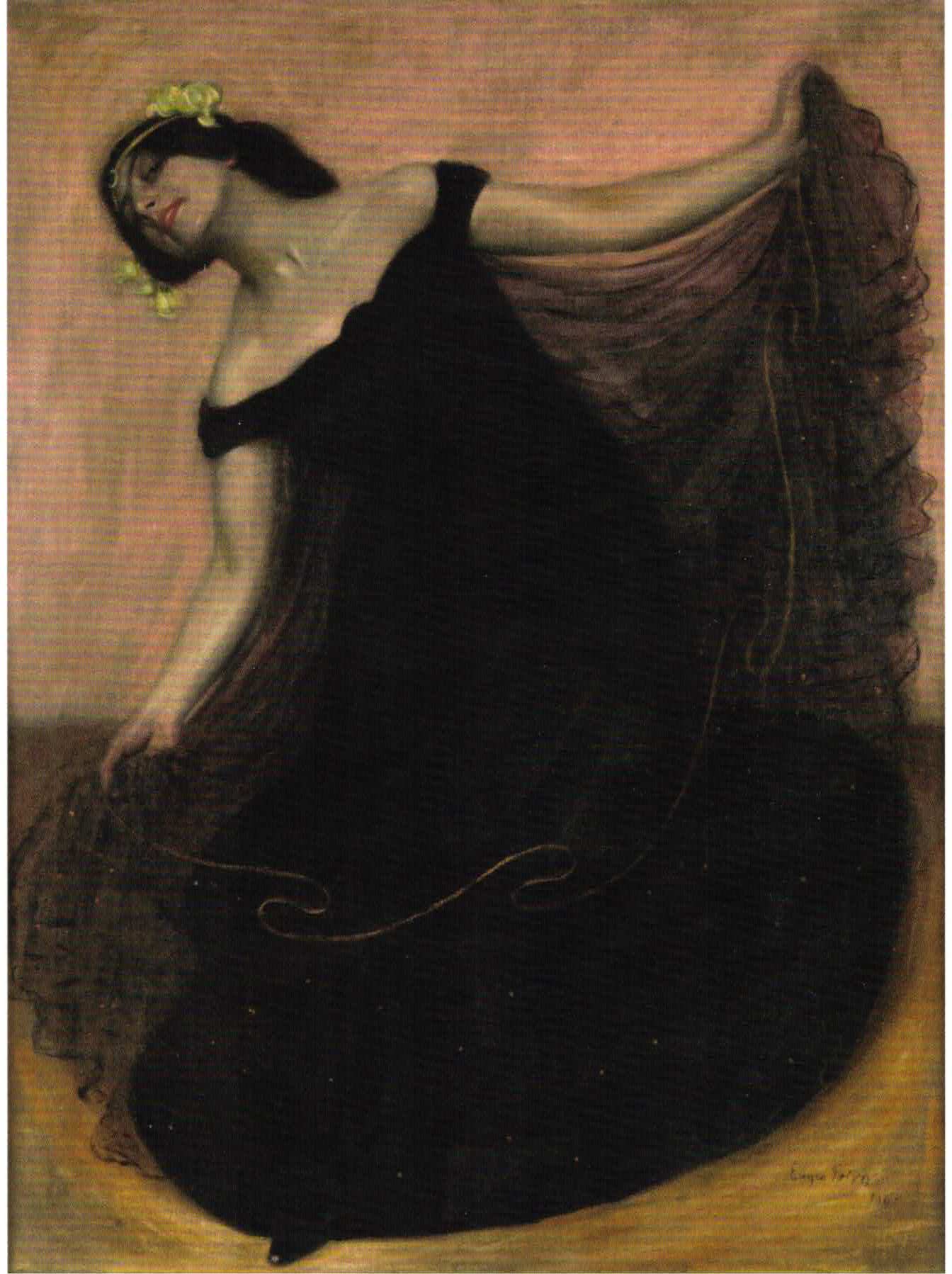
Eugen Spiro (1874-1972) reflected another new European style, Art Nouveau, in his work. The model in his portrait The Dancer Baladine Klossowska (Merline), 1901 is Spiro’s sister, herself a painter of the Berlin avant garde, who married the painter and art historian Erich Klosskowski. Spiro’s life again reminds us of the vagaries and tragedies of European history. He was born in Breslau, in Silesia, now Polish Wrocław, a town which has ‘belonged’ to Poland, Bohemia, Hungary, Austria, Prussia and Germany at various times. Like many a Jewish artist of the first half of the 20th century, Spiro ended his life in New York.


Spiro's portrait of his sister Baladine

Hannah Höch (1889-1978) was a Dadaist, whose work was much concerned with gender identity, and who liked to poke fun at conservative Weimar society. Roma, 1925, shows us a playful, yet acerbic, personality who enjoyed provoking those she disagreed with. Her art was a natural target for censorship under Nazi rule as Entartete Kunst (‘degenerate art’). Although other members of the Berlin Dada group left Germany, Höch stayed, living quietly in a remote Berlin suburb where she continued working until her death.


Hannah Höch, Roma

Otto Dix  (1891-1969) was another member of the Berlin Secession, famous particularly for his fiercely anti-war images based on his experiences in the German army (he volunteered for service and was awarded the Iron Cross second class). Like Hoch’s Dada works, Dix’s depictions of war were exhibited by the Nazis in Munich in 1937 as Entartete Kunst. Dix, however, was also a portraitist and The Poet Iwar von Lücken, 1926, is one of several portraits of this avant garde poet who lived in severely straitened circumstances. Dix depicts him as a lanky, undernourished man living in a garret that would have served well as a stage design for La Bohème. Oskar Kokoschka also painted several portraits of von Lücken (1874-1935), but the audience for his work was tiny and, apparently he published only one edition of poems (in 1928), of which only two copies remain.


Dix's portrait of Iwar von Lücken

Georg Schrimpf (1889-1938) was a self-taught artist and, like Dix, a member of the Neue Sachlichkeit (New Objectivity) movement. His Two Girls at a Window, 1928, is a charming image sandwiched between the horrors of two world wars. Schrimpf, who was born in Munich, became a professor at the Royal School of Art in Berlin but was fired in 1937 for having been a member of a socialist organization, and public exhibitions of his work were prohibited.

Schrimpf, Two Girls at a Window


One of the ironies of the avant garde, of course, is that sooner or later it becomes a rear guard, as Felix Nussbaum’s The Folly Square, 1931, suggests. Nussbaum (1904–1944), a surrealist, depicts a group of art students rebelling against the strictures of their elders and betters who, once innovators now uphold out-of-date traditions. Max Liebermann himself is shown on the roof of his house near the Brandenburg Gate painting a self-portrait held by Victoria, goddess of victory (from the victory column to the right). Felix and his wife, as well as his parents and several other family members were murdered at Auschwitz.


Nussbaum The Folly Square

Berlin’s history is, of course, ever present wherever you go in the city. As a visual overview the Berlinische Galerie is a s good an overview as you can get, and unlike most of the landmarks and tourist sites, it is a testament to human creativity, dissent, a refusal to conform and the questioning of what others tell us is the norm and good for us. The visitor also notices that many of the German artists on show were born in places that are no longer in Germany, and many died elsewhere, driven by Nazi dictatorship to take refuge in other countries, while others less fortunate or who for some reason did not flee died for their art or beliefs.

 A panoramic photo of Potsdamer Platz after the enf of the war converys powerfully the enormous damage the city endured, yet still people are seen going about their lives.

Potsdamer Platz (detail)


To return to John’s exam on the afternoon of Friday 2 February, he gave a 30-minute presentation of his dissertation to five professors who then grilled him (grilled is the word) for almost an hour. We were then asked to leave the room so that the professors could confer. When we were asked back in, we discovered that our son now has a PhD and were all poured a glass of sparkling wine to relieve the tension.

Sunday, 11 February 2024

Integrity in New Jersey


The former New Jersey State Senator, Paul Contillo, died aged 94 on 6 February. He was a politician of a school that believed in using public office for the public good, rather than simply to achieve power or for personal enrichment. I had the pleasure of meeting him several times and wish that more of our contemporary politicians were of Paul’s kind. This does not mean that he was averse to slugging it out with his opponents, but his politics were rooted in personal integrity and a stubborn insistence on doing what he considered to be the right thing.


Senator Paul Contillo

Shortly after we married in 1979, Jan and I moved into a two-bedroom rented apartment on Flower Avenue in Takoma Park, Maryland, a suburb of Washington, DC. Our neighbours in the apartment below ours were a young lawyer working as a clerk for a DC judge and a nurse. Bob and Chris Contillo became lifelong friends.


Bob was born and raised in Paramus, New Jersey, and after his stint clerking for Judge George Goodrich in DC he returned to work as a lawyer and later as a Judge in Bergen County. I knew from conversations with Bob that his father, Paul, had been a prominent figure in Jersey politics who stood out as (to quote an obituary written by a Republican) “an impeccably honest and stubborn Bergen County Democrat,” in a state not notable for the honesty of its politics.


My publishing travels enabled me to be a quite frequent visitor to Bob and Chris’ home in Haworth and during those visits to be introduced to many parts of northern Jersey. Occasionally, I would be welcomed into Paul’s home in Paramus or his beach home on Long Beach Island, sometimes for large and lively gatherings of the Contillo family. Paul was ever a generous and genial host, welcoming a wandering Englishman into family occasions and putting him at his ease. On one occasion he and Bob took me out in his boat on the calm waters sheltered from the Atlantic by Long Beach’s narrow strip of land so that I could try my hand at water-skiing. After multiple failures to get up on my skis, we returned home to a family dinner where Paul’s son-in-law Jimmy showed me how to open a clam by smashing the shell with his fist – Jimmy was a large powerful character. I failed at clam smashing also.


Paul was an accomplished water-skier

Unfortunately, I never had time to talk to Paul about New Jersey politics. As is often the case, I now know more about him from his obituaries than I learned from our meetings. It is clear from the tributes paid to him that Paul was, to quote a current state Senator, a titan of Bergen County politics. Paul was born in Brooklyn in 1929 into a large family of Italian American and German American heritage. At school he met his future wife Kathleen McConville – they were married for 69 years. He was an accomplished footballer (American, of course) at James Madison High School in Brooklyn. Most of the students at James Madison were Jewish and some went on to prominent national careers: Ruth Bader Ginsburg became a Supreme Court Justice, Bernie Sanders and Chuck Schumer US Senators. Paul would prove that those who make their mark at more local and state levels could also make contributions to the common good. He began by founding a successful business. He and a friend established a printing company, Allied Reproductions, in New York City. They developed the firm into a substantial enterprise serving Wall Street financial businesses.


Paul and Kathleen made their home in Paramus, where his public service career began as chair of the Paramus Zoning Board (in British terms the planning committee). He was a Paramus Councilman from 1971-1973. Then he was elected to be a New Jersey General Assemblyman in 1974, serving until he was defeated in 1980. From 1984-1991 he was a State Senator. He was also Chairman of Common Cause (1986-1988), a non-party-political organization that that works to support democratic principles in the USA, and Vice Chairman of the New Jersey Parole Board (2004-2009).


New Jersey politics is a rough-tough business. Paul’s acknowledged integrity must have appealed to voters, but he could wage a tough fight when he needed to. He accused a Republican opponent, John Paolella, of using his position in the Jersey Senate to promote his law firm, of being immature and a flip-flopper, and of not being a serious politician. He described another Paramus Republican and arch-rival, John Kosco, Chairman of the Assembly Banking Committee of being a pawn of the banking industry. Politics is, in the end, a game that nearly always ends in defeat – it was his bitter rival Kosco who defeated Paul in his last campaign in 1991.


Paul’s accomplishments as a legislator were notable. He sponsored America’s first mandatory recycling law, and the Local Ethics Law, which compelled all public servants to disclose their sources of income, including local bodies such as planning and zoning boards which provide many opportunities for corruption. Another of Paul’s initiatives prohibited building on land owned by the Hackensack Water Company, a law which still protects Bergen County’s water supply from pollution. He also campaigned to allocate state funds to cleaning up hazardous waste sites. He was an advocate of Bergen County’s “blue laws” which prohibit shops, including the county’s several large shopping malls, from opening on Sundays. He argued quite simply that retail workers should have a day off with their families, an opinion which I suspect was rooted in his Catholic faith. Paul and Kathleen were, Bob told me politically liberal, but socially conservative. Not all his initiatives were successful, however. One of Paramus’ most intractable problems was the intersection of route 4 and route 17, a source of many a traffic jam. A Mexican traffic engineer somehow heard of this problem and headed to Paramus to offer a solution: an intersection design he had successfully implemented in Mexico. Alas, on examination the economics of his proposal were based on Mexican labour rates, which New Jersey unions would never accept. However, Bob tells me that the intersection problem was eventually fixed with a solution based roughly on the Mexican’s design, although his contribution is probably lost to history.


I have a great affection for America, where I lived for four years and worked for four decades. I admired a political system that allowed for vigorous debate, protected the right of free speech, and had a can-do mentality, but I find the current political scene appalling. Too many are in thrall to demagogues for whom the art of politics is fear and the demonization of others. If only there were more Paul Contillos for whom the purpose of politics was to improve life for all in their community.