Sunday, 26 June 2022

Literally speaking …


According to the press reports I have read, one of the Supreme Court judges’ justifications for abrogating Roe v. Wade is the fact that the US constitution nowhere specifically mentions abortion and therefore it cannot be a constitutionally protected right. This, I believe, is a strict constructionist interpretation of the constitution: i.e., a ruling based only on the text of the constitution, ignoring any contextual issues, precedents, any discriminatory consequences of the ruling, any effect the ruling might have on other rights and so on.


This brought to mind something I read in the manuscript of a splendid book written by Professor Carol Hillenbrand, Islam, A New Historical Introduction, which I published at Thames & Hudson. Islamic jurisprudence holds that only practices stated to be permissible in the Q’uran or in the sayings of the Prophet are allowed. One jurist was asked whether it is permissible to eat watermelon: he scoured the texts for references to watermelons and, finding none, ruled that the consumption of watermelon is not strictly prohibited (since it is not mentioned) but that it would be wise to refrain from eating it just in case. I assume that the learned jurist would have ruled similarly if asked about tomatoes, mangos and any number of other nutritious and delicious foodstuffs. I must confess that I have not checked the text of the US constitution, but I suspect that it does not protect the right of citizens to have access to watermelons, mangos, tomatoes and so on. This is, perhaps, an absurd comparison, but perhaps constructionist interpretations are equally preposterous. What happens if one looks to the constitution to protect gay and transgender people (who I expect the founding fathers failed to think about, much as they omitted the rights of African-Americans) or other out of favour people who might be deprived of their rights?

Wednesday, 22 June 2022

Boris Johnson: a choricete, Gorgeous Gus or neither?


During a brief stay in Málaga I read a report of a senior member of the Partido Popular (PP) who held a meeting with legal figures who are members of an organization called Transparencia y Justicia (sic) to discuss how to suppress a police investigation. She was accused of avoiding a police fine by driving away and running over an officer’s motorbike. During a recording of the meeting the politician referred to two other senior PP figures as choricetes. A waiter in my hotel explained to me that a choricete is a thief, or one who greedily eats all the chorizo. However, a young bookseller in one of Málaga’s three independent bookstores told me that the chorizo derivation is a popular misconception. Choricete, he said, is an Andaluz term derived from chori, the Spanish Gypsy word for thief. The PP knows a lot about choricetes. A political scandal known as the Trama Gürtel, which has been under investigation since 2007, has rumbled on for years as numerous PP politicians have been found guilty of illegal fundraising, receiving sobresueldos (salary top-ups) and other illegal financial gains.


While we were in Málaga, the former King Juan Carlos (now known as the Rey Emérito) made his first visit to Spain since his abdication. He could have been remembered as the king installed by a Fascist dictator to preserve his legacy, but who instead helped to manage Spain’s transition to democracy and faced down an attempted military coup. Sad to say, Juan Carlos is now reviled as the king of Spain’s choricetes, known to have received large bribes to influence the allocation of government contracts. He has escaped prosecution only because the monarch has immunity from prosecution.


Juan Carlos sailing with friends during his visit in May

As we marked the platinum jubilee of our own monarch here in Britain, the Queen’s undoubted commitment to her duties stood in stark contrast to the behaviour and character of her current Prime Minister. Now, I do not think that Boris Johnson is a choricete in the sense that he has received corrupt payments, but I do think he is abjectly morally degenerate. It is common knowledge that his tastes exceed his income and that he eagerly accepts gifts from wealthy donors whose identity he is reluctant to disclose: for example, expensive holidays, an extravagant refurbishment of his Downing Street flat which far exceeded the budget allocated to each Prime Minister. But that does not put him in the league of Juan Carlos.


I think it is fair to say that even his admirers consider Johnson to be a bit of a loveable rogue. He has created a persona that has made him the most talented politician in Britain, in the sense that he seems able to persuade people who would not normally consider supporting a Conservative to vote for him. Thus, he was elected twice to be mayor of London, a city that is otherwise solidly Labour Party territory. He managed this feat by presenting himself as a surprisingly liberal mayor and – well – simply “Boris”. While his party became ever more anti-foreigner and anti-immigration, Johnson lauded the benefits that immigration had brought to our capital. While the Conservatives became an ever more small state party, Johnson enthusiastically favoured expanding public transport, and had an eye for expensive voter-pleasing projects, especially if they involved alliteration of the letter B. Thus, he introduced Boris Bikes that could be rented from and returned to bike stations around the city. Boris Buses, a nostalgic modern version of the iconic London red bus, the Routemaster, replaced the very un-Boris bendy buses. However, their windows did not open and their air-conditioning was inadequate. He proposed a floating airport in the mouth of the Thames rather than expanding runway capacity at Heathrow airport (which he vowed to oppose by lying down in front of the bulldozers) and commissioned Thomas Heatherwick to design a pedestrian-only “garden bridge” over the Thames, no doubt in part because of its alliterative potential (Boris Bridge). Neither project came to pass. The new runway at Heathrow was later approved under another Conservative Prime Minister when Johnson was Foreign Secretary. When the Heathrow project was debated in the House of Commons Johnson found that he urgently needed to visit India so that he did not have to cast his vote. He no longer talks of lying down in front of bulldozers. The garden bridge was eventually abandoned after Johnson left office as mayor at a sunk cost of some £250,000. However, he evidently had some difficulty in abandoning his search for a memorial Boris Bridge: when he became Prime Minister he proposed a bridge to connect Northern Ireland to Scotland. It too has been abandoned. Although most of his gestures as mayor had a certain liberal tinge, his innate Conservative instincts occasionally showed through. He responded to riots in London in 2011, caused by the police shooting dead a black man, by purchasing two used German water cannons which have never been used because he failed to ensure that they had legal approval to be used in the UK.        


He arranged to be photographed frequently, ideally engaged in some mildly comic stunt to prove that he is a “real person” not a “traditional politician”, who can speak his mind and say what others, intimidated by “political correctness gone mad”, dare not. Thus, he could write newspaper columns that described the “watermelon smiles” of African “picanninies”, or referred to gay men as “tank-top bumboys”. He invented fake news before Donald Trump had even thought of the term. He made his name as a journalist by filing stories from Brussels about dastardly and/or absurd European regulations, a favourite hobby horse of the fervently anti-EU brigade of the Conservative Party. Ludicrous as these stories often were (e.g. an edict to standardize condom sizes to accommodate the small penises of Italian men), Johnson has never been able to stop himself deploying a convenient lie to lampoon the EU. In 2019 he denounced the EU for requiring kippers in vacuum-sealed packaging to be transported on a “plastic ice pillow” as an example of ridiculous and onerous EU regulation. The only problem with this amusing tale was that the regulation in question was actually a British government requirement.


Searching for a metaphor to explain Johnson’s uncanny political appeal, I remembered a regular story in the boys’ comic, The Victor, which arrived weekly at the Jacobs home in Ipswich in the 1960s. A regular feature of the Victor was Gorgeous Gus, the story of a British aristocrat who, in the spirit of noblesse oblige, bought a football club, a quintessentially working-class institution. Gus was not only the owner, he was also, naturally, being of superior aristocratic stock, the star player in whatever position he was required to perform. He would typically sit on the bench in a silk dressing gown attended by his butler Jenkins, waiting to be called on in the event of a player being injured, which invariably happened. After his butler had removed and carefully folded his dressing gown, Gus would enter the field to rescue his team. If the team was losing, he would score the winning goals. Everything Gus did was effortlessly achieved, without the need to run, hurry or break a sweat (perish the thought that a gentleman should sweat) unlike his working-class players. If required to keep goal, he expended minimal effort to maximum effect. Instead of leaping to save a high shot, he would turn to face his goal and wait for the ball to strike the crossbar before rebounding straight into his hands at a convenient height.


I was more than once told a story by an old Etonian member of the House of Lords, who probably thought of himself as a sort of modern-day Gus. He claimed (apocryphally I am sure) that when he was at Eton his he and classmates challenged a group of coalminers to change places with them. The Eton boys worked in the mines and the miners took classes at Eton. According to the old Etonian, the miners found the work at Eton much too much or them. In other words, privileged Eton boys were effortlessly superior to the most radical working-class group at the time. This old Etonian clearly fancied himself as a sort of super Gus.


There is a lot of Gus in Boris Johnson, but there is one difference between the two. For boys (like the four Jacobs brothers) who read the Victor, Gus embodied the character traits of the British aristocracy that we were encouraged to admire: a man of superior intelligence and ability, graciously condescending, honourable. Gus would never stoop to foul an opponent or break the rules. Johnson has created a jovial, somewhat buffoonish pseudo-aristocratic character, Boris being Boris as the saying goes, who considers rules an absurd impediment to his ambitions and desires. Gus would never play the buffoon for self-advancement, nor would he lie or denigrate others as Johnson delights in doing.


One might be tempted to reassure oneself that, unworthy as he is of holding his high office, Johnson will eventually cease to be Prime Minister, just as he was replaced as Mayor of London after his two terms, by a Labour politician, Sadiq Khan. However, as Prime Minister Johnson has a malign agenda which could do permanent damage to the United Kingdom. The charge sheet is long, too long to cite in full, so here is a small sample:

·      Johnson is the man who “got Brexit done”. Brexit has already wrought cultural damage: Britain has left the Erasmus Programme which enabled students to study at any university in any EU country and has failed to make arrangements to continue UK membership of the EU’s Horizon scientific research programme. At a more mundane level, visits from schools in the EU to the UK have ceased almost entirely because of the costs and administrative burden of new UK immigration controls. Trade with the EU has plummeted, some economic sectors have permanently lost market share in EU countries, administrative costs and taxes have increased.

·      As the damage caused by Brexit increases and spreads, our political class, including Johnson’s opponents, and most of our media remains silent on the topic because Johnson has created a narrative in which anybody who questions Brexit is an undemocratic and unpatriotic “remoaner” (or “remainiac”). He paints a picture of plucky little Britain standing alone against the evil empire of the EU (on one occasion he compared the EU’s behaviour to Vladimir Putin’s invasion of Ukraine).

·      Johnson’s Brexit imperils the very existence of the UK. When Scots voted against independence from the UK in 2014, they were told by the Conservative government in London that an independent Scotland would cease to be a member of the EU. The same London government then called an “in-out” referendum on EU membership in 2016 in which Scots voted to remain in the EU. They now find themselves taken out of the EU against their will. Similarly, the people of Northern Ireland voted to remain in the EU. In order to “get Brexit done” Johnson proposed, agreed with the EU and signed the Northern Ireland Protocol, which keeps Northern Ireland in the very EU free market which the rest of the UK has left. Johnson falsely claimed that the Protocol would not require any customs checks between the UK mainland and Northern Ireland, and now argues that the very checks that he claimed would not exist justify unilateral abrogation of the Protocol, against the wishes of the majority of Northern Ireland’s elected politicians and therefore, presumably, of its voters. He also claims that the EU has refused to negotiate changes to the Protocol. The truth is that the EU has negotiated and offered changes, but Johnson is insisting on rewriting the text of the Protocol in ways that he knows the EU cannot accept. This narrative conveniently ignores the assurances given by Johnson and his associates during the Brexit referendum campaign that trade with the EU would continue much as it had in the free market because the EU needs the UK as much as the UK needs the EU. Now, his government explains that it was compelled to sign the Northern Ireland Protocol because the EU had the upper hand in negotiations. In short, Johnson has repeatedly lied to his own people and to the EU.

·      Johnson is undermining democratic norms in the UK. His government passed a bill that requires photo ID in order to vote, supposedly to deter fraud should it occur in the future, but certainly not not in the present since electoral fraud does not exist. Because the independent Electoral Commission investigated allegations that the pro-Brexit campaign in the 2016 referendum received illegal donations, the Johnson government has ended its independence. A government minister now dictates the objectives and policies of the commission. Johnson ignored an investigation into Russian influence in the 2016 referendum.

·      Johnson has actively undermined norms of ethical conduct, the rule of law and has sought so stifle dissent. His prorogation of Parliament to end debate of Brexit was unlawful. His government has proposed to restrict citizens’ access to judicial review, the most effective means to challenge the government’s conduct. New legislation restricts the right to protest and gives the police new and arbitrary powers to do so. The government recently revised the Ministerial Code, which is supposed to set standards for ministers’ conduct. The revision removed the requirement for ministers to act with honesty, integrity, transparency and accountability. The government further proposes to reform the Human Rights Act so as to give government ministers the right to ignore rulings of the European Court of Human Rights. In other words, politicians will give themselves the right to ignore the rule of law just as Vladimir Putin, Jair Bolsonaro, Mohammed Bin Salman and other autocrats and dictators do. If one is tempted to think that UK ministers would never behave in the arbitrary manner of a foreign autocrat, one needs only remember the WIndrush scandal.


Boris Johnson is not a Gorgeous Gus. He is a disreputable man who is a danger to the integrity of our country and to our rights and freedoms.

Friday, 10 June 2022

The constitutional right to decapitate children


Earlier this week I saw on Channel 4 news a report of testimony to Congress about the massacre of children in Uvalde, TX. One of the speakers was a paediatrician who attended to the wounded and the dead. He told the members of the House committee that so many bullets had been fired into the bodies of two children that they were decapitated. The bodies could be identified only by their DNA.          

So, when you hear Ted Cruz, Donald Trump, Wayne La Pierre of the NRA and others spout the facile argument that the answer to bad guys with guns is to sell more arms to the good guys, just remember two little decapitated children.

The last (and worst) school shooting in the UK occurred in 1996 in Dunblane. Sixteen students and one teacher were killed, fifteen others wounded. The murderer had four legally owned handguns. Subsequent legislation permitted ownership only of muzzle-loading and historic handguns and certain sporting handguns. All other handguns are prohibited. A few mass shootings since, which involved shotguns and rifles have taken place since Dunblane, but none in schools. Schools in the UK do not need armed guards. Teachers are not armed. Students do not need drills in what to do if a murderer with a gun comes to kill them. Parents do not bear arms.

Two brothers who were not wounded were present in Dunblane school the day of the shooting. Today they are both tennis champions: Andy and Jamie Murray. What the sixteen children killed that day might have achieved we will never know. Nor will the parents of the decapitated children in Uvalde be able to celebrate their future achievements. But Ted Cruz, Donald Trump and Wayne La Pierre will continue to act as salesmen for gun manufacturers.

It is worth noting that our current Prime Minister wrote of the restrictions on gun ownership after Dunblane: "Nanny is confiscating their toys. It is like one of those vast Indian programmes of compulsory vasectomy." This statement says a lot about Mr Johnson. He lives in a word in which nannies are the norm. They are not for most of the people over whom he rules. Guns used to kill children are dismissed as mere toys. The racism implicit in the comparison to an Indian vasectomy programme is typical of this man. Such a jokey, racist dismissal of a serious issue is diagnostic of the moral character of Mr Johnson. Fortunately, it is likely that he will not be in office much longer. Mr Cruz, and the NRA will be around for a lot longer.

A friend in Florida sent me the following text written by Heather Cox Richardson on 24 May 2022

“Today, a gunman murdered at least 19 children and 2 adults at Robb Elementary School in Uvalde, Texas. 

For years now, after one massacre or another, I have written some version of the same article, explaining that the nation’s current gun free-for-all is not traditional but, rather, is a symptom of the takeover of our nation by a radical extremist minority. The idea that massacres are “the price of freedom,” as right-wing personality Bill O’Reilly said in 2017 after the Mandalay Bay massacre in Las Vegas, in which a gunman killed 60 people and wounded 411 others, is new, and it is about politics, not our history.

The Second Amendment to the Constitution, on which modern-day arguments for widespread gun ownership rest, is one simple sentence: “A well regulated militia, being necessary for the security of a free state, the right of the people to keep and bear arms, shall not be infringed.” There’s not a lot to go on about what the Framers meant, although in their day, to “bear arms” meant to be part of an organized militia.

As the Tennessee Supreme Court wrote in 1840, “A man in the pursuit of deer, elk, and buffaloes might carry his rifle every day for forty years, and yet it would never be said of him that he had borne arms; much less could it be said that a private citizen bears arms because he has a dirk or pistol concealed under his clothes, or a spear in a cane.”

Today’s insistence that the Second Amendment gives individuals a broad right to own guns comes from two places.

One is the establishment of the National Rifle Association in New York in 1871, in part to improve the marksmanship skills of American citizens who might be called on to fight in another war, and in part to promote in America the British sport of elite shooting, complete with hefty cash prizes in newly organized tournaments. Just a decade after the Civil War, veterans jumped at the chance to hone their former skills. Rifle clubs sprang up across the nation.

By the 1920s, rifle shooting was a popular American sport. “Riflemen” competed in the Olympics, in colleges, and in local, state, and national tournaments organized by the NRA. Being a good marksman was a source of pride, mentioned in public biographies, like being a good golfer. In 1925, when the secretary of the NRA apparently took money from ammunition and arms manufacturers, the organization tossed him out and sued him.

NRA officers insisted on the right of citizens to own rifles and handguns but worked hard to distinguish between law-abiding citizens who should have access to guns for hunting and target shooting and protection, and criminals and mentally ill people, who should not. In 1931, amid fears of bootlegger gangs, the NRA backed federal legislation to limit concealed weapons; prevent possession by criminals, the mentally ill and children; to require all dealers to be licensed; and to require background checks before delivery. It backed the 1934 National Firearms Act, and parts of the 1968 Gun Control Act, designed to stop what seemed to be America’s hurtle toward violence in that turbulent decade.

But in the mid-1970s, a faction in the NRA forced the organization away from sports and toward opposing “gun control.” It formed a political action committee (PAC) in 1975, and two years later it elected an organization president who abandoned sporting culture and focused instead on “gun rights.”

This was the second thing that led us to where we are today: leaders of the NRA embraced the politics of Movement Conservatism, the political movement that rose to combat the business regulations and social welfare programs that both Democrats and Republicans embraced after World War II. Movement Conservatives embraced the myth of the American cowboy as a white man standing against the “socialism” of the federal government as it sought to level the economic playing field between Black Americans and their white neighbors. Leaders like Arizona Senator Barry Goldwater personified the American cowboy, with his cowboy hat and opposition to government regulation, while television Westerns showed good guys putting down bad guys without the interference of the government.

In 1972, the Republican platform had called for gun control to restrict the sale of “cheap handguns,” but in 1975, as he geared up to challenge President Gerald R. Ford for the 1976 presidential nomination, Movement Conservative hero Ronald Reagan took a stand against gun control. In 1980, the Republican platform opposed the federal registration of firearms, and the NRA endorsed a presidential candidate—Reagan—for the first time.

When President Reagan took office, a new American era, dominated by Movement Conservatives, began. And the power of the NRA over American politics grew.

In 1981 a gunman trying to kill Reagan shot and paralyzed his press secretary, James Brady, and wounded Secret Service agent Tim McCarthy and police officer Thomas Delahanty. After the shooting, then-representative Charles Schumer (D-NY) introduced legislation that became known as the Brady Handgun Violence Prevention Act, or the Brady Bill, to require background checks before gun purchases. Reagan, who was a member of the NRA, endorsed the bill, but the NRA spent millions of dollars to defeat it.

After the Brady Bill passed in 1993, the NRA paid for lawsuits in nine states to strike it down. Until 1959, every single legal article on the Second Amendment concluded that it was not intended to guarantee individuals the right to own a gun. But in the 1970s, legal scholars funded by the NRA had begun to argue that the Second Amendment did exactly that.

In 1997, when the Brady Bill cases came before the Supreme Court as Printz v. United States, the Supreme Court declared parts of the measure unconstitutional.

Now a player in national politics, the NRA was awash in money from gun and ammunition manufacturers. By 2000 it was one of the three most powerful lobbies in Washington. It spent more than $40 million on the 2008 election. In that year, the landmark Supreme Court decision of District of Columbia v. Heller struck down gun regulations and declared that the Second Amendment protects an individual’s right to keep and bear arms.

Increasingly, NRA money backed Republican candidates. In 2012 the NRA spent $9 million in the presidential election, and in 2014 it spent $13 million. Then, in 2016, it spent over $50 million on Republican candidates, including more than $30 million on Trump’s effort to win the White House. This money was vital to Trump, since many other Republican super PACs refused to back him. The NRA spent more money on Trump than any other outside group, including the leading Trump super PAC, which spent $20.3 million.

The unfettered right to own and carry weapons has come to symbolize the Republican Party’s ideology of individual liberty. Lawmakers and activists have not been able to overcome Republican insistence on gun rights despite the mass shootings that have risen since their new emphasis on guns. Even though 90% of Americans—including nearly 74% of NRA members—support background checks, Republicans have killed such legislation by filibustering it.  

The NRA will hold its 2022 annual meeting this Friday in Houston. Former president Trump will speak, along with Texas governor Greg Abbott, senator Ted Cruz, and representative Dan Crenshaw; North Carolina lieutenant governor Mark Robinson; and South Dakota governor Kristi Noem—all Republicans. NRA executive vice president and chief executive officer Wayne LaPierre expressed his enthusiasm for the lineup by saying: “President Trump delivered on his promises by appointing judges who respect and value the Constitution and the Bill of Rights and in doing so helped ensure the freedom of generations of Americans.”

Tonight, President Joe Biden spoke to the nation: “Why are we willing to live with this carnage? Why do we keep letting this happen?... It’s time to turn this pain into action. For every parent, for every citizen in this country, we have to make it clear to every elected official in this country, it’s time to act.” In the Senate, Chris Murphy (D-CT) said, "I am here on this floor, to beg, to literally get down on my hands and knees and beg my colleagues....find a way to pass laws that make this less likely."

But it was Steve Kerr, the coach of the Golden State Warriors basketball team, whose father was murdered by gunmen in Beirut, Lebanon, in 1984, who best expressed the outrage of the nation. At a press conference tonight, shaking, he said, “I’m not going to talk about basketball…. Any basketball questions don’t matter…. Fourteen children were killed 400 miles from here, and a teacher, and in the last ten days we’ve had elderly Black people killed in a supermarket in Buffalo, we’ve had Asian churchgoers killed in Southern California, and now we have children murdered at school. WHEN ARE WE GONNA DO SOMETHING? I’m tired, I’m so tired of getting up here and offering condolences to the devastated families…. I’m tired of the moments of silence. Enough. There’s 50 senators…who refuse to vote on HR 8, which is a background check rule that the House passed a couple years ago…. [N]inety percent of Americans, regardless of political party, want…universal background checks…. We are being held hostage by 50 senators in Washington who refuse to even put it to a vote despite what we the American people want…because they want to hold onto their own power. It’s pathetic,” he said, walking out of the press conference. 

“I’ve had enough.””

Another friend told me a story about the time he ran for election to the New Jersey state congress for the district of Paramus. In an election meeting a man asked him what his attitude was to gun control. My friend replied that nobody needs to own an assault rifle to defend her/himself. The voter disagreed and a lively discussion ensued. My friend asked the man if the Second Amendment should allow every US citizen to own tactical nuclear weapons. The answer was “Yes”.

In 2005 I was driven around Houston by a colleague who had previously been a school teacher. He described how active shooter drills were organized in his school. One day an active shooter alarm was broadcast and, in error, the code that told teachers this was a drill was omitted. The children were on break, so he rushed as many as he could into his room where they hid in a closet. His task was to keep the frightened children absolutely quiet until another message informed him that it was safe to leave the closet. Some children were absolutely silent, others were scared and wept. My colleague’s duty was to try to stop them crying. Many children were terrified that day, but unlike those two little ones in Uvalde, they all kept their heads.

The week after I left Houston for the last time an open carry law was to come into force. I heard on the radio an interview with the Houston Chief of Police. He explained that the police were anticipating many emergency calls for the first few weeks of the new law. As he put it, a shopper in Walmart might turn into an aisle to see a person carrying a large assault rifle. Since she/he could not know whether this was an armed terrorist, madman or a simple criminal, the shopper was recommended to call 911 for reassurance. I am glad I no longer have to go to Houston.

Wednesday, 8 June 2022

In the Footsteps of William Morris


Jan and I recently visited Kelmscott, the village in Oxfordshire where William Morris, his fellow Arts & Crafts designer and wife Jane, and Dante Gabriel Rosetti leased Kelmscott Manor as their country retreat. In one of the rooms there are a few objects from Iceland. I asked the volunteer who was there to answer questions how these items came to be in the house. He explained that Morris was angry because his wife spent a lot of time in conversation with Rosetti. It seems that this was, in fact, something of a ménage à trois, although the rather decorous information supplied by the helpful volunteer guide leaves the visitor in some doubt as to the exact nature of Jane’s relationship with Dante. It was certainly sufficiently troublesome to William to cause him to travel to Iceland to distance himself from Dante and Jane’s friendship. Recent research suggests that Jane’s relationship with Rosetti was not her only such affair.  

One of the Icelandic artefacts on display is an askur carved in 1874, a wooden bowl used to store food, which also functioned as a plate. It was especially useful in traditional turf or wooden houses which had much less furniture than we are used to today. In the 19th century Icelanders ate dinner from an askur sitting on their beds.

An Icelandic askur


Kelmscott Manor was built by a farmer, Thomas Turner, in 1570. An additional wing was added in the 17th century. The Turner family occupied the house until 1734, when they leased it out after the death of George Turner. William and Dante leased the house in 1871. After William’s death in 1896 Jane continued to live there and purchased the house in 1913. After Jane’s death her daughters occupied it until one of the daughters, May Morris, bequeathed it to Oxford University on her death in 1938. Oxford evidently tired of May’s stipulation that the house be maintained as a museum and passed it to the Society of Antiquaries in 1962. The fabric of the house is as it was in the Morris’ time and is furnished and decorated in part with objects that once belonged to the couple (including, for example, some of William’s books and some Dürer prints), textiles designed by Jane and William and one by May. Other objects donated by the Turner family were typical of the era, but were not necessarily owned by the Morris family.


Kelmscott Manor

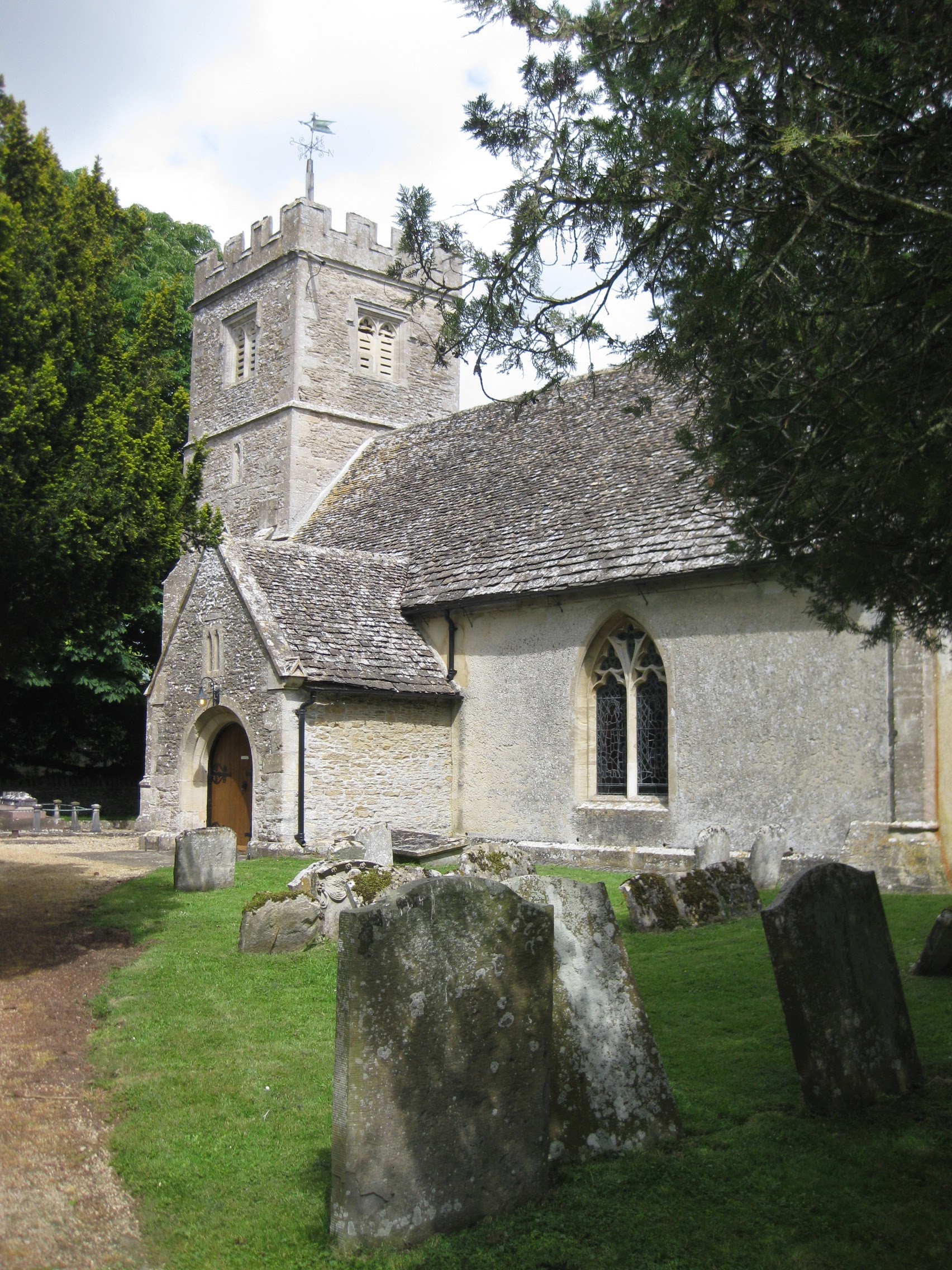
Morris was buried in the graveyard of St. George’s church in Kelmscott. The church was, until 1430, designated as a “chapel of ease”, a sort of parish subsidiary built for the convenience of worshippers who lived too far from the parish church to attend there regularly.  The doorway and nave are Norman. The addition of the South Chapel about 1320 completed the church plan. Clerestory windows, the final Medieval addition, were added to the nave in 1430. The bellcote (there is no tower) houses an early 13th century bell, one of the oldest in Britain. The south porch was added in Tudor times about 1550. William and Jane are both buried, with their daughters Jenny and May, in the graveyard. The Morris’ friend Philip Webb designed a simple stone monument to mark their graves.


St George's Kelmscott


The altar of St George's Kelmscott

A stained glass window showing St. George slaying the dragon, St George's Kelmscott

The Morris grave


St. George’s Kelmscott escaped the Victorian gothic makeovers that Morris felt disfigured many Medieval churches. He founded (with Philip Webb and others) the Society for the Preservation of Ancient Buildings in 1877, which is still active in England, Scotland, Wales and Ireland, to prevent such ‘restorations’. 

The Thames between Kelmscott and Buscot lock with WWII pillbox


During our second visit to Kelmscott Jan and I walked the Thames Path from Kelmscott upstream to Buscot lock. In between rain showers this was a quite idyllic walk. Great numbers of dark blue-green dragonflies fluttered among the riverside plants, hunted by swifts. A hare sat in a field on the other side of the river. A solitary swan sailed serenely by. I was reminded by the lush vegetation of a comment made by two of my authors at Thames & Hudson. Graham Diprose and Jeff Robins had studied the work of Henry Taunt (1852-1922) who sailed the Thames in a small boat with its own darkroom. Taunt photographed and mapped the Thames and published the first edition of his illustrated A New Map of the River Thames in 1872. The sixth and final edition was issued in 1879. Graham and Jeff set out to photograph with a modern digital camera the views with which Taunt had illustrated his map (unfortunately, the resulting book was published not by me but by my publishing friend John Nicoll who managed Frances Lincoln Ltd. after the death of his wife who founded the company). Graham and Jeff remarked to me that the Victorian Thames was a working river. Abundant trees, bushes and other riverside plants which make the Thames so agreeable for leisure, were a liability for a river devoted to commerce. Their book* documented these contrasting faces of the Thames.


St Mary Buscot

Jan and I walked to the church of St Mary Buscot, built to a 13th century plan, with 15th century additions. It was restored in 1854, and curiously enough, despite William’s reservations about renovations of historic buildings, Morris & Co. had a hand in a later restoration. William’s friend Edward Burne-Jones designed four stained glass windows, manufactured by Morris & Co. and installed between 1892 and 1924. Buscot was very much Burne-Jones territory. He also painted four panels at Buscot Park house which illustrated a poem, The Legend of Briar Rose, written by William Morris.


Burne Jones, The Briar Wood

Burne-Jones, The Council Chamber


Burne-Jones, Garden Court

Burne Jones, The Rose Bower
Today Kelmscott and Buscot are picture perfect villages, like many others in the Cotswolds, that seem to preserve a long-lost way of life, but in fact they are above all a comfortable leisure venue for the well-to-do in our profoundly unequal society. The contemporary Britain of low-wage, insecure employment and foodbanks is in another world not too many miles away. I thought of this as we walked from Kelmscott to Buscot. Admiring the beauty of the river, the countryside and the bird and insect life, we came upon two WWII pill boxes, built of thick concrete to defend the river from a much-feared German invasion. So, 80 years ago this was not such a tranquil place but rather one of apprehension. And looking back to times before the Morris family and Rosetti leased Kelmscott Manor, the house has a large attic, which was once used to provide accommodation for seasonal farmworkers. In those days Kelmscott would have been a village that lived on farming, an altogether scruffier and smellier place than it is today. The meaning of places changes with history even when their fabric seems to be almost unchanged.


The Plough Inn at Kelmscott, an altogether more luxurious inn than it would have been in Morris' day.

*Graham Diprose and Jeff Robins. The River Thames Revisited. In the Footsteps of Henry Taunt. London: Frances Lincoln Limited, 2007


Monday, 2 May 2022

Reviving Silliness in Sunninghill


 For many years a wheelbarrow race to raise money for the local Day Centre for our elder residents (which now includes me!) and the Rotary Club has taken place on New Year’s Day. The contestants gather in the car park in our street and race past our house on a course around the centre of the village. The race started originally as a humorous contest between drinkers at the local pubs (stopping at each pub for a pint) and over time became a way to raise money for community causes. The pandemic caused the last two races to be cancelled, but the event was revived today. Eighteen teams competed for the prizes: fastest men’s team, fastest ladies’ team, fastest mixed team, best fancy dress, best junior fancy dress, most sponsorship money raised. There is also a raffle and an auction. A friend who manages the money on the day told me that the race usually raises £30,000. 


A local restaurant's team


The team from the Dog & Partridge pub and restaurant


The law
A pizza theme


The church choir team


Local superheroes


A unicorn team

The team from the Duke pub


The Brewer family's sunflower theme


The Quince Players advertising their next production: 'Allo 'Allo

The NHS team


The Jubilee team. A Prime Minister "look alike" brought up the rear but without the bottle of champagne which has lately become his trademark.

Team 18 sets off

Friday, 25 March 2022

How do you say “Howzat?” in Spanish or Japanese


For my American and Mexican friends, “Howzat?” is what a bowler in a cricket match shouts to the umpire when the bowler believes that the batter is out.


When Jan and I were first married and living in Takoma Park, Maryland, we played tennis at a local high school. One day, we came across some bemused Americans watching West Indian men playing cricket. We explained to the Americans, as best we could, what these people were doing, but I suspect that they understood very little. Years later, in 2016, I was being driven around Houston by a young American colleague who asked me to explain the mysteries of cricket to him. This took some time, so we agreed to continue the conversation over dinner. Before we met at the restaurant, I searched the Internet and, to my surprise, discovered a Houston cricket league, mostly played by men of South Asian origin.


Sano International Cricket Ground

Recently, in The Guardian I came across a town in Japan called Sano, about 90 miles northwest of Tokyo. Sano is well-known for its ramen restaurants, but also happens to be, since 1984, the location of the head office of the Japan Cricket Association (JCA). There are ten cricket associations in Japan from Hokkaido in the north to Kyushu in the south. According to the JCA website, there are 200 teams, 3,000 players and 15,000 participants (I am not sure what the distinction is between players and participants) in a country of 128 million people. Clearly, Japanese cricket is the very definition of a minority sport.


Cricket at the Yokohama Country and Athletic Club


Cricket was first played in Japan in June 1863. A Royal Navy team played a team of British Yokohama residents, captained by a Scot, James Campbell Fraser. Some players wore revolvers as they played, while others kept firearms within easy reach. The British Chargé d’ Affaires had warned British residents that they would be attacked by samurai on 25 June, but since the British government would not indemnify traders against losses, the businessmen refused to leave, unlike their servants and Japanese inhabitants of Yokohama, all of whom fled. The Royal Navy put men ashore to protect British subjects, and since they and the businessmen had nothing to do, they agreed to play a cricket match. Apparently, the Navy team won, but no details of the score survive. And since no samurai attack materialized, peace and calm soon returned to Yokohama.


James Campbell Fraser

The first cricket club in Japan, the Yokohama Cricket Club (now the Yokohama Country & Athletic Club) was founded in 1868. Ernest Price and a few other cricket enthusiasts met that year in the dining room of a Scottish tea merchant, James Pender Mollison (born in Glasgow in 1844, died in Kamakura in 1931), who had previously lived in Shanghai and played at the Shanghai Cricket Club. In the first match, Mollison opened the bowling and the batting – he was clearly an all-rounder.


J. P. Mollison

Cricket came to Mexico long before a leather ball met the willow of a cricket bat in Yokohama. Cricket accompanied British commerce after Mexico’s independence in 1821 had ended Spanish monopoly trade policies. Businesses from the USA, Britain and other European nations hurried to Mexico to seek profit from mining, farming and other businesses. In 1827, the Mexico Union Cricket Club (MUCC: now the Mexico Cricket Club, or MCC) was established in Mexico City by British and other foreign merchants and diplomats. Two early members were the British brothers Daniel (joined 1828) and Lewis Price (joined 1835). Daniel and Lewis ran an import-export business in Mexico City and the Gulf Coast port city of Veracruz. In February 1838 the club met at an AGM where a committee was formed to revise the rules of Mexican cricket. The rules agreed were those of the Marylebone Cricket Club in London (recently revised in 1835 to permit a new over-arm bowling action), amended as required by local circumstances. The Marylebone club’s rules stipulated that an over consist of four balls (today it is six), but a Mexican over consisted of twelve. The Mexican rules also provided for teams of fewer than five (the standard number was eleven). Other rules specified the required attire. Since this included a hat, the Mexican rules a hat law: should a fielder stop a ball with his hat five runs would be added to the opposition’s score.


In 1827 the membership of the club was 27, a mix of merchants and diplomats, mostly British, but some German miners also joined. One member particularly infamous in Mexican history was the US Chargé d’Affaires, Joel Roberts Poinsett, who wielded the American big stick with vigour both against Mexico’s government and America’s commercial competitors, such as the British merchants with whom Poinsett played cricket on Sundays, substituting a bat for a big stick. By 1837 and 1838 the first Spanish names appeared in the membership list: R. González, J. M. Chávez, A. Tagle and T. Durán, perhaps the first Mexicans ever to play the game.


In 1864, a British traveller, Henry Bullock, described a game. The ground, in a village called Nápoles (now a neighbourhood of Mexico City), was a meadow ‘as hard as iron’ surrounded by cactus hedges. Nápoles was favoured by foreigners as a location for their country houses and estates, and was conveniently reached by tram. The players, a number of whom were over 60, assured Bullock that Mexico’s turbulent politics had never disturbed their cricket, even when shooting could be heard in the nearby hills. The best player that day was a Mexican, who had been educated at Bruce Castle School in Tottenham, north London. Bullock noted that while the ladies attended church, the men played cricket, supplied by a firm called Blackmore with beer, for ‘Cricket is nothing without beer’. The season ran from October to March, April to September being the rainy season.


At the time of Bullock’s visit, Mexico was an empire ruled by the Austrian Maximilian, imposed by Napoleon III. It seems that Maximilian (who came to a sticky end, executed by a Mexican firing squad in June 1867) was a cricket fan, since he appears in a photograph taken by a Belgian photographer, François Aubert, in 1865.


Aubert's photograph of Maximilian at the 1865 cricket match. Maximilian is said to be in the centre. I cannot identify him, however.

In 1868, after the restoration of the Mexican government of President Benito Juárez, an English-language newspaper began publication in Mexico City. The Two Republics included reports of cricket matches of the MCC. They were still played on Sundays in Nápoles by two teams, the Blues and the Reds, which were rarely able to muster a full complement of eleven players. On 31 October the MCC played a combined team of Barron, Forbes & Co., the Railway Company and the Gas Company. Players were to take the 7am train from Calle San Bernardo and Calle Cadena. Play started at 9am sharp, to be interrupted by breakfast at 1pm, and stumps drawn at 4pm. The MCC lost the match by a substantial six wickets.


Two Mexicans played that day, a Mr. Mora and J. M Trigueros, the latter a member of a prominent sporting family, who scored 64 of his team’s 269 runs. Trigueros later founded the Victoria Cricket Club, whose members were, in part, Mexican students at the Escuela de Artes y Oficios (School of Arts and Trades), and some non-Mexicans. At this point, international politics brought cricket to a halt. Unable to reach agreement over foreign interference in Mexico, the British government terminated diplomatic relations in 1867. Many MCC members left the country, but the club was able to muster seven players for one last game to play Victoria’s ten. MCC won by 32 runs and ten wickets, but did not play again until the resumption of Mexican-British diplomatic relations in 1884.


Dining Room of the Reforma Athletic Club, 1920s?

The revival of cricket was a consequence of the return of foreign business interests to Mexico under the dictatorship of Porfirio Díaz (a period known as the Porfiriato: 1876-1910) whose regime encouraged foreign investment. Soon there were clubs in Pachuca, a silver mining town where British miners had first arrived in 1824. Many were from Cornwall. They brought with them their pasty, still baked in Pachuca to a Mexican recipe. There was also another MCC: the Monterrey Cricket Club in northern Mexico. In 1887 a match between a Mexico City team and a Pachuca team ended with a win for Mexico City by 27 runs and eight wickets.


Reforma Athletic Club, 1920s?

The three Pachuca teams joined together in 1895 to form the Pachuca Athletic Club, and clubs popped up in parts of Mexico that seemed most unlikely places for the extensive areas of grass required for cricket. In 1992 there was a club in Mérida, on the Yucatán peninsula. Even in the desert of Coahuila bat was heard to strike ball when a Scottish cattle rancher, David McKellar became the founding president of the Santa Rosa Athletic Club whose team was known as Los Rancheros. On 4 July Los Rancheros played a team of English railway workers from Ciudad Porfirio Díaz. McKellar’s team won by 65 runs, but his sporting career came to a violent end. Local Mexican ranchers objected to his fencing off his land and water sources. On 29 July they ambushed him and shot him dead.


Cricket flourished in the parts of the republic where British businesses were active. There were a number of teams in the capital: Mexico Cricket Club, Mexico Wanderers, British Club, United Railway Men, Read and Campbell Cricket Club, Pearson and Son, Mexico Gas and Electric Light Company, and a Canadian eleven. And the teachers of the English school in San Cristóbal, just outside the city, joined the workers of Pearson and Son, who were building a great canal to drain the Valley of Mexico to prevent regular flooding of the capital, to found the San Cristóbal British Cricket Club.

Pavilion of the Reforma Athletic Club, Avenida de la Reforma, Mexico City, c.1900


Cricket team of the Reforma Athletic Club, early 20th century? The only Mexican seems to be the figure at the far left.


Thomas Phillips, founder of the Reforma Athletic Club

However, the most prestigious cricket club in Mexico was established in Mexico City, when, on 16 March 1894 Thomas R. Phillips called a meeting to discuss the foundation of the Reforma Athletic Club to play lawn tennis, cricket and other sports. The club took its name from the location of its first sports round, on the Avenida de la Reforma, on the site now occupied by the Rufino Tamayo Museum. The club moved to two other sites, before settling at a location in Naucalpan some 14 kilometres northwest of downtown Mexico City. The Reforma’s website proudly notes that in 1896 the club formed the first national football team, whose players were: M. S. Turner, Robert J. Blackmore, Charles Blackmore, Claude M. Butlin, Ebenezer Johnson, Ted Bourchier, P.M. Bennett, C.D. Gibson, Vicente Etchegaray, Julio Lacaud, Robert Lock, and Phillips who was also the team’s trainer. Some of the team’s members also played for the Reforma’s cricket team, and it was the cricket players that organized the first sports league in Mexico in March 1900. The first football league kicked off later, in 1902, but proved to be much longer-lived. The cricket league ended in 1909, while the football competition is now Mexico’s professional league


Reforma Athletic Club Football Team, 1901


Claude Butlin, who had played football and cricket for the Reforma club, was one of Mexico’s most outstanding sportsmen. In addition to football, he played cricket, rugby, Basque pelota, golf, cycling and hockey. He scored Mexico’s first ever point in a Davis Cup tennis tournament. Butlin, born in Sri Lanka in 1872 or 1877, arrived in Mexico in 1890. He died in 1940, the proud owner of 450 trophies

Claude Butlin with his trophies


Another significant figure in the history of Mexican cricket is Luis Amor, a Mexican sugar plantation owner, educated at Stonyhurst College in Lancashire, who was captain and treasurer of the Mexico Cricket Club (MCC). His brothers Alejandro, Víctor and Pablo, also educated at Stonyhurst, played for the club. At the annual general meeting in December 1900 the MCC elected as Honorary President the Finance Minister, José Yves Limantour, one of the most powerful figures in the Mexican government. Clearly the Amor brothers had friends in high places.


Aerial view of the contemporary Reforma Athletic Club, Naucalpan, Estado de México

The Reforma continues to be the leading cricket club in Mexico, although there are now teams in several cities. The Asociación de Cricket de México aims to have a club in every state in the republic and to make cricket the number one sport for girls (I assume that weaning boys off football is too great a challenge) by 2030. Judging by the names mentioned in match reports and the accompanying photos, the majority of players are of South Asian origin. However, there is a national women’s cricket team, whose captain is Caroline Owens, which suggests that Mexican girls may not be flocking to the sport.


Cricket match at the Reforma Athletic Club, possibly 1920s

I have not yet discovered the precise Japanese or Spanish equivalent of Howzat?, but by studying reports of matches in Mexico I have picked up. Much of the basic vocabulary is English (hat trick, maiden over, over, wicket). Other terms are Mexicanizations of English terms: fildeador for fielder, portador de wicket for wicket keeper, abridor for opener. But a serious cricket fan might be rather shocked to learn that bowling is lanzamiento (throwing) and a slow bowler is a lanzador lento. [For my American and Mexican friends, a bowler must never throw a ball.] An ingenious invention is unir una sociedad (to form a partnership: literally to incorporate or consolidate a business partnership or corporation).


My best guess at Howzat? Is one of the following: cómo estuvo? (how was it?), or more colloquially in Mexican Spanish qué hubo?, or more colloquially still qui húbole? (roughly, what went on?). A phrase which would surely perplex a Mexican is the translation of the English “he was caught at deep square leg”: le agarró en la pierna cuadrada profunda. To the uninitiated this conjures up images of a player with a rather basic prosthetic leg being tackled rugby-style.


For a readable history of Mexican cricket see Craig White’s The Golden Age of Mexican Cricket:

https://www.playingpasts.co.uk/articles/team-sports/golden-age-of-mexican-cricket-part-1/

https://www.playingpasts.co.uk/articles/team-sports/golden-age-of-mexican-cricket-part-2/

See also Michael P. Costeloe, “To Bowl a Mexican Maiden Over: Cricket in Mexico, 1827-1900. Bulletin of Latin American Research, vol. 26, no. 1: 112-124; and William H. Beezley. Judas at the Jockey Club and Other Tales of Porfirian Mexico, Lincoln: Unversity of Nebraska Press, 18-19, 22