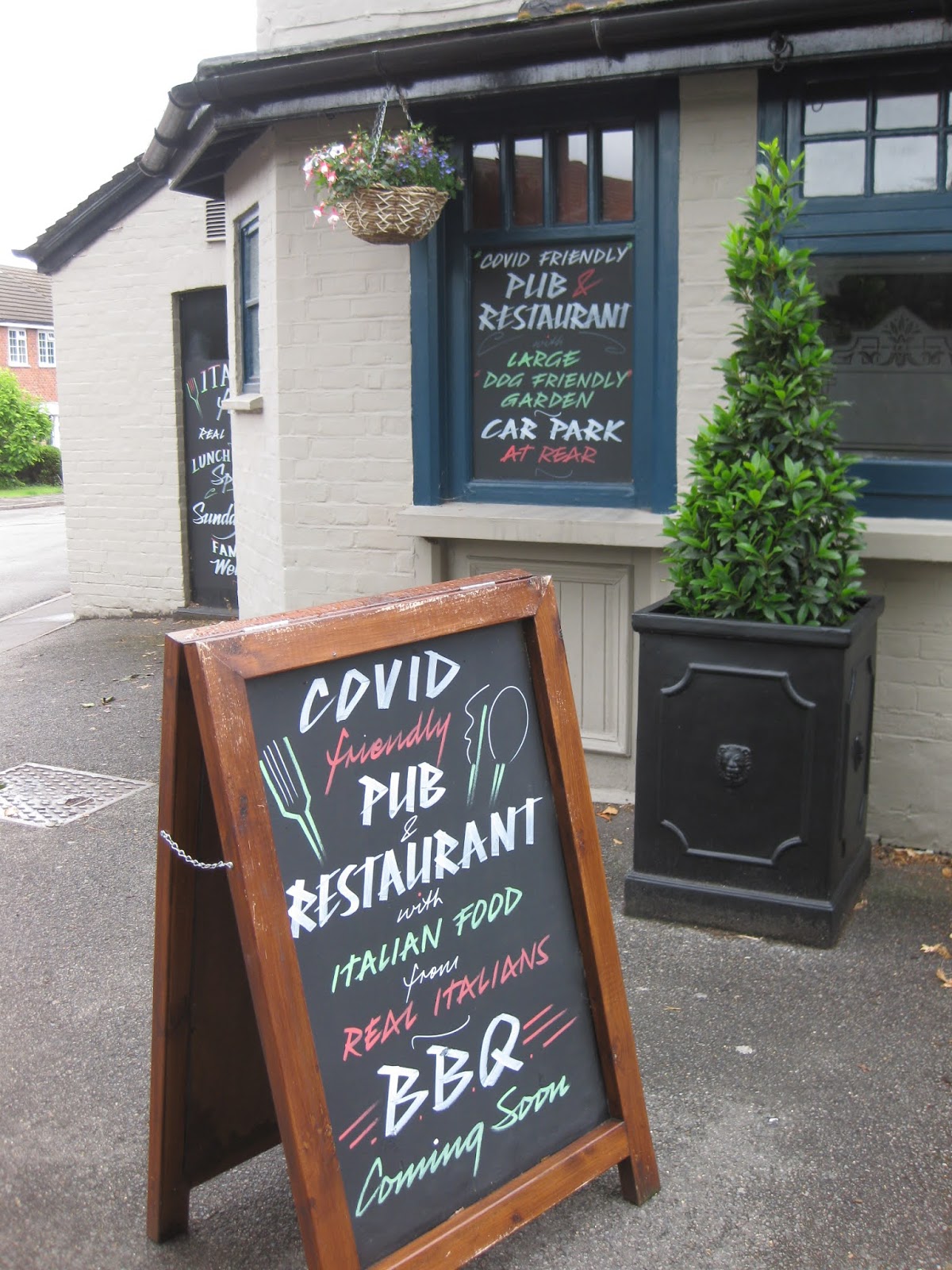
Today, Saturday 4th July, pubs are allowed to open in England. There are three pubs in Upper Village Road: The Dog and Partridge, the Carpenter's Arms and The Duke (formerly, and properly, The Duke's Head). The Duke has struggled for many years. It is now run by two genial Italian men. As we left for our Saturday walk, we noticed that the notice outside the Duke is slightly ambiguous.
We are not sure that the pub should be as friendly to Covid as it is to dogs.
Saturday, 4 July 2020
Friday, 3 July 2020
Farewell to the man who put the ❤️ in New York
![]() |
| Milton Glaser, photographed by Sam Haskins |
26 June brought some
sad news. Milton Glaser, the graphic designer who invented the famous logo that
promoted New York City to the world, died on 26 June, his 91st
birthday.
I met Milton a couple
of times in 1996. My colleague Karin Agosta and I had chosen as our publicists
for the launch of The Dictionary of Art a duo who became good friends.
Missy McHugh had been working at Christie’s and went on to do very distinguished
work at the Metropolitan Museum of Art. Her colleague Pete Tannen had worked in
advertising in New York and Australia, was a jazz fan and a humourist with a
very wry taste in jokes. Pete had known Milton for a long time and recommended
his studio to design our materials.
I tagged along to a
couple of meetings at which Milton presided, gave advice and then left us in
the capable hands of one of his colleagues. As soon as I shook his hand, I knew
that I was dealing with a genial wise man who really knew what made great graphic
design. New York is a complicated city, whose earthy rough edges accommodate, without
contradiction, a certain kind of humane, liberal, learned, eternally interested
in ideas, kind of person. Milton was a supreme example of that noble side of
the city.
He is, of course, not
famous for the work his studio did for Karin and me. One of his most iconic
designs is a poster he designed for CBS records in 1966 to accompany a Bob
Dylan album. Dylan was portrayed in austere black-and-white profile, but from
his head sprang a multi-coloured rainbow of hair. The image was instantly
arresting and spoke to the spirit of the 60s, just as much as did Frank Zappa
and the hippy scene in San Francisco. His other iconic design was the I ❤️New York
symbol, familiar even to those who have never been to the city.
Milton was also the
co-founder and co-publisher of New York magazine. He was also its
restaurant critic. He was literate as well as visually acute. He was also a
great supporter of graphic design education. Later, when I worked for Thames
& Hudson, many graphic design professors in the New York area told me that
he regularly gave his time to give classes in the city’s design schools.
I commented to Pete
that Milton had struck me as a gentle soul. Pete replied: “And not always that gentle, to be honest-- when he
got going on conservative politicians, he became so angry and passionate that
people turned and looked at us in restaurants!”
I am sorry that
I met him only so briefly, but those are meetings I will not forget.
Sunday, 28 June 2020
What are policemen and prisons for?
In 2012 a colleague collected me from the Miami airport
Hilton for a tour of college campuses to promote my textbook, Gateways to
Art. As we walked to his car, we noticed a large number of police vehicles
in the parking lot, all marked as police dog vans. My colleague, David, commented
that he had loved working with police dogs. Until recently, he had been a drugs
cop in Chicago. A transition from police officer to book salesman is quite
unusual, so, as we drove around Miami and Palm Beach, we talked about his law
enforcement career.
David told me that he resigned from the police force because
he concluded that anti-drug policing was essentially corrupt. When his force was
ready for a big bust, they would notify a local TV station, so that they were
filmed for maximum publicity value to secure continued support from politicians
and the public. Apparently, the police force earned a share of the value of each
bust, which enabled them to buy more arms, helicopters etc. In short, if the
drugs business disappeared the police business would suffer.
Earlier this week a friend sent me a brief article by a
Mexican historian and commentator Héctor Aguilar Camín. The text referred to a
forthcoming study of human rights abuses committed by the Mexican police. The
writer argues that the US government, as part of the “War on Drugs”,
established programmes to train Mexican police officers. Increasingly, the federal
government, supported by police unions, has provided funding to equip American
officers with quasi-military capabilities (and quasi-military mindsets). The
training programmes for Mexican officers, apparently, were based on the same
assumptions.
I don’t think it would be reasonable to blame US training
methods for the many problems of Mexican policing, but this report reminded me
of a book that my son Chris gave me a few years ago, by a remarkably fearless journalist,
Anabel Hernández. The argument of her book is that until the mid-1980s the
trade in drugs to the US market was run by Colombian cartels, for whom the
Mexican crime gangs were humble intermediaries. In 1985, the Reagan
administration wanted to arm insurgent groups (the so-called Contras) in
Nicaragua in order to depose the revolutionary Sandinista government. The problem
was that the US government was legally prohibited from spending federal funds
for this purpose. The solution was to sell arms covertly to the Khomeini
government in Iran, and to use the proceeds to buy arms for the Contras.
There remained one difficulty to overcome: transport. The Mexican
drug gangs were the solution, since they had planes used to transport Colombian
drugs that could be repurposed to ship arms to Nicaragua without any apparent
US involvement. In return, the Americans told the Mexicans, they could bring
back from Nicaragua whatever they liked. And, of course, they liked drugs and their
enormous profit margins. Thus began the rise of the Mexican drug cartels.
Then, of course, the Mexican cartels used their profits to
arm themselves. A friend told me a story of an exchange of views during an
election campaign in New Jersey in 1982. A proposed ban of assault weapons in
the state was a much-debated issue at that time. My friend was asked whether he
supported the ban, to which he replied “Of course”. “Why of course?”. My friend
responded that military weapons should not be in the hands of the public. The
other man stated his view that the constitutional freedom to bear arms had
automatically expanded in scope as new kinds of armaments were developed. When
my friend asked if, therefore, he would advocate the freedom to bear tactical
nuclear weapons, the man replied “Of course”. Now, it is not easy to acquire
firearms legally in Mexico, but it is very simple indeed for American suppliers
of firearms to sell them to drug cartel representatives who can then smuggle
them into Mexico. As a result, the cartels now outgun not just the police but
the Mexican army. When I lived in Mexico in the 1970s police officers were
armed with revolvers. The only time I saw more potent weapons was in the hands
of a bank security guard, or of soldiers searching buses for suspected guerrillas
in the mountains. Today, a common sight is a pickup truck in the back of which
stand behind shields police officers equipped like soldiers. Indeed, the
federal police was recently brought under the command of the army.
The illegal trade in arms from the USA to Mexico is no
secret. From 2006-2011, the federal Bureau of Alcohol, Tobacco, Firearms and Explosives
(ATF) in Arizona carried out a sting operation to crack down on such sales. The
idea was to trace the firearms along the distribution channels to senior cartel
figures. Unfortunately, the ATF lost track of the guns. Some were used to
murder a US Border Patrol Officer, others were eventually seized by the Mexican
army. Some simply disappeared into the hands of Mexican criminals. So, when Mr
Trump vows to defend the freedom to bear arms, he is also vowing to continue to
arm the very Mexican criminals from whom claims to protect Americans.
Add a good dose of corruption in most Mexican police forces,
and you have a potent recipe for police abuse of human rights. In a society
with a theoretical, but, in practice, very weak rule of law, the police can usually
act with impunity. While in the USA and the UK protests have been at a national
level and have focused on racial injustice in policing, in Mexico protests have
been directed at local abuses.
For example, on 4 May a young bricklayer, Giovanni López,
was arrested by police officers in Guadalajara for reasons that remain unclear.
His family searched for him in various police stations without success, and the
next day discovered that his dead body was in a city hospital. He died from
cranial trauma and had several other wounds, including a gunshot to his leg. On
9 June, Alexander, a 16-year old American citizen visiting family in a small town
in the state of Oaxaca, was shot dead by municipal police officers while riding
his motorbike after buying soft drinks from a petrol station. In both cases,
police officers have been arrested, but past incidents suggest that punishment
may or may not ensue.
In sum, those directly responsible for the abuses that Mexicans
suffer are individual police officers, but punishing “bad apples” alone will
not solve the problem. An end to impunity would be a major step towards reform,
but the forces that have shaped Mexican policing are far broader, and extend
beyond the country’s borders. The bad apple theory does not fully explain
police abuses, any more than it does in the USA.
Oppression and cruelty is not confined to the policing
element of the US justice system. I recall a visit to Delta State University in
Cleveland, Mississippi. I met a photography professor who told me about his
project photographing prisoners in the nearby Bolivar County Regional
Correction Facility. He told me that the prison had provided quite a good
education programme for its prisoners. However, a Republican politician had
worked out that the per capita amount spent educating the prisoners exceeded
the per capita sum spent to educate children in the state’s schools. One response
would have been to increase the school budget, but the Republican gentleman
preferred a much more law and order solution: abolish the prison’s education programme.
California’s higher education system has a justifiably excellent
reputation. A professor once told me that there was a time when spending on the
state’s universities exceeded the spend on prisons. However, a variety of
law-and-order initiatives expanded the prison population to the point that spending
on prisons exceeded the budget of state universities. In recent years, the
state has introduced initiatives that have reduced the number of incarcerated
prisoners somewhat. Nevertheless, in 2019-2020 the prison budget was $13.3
billion, while the state university system budgeted $7.3 billion. The political
and business interests that drove the expansion of the prison population have
been far more powerful than the educational lobby. California’s prisons have
been run by private companies. In 2019 Governor Gavin Newsom signed a bill to
end the involvement of private companies in prisons by 2028. Perhaps reducing
prisoner numbers and ending private management of prisons will be beneficial,
but results will take time.
A relentless focus on eliminating racism (a problem that
will not be quickly fixed) and abusive behaviour is essential, but whether
reform will include the wider interests and forces that determine how the USA
is policed is another matter. Similar forces operate in the UK. One of our friends
was employed in a prison to educate school-age prisoners. Her job was difficult
because prisoners were often moved for administrative reasons, which disrupted
their education. A private company, Capita, won the contract to manage the
prison and told our friend that her role and salary would be reduced to that of
a teaching assistant. She left and the prison lost an excellent teacher.
Saturday, 20 June 2020
Colour and tradition: A lockdown trip to Mexico
We have all, of
necessity, been preoccupied with too many gloomy topics in the last several
weeks. I thought this might be a good time for something colourful and cheery. A
visit to Mexico is always a feast for the senses, so I thought an online
exhibition of some of the visual pleasures of Mexico would provide some needed joy.
A phrase that has
stuck firmly in my mind while reading for my Mexico project is a comment that
ancient Mexicans were “people of the book”. They kept records of all manner of
things, using a pictographic writing system on paper made from fig bark. Stone
tools for pounding bark into paper are frequently found in archaeological
sites. Nowadays, paintings on fig bark are a popular form of tourist art in
Taxco, a colonial silver mining town about 180km from Mexico City. Over the
years I bought a few paintings that appealed to me. The first two were made in
Maxela, a village about 100km south of Taxco, which specializes in bark
painting.
| Paintings on amate (fig) bark from Maxela, Guerrero |
Like most tourist art,
these views are idealized, but they succeed in portraying various aspects of village
life. The architecture of the houses and church are reasonably accurate. The leisure
activities are typical of rural Mexico: the charreada (a variety of
rodeo), the cock fight, the musical band. The fauna and flora are also
representative, with the exception of the coconut palms, imaginatively
transplanted a long way from the coast to the mountain village.
These two were bought in
the 1980s. I am not sure whether ploughs drawn by animals are still much used,
but they were a common sight in the 1970s when I travelled around rural
Guerrero. Hunting is definitely an important rural activity.
| Paintings on fig bark purchased in Taxco, 1980s |
When the Spaniards
conquered Mexico in the 16th century they were few in number and
relied on indigenous labour for pretty much everything, including painting and
architecture/construction. While we were in Mexico in 2018 we visited two magnificent
churches in small towns in Michoacán. The 17th-century church in
Nurio has a magnificent painted ceiling over the entrance.
| St James the Apostle façade |
| St James the Apostle altar and retablo (reredos) |
To one side of the
church is an elegant chapel (known as a huatapera in Michoacán).
The interior of the 16th-century
church of Saint Bartholomew in Cocucho is much more restrained in its decoration,
but the splendid paintings over the entrance more than compensate. Angels serenade
on contemporary musical instruments while St. James the Moor Slayer goes about
his business of dismembering infidel Moors. Unfortunately, 16th-century
Tarascan craftsmen had never seen a Moor, so they assumed they looked much like
a Spaniard.
| This space, with its cross, would have been used in the 16th century to preach to Indians too numerous to fit in the church |
| Paintings on the ceiling over the entrance, church of St Bartholomew, Cocucho, Michoacán |
| Interior, St Bartholomew, Cocucho |
| Our Ocumicho diablito |
A visit to Ocumicho, a
short drive from Zamora, where we stayed in 2018, took us to another huatapera.
It lacked the paintings of Nurio and Cocucho, but we were visiting in May, the
month of the Virgin, so the church was a riot of flowers, topped up every day
by young girls. Ocumicho is a centre for crafts, particularly ceramics. The
local potters specialize in making diablitos (little devils), and a side-line
in erotic sculpture which earns the severe disapproval of the village priest. We
opted instead for a painting of the Virgin of Guadalupe, which would surely have pleased the priest. Our diablito and the Virgin are the work of Octavio
Esteban Reyes.
| The huatapera of Ocumicho, Michoacán, altar and flowers in May 2018 |
| The huatapera of Ocumicho, façade |
Saturday, 13 June 2020
Brown Lives, Black Lives, Statues
The killing of George
Floyd has made the questions of skin colour, racism, discrimination,
inequality, and community here in the United Kingdom a very live issue, as well
as in USA. I thought that perhaps looking at how these issues have played out
in another country might add an interesting perspective.
Part of the debate in
the UK has centred on the responsibility of Britain for the ills of slavery
and, more widely, of colonialism. The British were not, of course, the first European
colonialists or slavers – the Spanish preceded us, but with a different model.
The defeat of the
Aztecs in 1521 was possible only because the indigenous enemies of the rulers
of Tenochtitlan fought with a few thousand Spaniards. Those Spaniards suddenly found
themselves nominally in charge of some 22 million Indians. They were not
inclined to be tillers of the land as the British would be further north. They
needed to rely on others to grow their food, provide domestic service, build
their churches and houses, work in their mines, and ideally make them stinking
rich. On the other hand, the King’s deal with the Pope made Mexico his private
property, but he was specifically obliged to care for the welfare and
conversion to Catholicism of the Indians.
The tensions between
these competing demands led to a vigorous religio-legal debate about the status
of the Indians: were they human, did they have souls, could they be enslaved?
The verdict was that they were children, without fully developed souls, could
not be held fully responsible for their actions, could be enslaved only for
rebellion, and should be protected by the state. The Indians had obligations,
but also certain privileges and protections. They had to pay tribute (taxes),
either to the King or to a private individual, and were subject to drafts of
forced labour. On the other hand, they could not be prosecuted for heresy by
the Inquisition, were exempt from certain taxes, and had a degree of
self-government in communities designated repúblicas de indios (Indian
republics).
But as the Indians
died in enormous numbers, the Spaniards needed labour. They could not, in good
Catholic conscience continue to enslave the Indians, but it was quite all right
to enslave Africans, and assorted Asians (Chinese, Filipinos, Malaysians and
the like). Odd as it may seem, these imported slaves sometimes enjoyed greater
social status and home comforts than the Indians: Africans were often foremen
in the mines or on the cattle ranches, managing Indian labourers. On the other
hand, while the Indians were not liable for heresy, bigamy and the like, the
Africans and Asians were. They had to watch out for the Inquisition, therefore.
All of this led to a
society in which the obligations, rights, access to state offices and
privileges, and wealth were determined by racial categories. The first level of
division was a simple dichotomy. The Spaniards, Africans and Asians were
“people of reason”. They had souls and could be held responsible for their
actions and misdeeds. The Indians lacked fully formed souls and must therefore
be treated well (in theory) as wards of the state.
Two categories were
not enough, so, the different groups had to be categorized. Initially, this was
simple. There were Indians, Negros, Chinos (all Asians, not just
strictly Chinese) and Spaniards. Before long, more categories were needed.
There were very few Spanish women in Mexico for the first several decades of
the colonial period, so racial mixing soon proliferated. Rather like the spread
of a virus, each procreational contact exponentially increased the number of
categories needed to classify the population. At the simplest level, the offspring
of sex between a Spaniard and an Indian woman was a mestizo. A Spaniard
and an African woman’s child was a mulato. But what if the mulato
married a mestiza, and that if their child married somebody of yet
another mix of bloods? If a mestizo married an Indian woman, their child was
categorized as a coyote, a particularly unpleasant term.
It was not easy to keep
up with this confusing proliferation of racial categories. Some kind of aide
memoire was needed: artists were commissioned to make paintings that
depicted in little boxes a man and woman of different racial groups and their
child, with a caption denoting the child’s racial category. These were called casta
(caste) paintings. In practice, this was an extremely imperfect science.
Priests, officials, and society in general pretended to know what they were
doing, but often had no idea. Three centuries of colonial rule made Mexicans a
pretty mixed up lot from a genetic point of view.
But the Indians,
living in theoretically separate Indian republics, with their own government
systems, land, languages, cultures, syncretic varieties of Catholicism, rights
and obligations, remained somewhat separate (in theory, but not always in
practice). When Mexico achieved Independence in 1821 things changed. The new
republican rulers had no deal with the Pope to honour, and a good many of them espoused
a 19th-century liberalism whose ideal was the enterprising individual.
They declared the Indians free and equal citizens.
You might think that
the Indians just whooped for joy as they gained their freedom from the hated
monarch. Things were not that simple. Firstly, the Indians lost the protections
they had under colonial rule. Simultaneously, they lost their tax exemptions,
and their way of governing their communities came under threat. In short, they
had most to lose from independence, and not much to gain. In the second half of
the 19th-century, politicians with liberal views came to power. They
favoured the modernising, dynamic invisible hand of free enterprise, and
therefore opposed the community management of assets typical of many Indian
communities. They also tended to consider the Indians as socially and
economically backward. They favoured importing European blood to bring in new
skills and energies. Many Indian communities lost their land, legally or
illegally, their members forced to become labourers cultivating their village’s
land for a new owner. Yet, at the same time the government used Mexico’s
ancient heritage to promote the country in international trade fairs. Artists
painted fanciful pictures of the ancient cultures.
During the 1910-1920
Revolution many communities rose up and seized land expropriated from them. The
revolutionary regime espoused agrarian reform. It restored land to many
communities, and gave land to some villages that had never owned any. The
indigenous cultures of ancient Mexico became potent symbols in the great mural
painting programmes of the 1920s and 1930s, alongside images of national
heroes, including liberals who had expropriated Indian land, and Marx and Lenin.
Revolutionary peasant leaders, and their agrarista (agrarian reformers)
followers appeared alongside their presumed indigenous forebears.
But this was not a
return to a glorious indigenous past, as the murals and revolutionary rhetoric
intimidated. Indigenous Mexicans now became clients of a corporatist state.
They could be delivered by their leaders to vote in elections, join
demonstrations, combat rebellious generals, and fight against devout Catholic
rebels. The price of land was support, and sometimes death at the hands of
landowner’s gunmen. To some degree the government protected the indigenous
cultures and languages, so praised in the soaring rhetoric of revolutionary
political leaders. Government social programmes provided clinics, schools,
libraries and technical assistance. But, the descendants of the Aztecs,
Tarascans, Zapotecs, Mayans, Lacandons and so on, honoured in school textbooks,
rhetoric and ceremony, are among the poorest of the nation. Their education and
health care are basic at best. They tend to be looked down on by sophisticated
city dwellers.
The descendants of the
slaves imported from Africa and Asia are not numerous. Moreover, they have
generally mixed with indigenous populations to create certain regional types, in
whose skin colour and cultures traces of African ancestry can be seen. They do
not form an easily identifiable (nor, indeed self-identifying) group, subjected
as a group to systemic discrimination like the African Americans of the USA or the BAME (Black,
African and Minority Ethnic, a complicated acronym covering quite disparate
peoples) of the UK, or the Arabs of France.
The net result of this
history, is that, although slavery was common practice for several centuries,
and although some (probably many) Mexicans are descended from slave owners, it
is not easy clearly to identify any contemporary group of people who are enjoying
the benefits of slavery. In Mexico there are is no equivalent of the
Confederates and the Confederate flag. Nobody lives in grand country houses
built on the profits of slavery. If identifiable villains there be, they are
probably in Spain, or the African and Asian countries of origin.
As for statues, Hernán
Cortés, the conqueror of the Aztecs, is strictly not welcome: no statue records
his violent but foundational contribution to Mexican history. Nor does his
victim, emperor
Moctezuma, merit a statue. Mexicans are ashamed of this cowardly
emperor who surrendered rather than resist. His successors, Cuitláhuac, killed
by European disease, and Cuauhtémoc, cruelly tortured to death by the Spanish,
are honoured as heroes with statues in the capital. Curiously, however, Charles
V, King of Spain and the first sovereign of New Spain (as Mexico was known then),
is commemorated with an equestrian statue (popularly known as El Caballito,
the little horse), which for many decades occupied a prestigious location on the
Paseo de la Reforma, the capital’s main boulevard. American friends might
imagine what they would make of George III honoured with a statue on
Pennsylvania Avenue, just a block or two from the White House. One colonial
Spaniard who deserves statues in places of honour is Bishop Juan de Zumárraga,
the first bishop of Mexico, known as the Protector of the Indians.
![]() |
| Monument to Cuauhtémoc, Cuitlahuac and other Aztec warriors, Paseo de la Reforma, Mexico City, c.1880 |
![]() |
| Cuauhtémoc monument in its modern setting |
Thus, Mexico does not
have a statue problem comparable to those of Confederate leaders in the USA, or
slavers in the UK. This does not mean that racism is not a problem, simply that
there is no easy target for protest on public display.
As for police
brutality, sad to say that it is quite pervasive. A citizen perceived as “un
pinche indio” (a ******* Indian) or “un negro” or a “pardo”
(mixed race), is an easy target for casual violence. But an ill-trained, badly
paid police officer, who can be confident of impunity, exposes all but the most
powerful of Mexicans to the risk of arbitrary violence.
A footnote concerning
statues out of favour in USA:
A friend in
Indianapolis tells me that in 1912 a monument was erected to commemorate 1500
Confederate prisoners of war buried in mass graves. In the 1920s the remains of
the prisoners were reburied in another cemetery and the monument moved to a
park. The central plinth was surmounted by the word “pax” and bronze tablets
recorded the names and units of the dead men. After the Black Lives Matter
protests in Indianapolis, the monument was taken apart and the pieces removed
to an undisclosed location. This means that the names of those buried are no
longer recorded. For example, a descendant who wants to know what happened to
an ancestor who might have been one of those who died in captivity in
Indianapolis can no longer find this out. I think this has taken historical
erasure too far, with no benefit to anybody. None of us can know whether one or
more of these 1,500 men were good or bad characters, simply that they fought and
died for a cause that is now judged much more harshly than it was in their
lifetimes, some 150 years ago.
Saturday, 6 June 2020
Black Lives Matter: reports from the ground
Black Lives Matter reached quiet
Sunninghill this week as I noticed when I posted a letter.
I asked several friends in the USA what
had happened in their neighbourhood. Their reports follow, unedited, except to
clarify a point or correct a minor eror. In some cases, they are responding to specific
questions I asked so I have summarized my questions to make sense of their
answers.
The combined texts are quite long. For
those who retain faith in the potential of community and politics to work for
the good, but do no have time to read all, I recommend you scroll down to the
account from Indianapolis.
New York City (from two friends):
|
The protests are centered in Manhattan and
Brooklyn. There are thousands peacefully protesting racial inequality and
policy brutality throughout the [country]. Union Square, Washington Square
Park are major venues, as is Times Square and the Barclay Center in Brooklyn.
During the day and early evening, the protests are calm and then the evening
brings looters and other evil doers. It has been pretty bad. The protests are
borough-wide, though I wouldn’t imagine there are any protests in Staten
Island, since they don’t welcome people of color under the best of
circumstances.
It is amazing to see the protests in so many
cities throughout the country. I say this because so many of the people
are not black.
Now, if there was something we can do to work on
systemic racism. Sad to say that is for the next generation to see any headway.
The 18,000 police departments in the U. S. (yes) and the big police unions in
NYC, LA, etc. have fought change at every step.
I do remember being pushed, shoved and otherwise
abused during the 1968 Chicago demonstrations and police riots.
|
Yes, the ignorant and criminals are at work after
the protests. Thousands of protesters yesterday throughout the city with
virtually no problems. A country that has tolerated systemic racism and police
brutality is facing some terrible truths. Now we need to work on equality and
changing the militarism of the police culture — fostered by police unions and
no transparency. There was an Obama policy/guidelines defining two types of
policing in existence - 1) warrior and 2) guardian, recommending that the
current culture of police as warrior be changed to guardian of the people.
Needless to say, guns, etc. would be involved, but the mentality should be
different. Obviously nothing happened with this — and perhaps it will be
impossible to implement.
It took a video by a 17 year old girl to unleash
the anger masked by denial.
[In answer to my question as to whether there were protests
in all the boroughs.]
And, yes there are even protests in Staten Island
where Eric Garner was murdered by the police in a chokehold in 2014. The cop
was never indicated and never lost his job. He’s been trying to get reinstated.
Here is a list of today’s protests. They are all
registered with the city and are primarily citizens expressing their first
amendment rights
In many of the looting situations, the police are
standing back and helping exacerbate the situation. I have anecdotal evidence
of this, as well as stories and videos from the news. There are 30,000 cops in
NYC. They are all not working on the streets to protect protesters’ 1st
amendment rights.
[In answer to my comments about policing policies
in the UK.]
Entrenched racism and the militarism of police
throughout the country is at the heart of the problem. They are quasi-militarized
and use military equipment given them by the military. There can be no real
comparison with American policing and any other policing. It is up to the
lawmakers and citizens of this country to DO something. These are more like
uprisings than demonstrations. This has been building in the minds and hearts
of many Americans for some years now, seeing what the police do to unarmed
citizens and get away with it. So, no surprises that watching the killing of a
black man (who shouldn’t have been arrested by 4 cops to begin with) sparked
this. Compounded with the COVID crisis, the fact that so many minorities were
impacted by the virus in poor neighborhoods . . . a perfect storm. NYC’s police
department (the largest in the country with 30,00 cops) has been run by the
police union pretty much. There are any number of problems I can talk about,
including the fact that we (pretty much in each state and certainly in NYC) are
not allowed to see the “track records” or complaints against individual police
offers.
This has been a long an intense discussion in this
city and perhaps it takes Minneapolis (with a particularly racist police
department) to get us to do something.
[In answer to my question why a mere accusation that
one man had committed a non-violent crime was responded to by four armed
officers.]
Store owner [in Minneapolis who called the police
and accused George Floyd of trying to pass a forged $20 bill] was Middle
Eastern, as are many of the bodegas and small store owners in cities. There has
been a history of problems of Korean stories owners (when they were primary
owners of small delis) treating black people badly (like calling the police).
There is an underlying movement to work with Middle Eastern store owners
serving the black communities to stop this profiling. But we shall see.
[In answer to my question about the shooting of
Ahmaud Arbery, an unarmed jogger, by two men with guns.]
In the case of the jogger, this father and son duo
were just all out racists — with a history of such and they profiled a young
black man running. They are just horrible people with guns. Nothing surprising
here. But, if this wasn’t videoed no one would have followed up.
The word is racism and racism.
_____________________________________________________________________
It's shocking really to see the criminals
destroying property so indiscriminately. The mobs of protesters are
throughout the city in all boroughs - and the looters just follow along.
The 8 pm curfew made a difference, but how disturbing to know that we have to
live in a country that must impose curfews for public safety. The whole situation
is disgraceful.
New Jersey (from two friends):
The cities have been active with protests but are not
seeing the kinds of violence seen elsewhere. Jersey City, Camden and Passaic
are viewed as having community friendly departments. The police chief in Camden,
Wysocki, joined the protesters. Even Newark, where downtown was reduced to
ruins in the riots of the late 60s, has been peaceful. Paterson has not seen
much protest related violence. But it has seen an ugly spike in gun violence,
with two people killed and 23 others wounded in gun violence in the month
of May. A disturbing element of the protests is that it appears some may be hijacked
into violence by white anarchists, leaning left. It serves to escalate the
oppression, discredit the protests, and destabilize the body politic. The [New
York] Times reported that right wing gun nuts are making plans to head out and
protect private property and law and order. Don’t be surprised when the Lunatic
in Chief calls out the Second Amendment Boys to bring order to the cities.
Cities and towns control their local police
departments but most, if not all, are under the ultimate authority of the
state attorney general, who is under the governor. The president does not have
the authority to employ the armed services against American citizens except in
an insurrection like the Civil War. Fear is Trump May claim insurrection and
send in the troops.
__________________________________________________________________________
An email sent to the mayor of Jersey City:
My husband and I moved to Jersey City (from Hoboken)
over 3 years ago, partially because we are appreciative of Jersey City's
position as an incredibly diverse and progressive American City, and because we
are invested in the same values you and your Administration are invested
in.
I am grateful to see you marching with protesters
this week, as I've seen you do before. I am reaching out today to urge you to
advance specific action that would help address police brutality and improve
quality of life for black and brown citizens in Jersey City. I know how proud
you are of our police force - which under your leadership has grown to its
largest size ever - and I think these actions will not only protect residents,
but will make acceptable and unacceptable police behavior clearer, which in
turn helps protect cops.
Please, through legislation or executive order :
- Require De-escalation
- Ban Chokeholds and Strangleholds
- Require a Duty to Intervene
- Require Comprehensive Reporting
Finally, I urge you to support Councilmember
Solomon's recent resolution establishing the creation of an ad hoc community
review board, once its voted upon by the full Council. My hope is that under
your Administration, this board would go above and beyond what Jersey City's
current police citizen advisory board (which I know has been successful in its
own ways!) can do.
Jersey City has been a leader in so many ways - in
welcoming refugees, in celebrating our diversity, in City-funded rights to
trans employees. I would be so proud to live in a City that, in the wake of
George Floyd's murder, became compliant with all 8 tenents of the #8CantWait campaign.
Indianapolis:
We had two nights of curfew
declared for Sunday and Monday from 8 PM to 6 AM. This was in response to
the deadly destruction wrought in the downtown by violence and vandalism on
Saturday night. The protests rallies during the day on Friday and
Saturday stayed within bounds.
But Friday night and especially
on Saturday night a lot of damage was done in breaking plate glass windows on
any number of downtown buildings---including my branch bank office.
Looters entered and ransacked some of the businesses. To this we
have as well that two people were shot and killed on Saturday in the downtown
protest area.
The police were out with
all their riot gear and fired tear gas and pepper stuff. Unlike the
daytime gatherings, the evening protests were pretty tense and hard to
control. We see how some bad types used the protest rally as a license to
be vandals. The scale of their mischief is shocking to see---and a sober
reminder for why we need the cops.
But let me say that for us living
but two miles from where all this was happening, we heard nothing
directly. Only by checking the news did we discover what was going on
downtown. Sometimes for summer festivals the distant sound of concert music
reaches us in the evening from the downtown parks. But I heard nothing
untoward here coming from that direction Saturday evening.
Last night we got a reprieve as
before the curfew hour the police and the protesters saluted each other and
then paraded together in peaceful, and presumably friendly, tandem up to the
Governor's Mansion some twenty blocks north of Ivy Tech [Communit y College].
There was no alert on my cellphone this morning as there was on Sunday and
Monday telling me of the curfew.
Indianapolis famously did not
burn in April 1968 after Martin Luther King, Jr. was assassinated in
Tennessee. Robert Kennedy* was here that evening for a presidential
campaign stop. He spoke movingly to a gathering in a predominantly
African American neighborhood (just over a mile from here), of this latest
American tragedy. The eloquence of his appeal to honor King by peaceful
vigils kept things calm in this city when so many others burned that evening.
So, we had a reputation to
sustain as a community that knows how to keep its head and heart when others
seem to lose theirs. A lot of us are thus pretty disappointed for
what happened here this weekend, even as we know how the underlying issue of
what is labelled as 'police brutality’, has local import. We had two
recent instances of police killing that are being investigated. We thus
have our own tinder here. (We were stunned a month ago when in a two week
span, a police officer and a postal letter carrier---both women---were each
shot to death on the job---by angry young men with guns).
The shocking killing in
Minneapolis justly ignites national outrage. We can add to our fury with
the dawdling in Georgia where officials took two months(!) to charge the
vigilante father and son who chased down in a truck and then shot to death a
runner who was out exercising on a public street.
So, things here in the USA are in
flux and many of us hope we can somehow get through this till November when we
have our rendezvous with destiny. Need I say more on that?
My usual neighborhood polling
site is not open this time. So, I went to another one---in the Culinary
Building at Ivy Tech! It was a surprisingly smooth process such that it
took me all told but a little more than an hour---including to pedal my bicycle
to campus and back home!
Although I felt that Elizabeth
Warren should be our next president given just how smart she is about how the
tricksters game our system, I voted for Joe Biden as our yet great hope.
* For the text of Robert Kennedy’s speech (I
recommend it) on 4 April 1968 see:
This extract contrasts starkly with “When
the looting starts, the shooting starts”:
“What we
need in the United States is not division; what we need in the United States is
not hatred; what we need in the United States is not violence or lawlessness;
but love and wisdom, and compassion toward one another, and a feeling of
justice toward those who still suffer within our country, whether they be white
or they be black.”
Houston:
As for Houston, in comparison to the other
major cities and many smaller ones, despite being George Floyd's home town
(funeral scheduled for next week) it's been relatively chill here, in part
perhaps because the police chief (Art Acevedo) has been super-decent, to the
point of going on CNN to say that if Trump can't do anything to calm the
nation's waters the least he could do is to shut up.
He also accompanied the Floyd family during
the memorial procession yesterday (with up to 60,000 in attendance). But
historically there hasn't been large-scale violence here; in the 60s Houston
was the first major city in the south to desegregate public labor contracting
(a booming economy didn’t hurt either) while elsewhere (and not only in the
south) racist cops, unions and other institutions remained entrenched.
My Chinese-American friend who lives near to
where Floyd was killed in Minneapolis tells the opposite story: one of the most
racist police departments overseeing practically THE most racially unequal city
in the country, liberal as it may be. He thinks it may have been a mix of
boogaloo bois (far right accelerationist gun freaks) and some Antifa provoking
and committing after-hours arson and other violence.
I've said it before and been wrong, but
between the virus, the crash and now this, Trump's show seems to be falling
apart at the seams. Even his lackey defense secretary, who had authorized the
appalling spectacle of a phalanx of soldiers armed to the teeth deployed in
front of the Lincoln Memorial, just came out and said there's no basis for
invoking the Insurrection Act if he has anything to say about it.
Vallejo, California:
[A protester, his hands raised high, was shot
dead by a police officer who suspected that he had a gun in his pocket. This
turned out to be a hammer.]
I’m
in Fairfield now, up the road from Vallejo --we had a curfew in our county for
the past few days, and some of the drug stores and grocery stores have boarded
up windows for safety. The protests are definitely more concentrated in
Vallejo, and the police were very slow to even admit that the killing
happened. Every day there are dozens of new videos and stories on Twitter
from across the country – here, police take a knee as the protesters go by, and
there, police freely wield billy clubs, plant evidence (in plain sight), and
rough up protesters for fun. It’s systemic.
The
police have taken the neo-Nazis aside and given them warnings, saying “oh we’re
going to be using the tear gas soon, just so you know…” But of course, we have
this horrible president, who is setting the tone. Meanwhile, aside from
protesters exposing themselves to Covid-19 in order to defend civil liberties,
the whole country is sick of this whole “Covid thing” and so has decided social
distancing isn’t worth their time. We are going to see a huge spike in
cases in the South and Midwest. A whole lot is riding on this November’s
election!
Meanwhile in Mexico:
This week in Guadalajara, police stopped a
man for ingoring the state edict that masks must be worn in public. The man was
arrested (the police claim for violent conduct). The man’s family could not
find him at the police station. They went to the hospitla where they found him
dead. He had a bullet wound in one foot and died frm blunt trauma to his head.
Casual disregard for human rights is not uncommon in Mexican policing. One
interesting connection with the US situation is that many Mexican police
officers have been trained in the USA as part of the War on Drugs. In other
words, the USA teaches Mexican police the same militarized approach to policing
that is applied in the North.
Subscribe to:
Posts (Atom)


